Up to Date with Rates
• The Federal Reserve left rates unchanged at 3.50% to 3.75%, citing solid economic growth while still cautioning that inflation remains somewhat elevated. Looking ahead, Powell noted that the Fed would remain data dependent rather than reacting to political pressure. Market participants still expect at least two 25bps rate cuts for 2026. For more details, check out our recap of the Fed meeting here.
• In Europe, the ECB kept its three main policy rates unchanged when they met on 17-18 December 2025. With the European economy posting stronger growth, given unexpected resilience to uncertainty and trade tensions, and inflation coming in softer, market participants expect the ECB to keep rates unchanged at their upcoming February 4-5 meeting.
• In the UK, the BOE cut rates by 25bps in its latest meeting on 18 December 2025. Its current Bank Rate stands at 3.75%. December inflation came in higher than expected (3.40%), led by sticky prices and strong wage growth. Market participants assign a high probability (90+%) that the BOE will keep the rate unchanged at their upcoming 5 February meeting.
• In Japan, the BOJ kept rates unchanged at 0.75% at the January 22-23 meeting. With stronger economic growth and higher wages expected for 2026, the BOJ is expected to remain on its gradual rate hike cycle over the course of 2026.
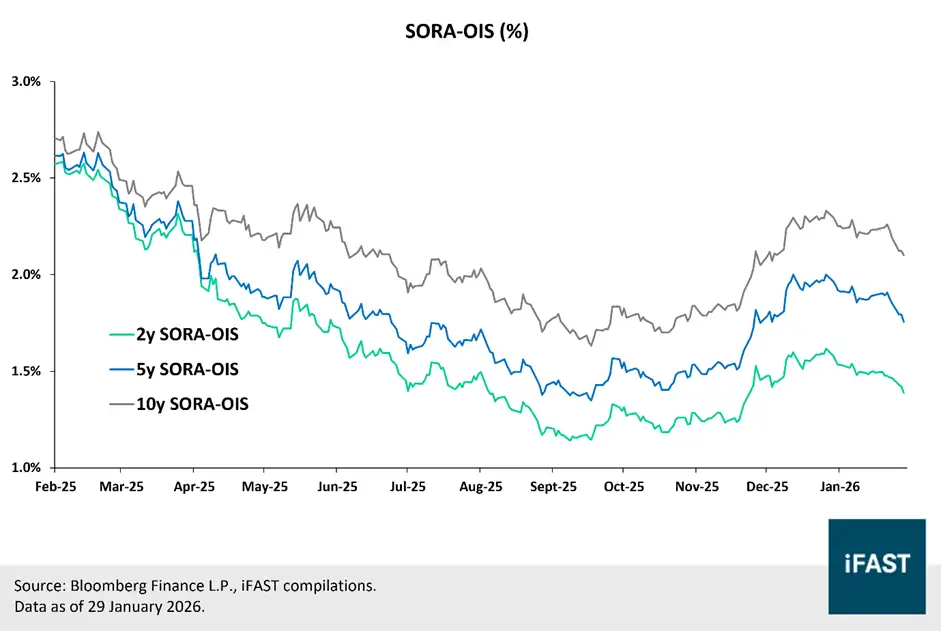
• For the period from 17 December 2025 to 28 January 2026, the 2-year Singapore Overnight Rate Average-Overnight Index Swap (“SORA-OIS”) declined by 16 basis points to 1.39%, the 5-year SORA-OIS decreased by 19 basis points to 1.76%, and the 10-year SORA-OIS declined by 20 bps to 2.10%. Overall, this continues the recent trend of lower yields for the medium tenors, in line with major non-US rates.
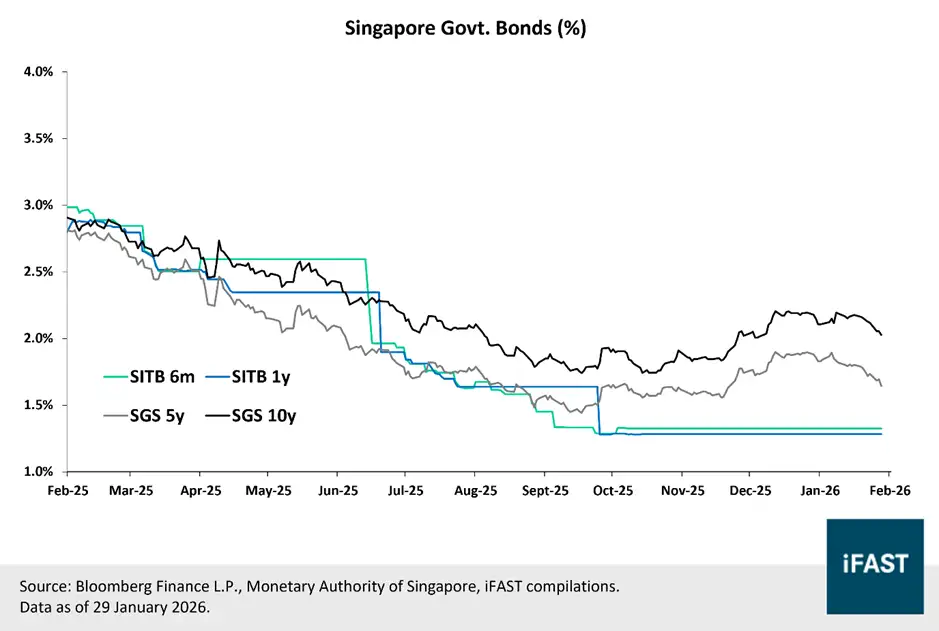
• Over the same period, yields for both the 6-month and 1-year SGD T-bills remained the same, at 1.33% and 1.28%. The 5-year Singapore Government Securities decreased by 24 bps to 1.64%, while the 10-year Singapore Government Securities declined by 17 bps to 2.03%.
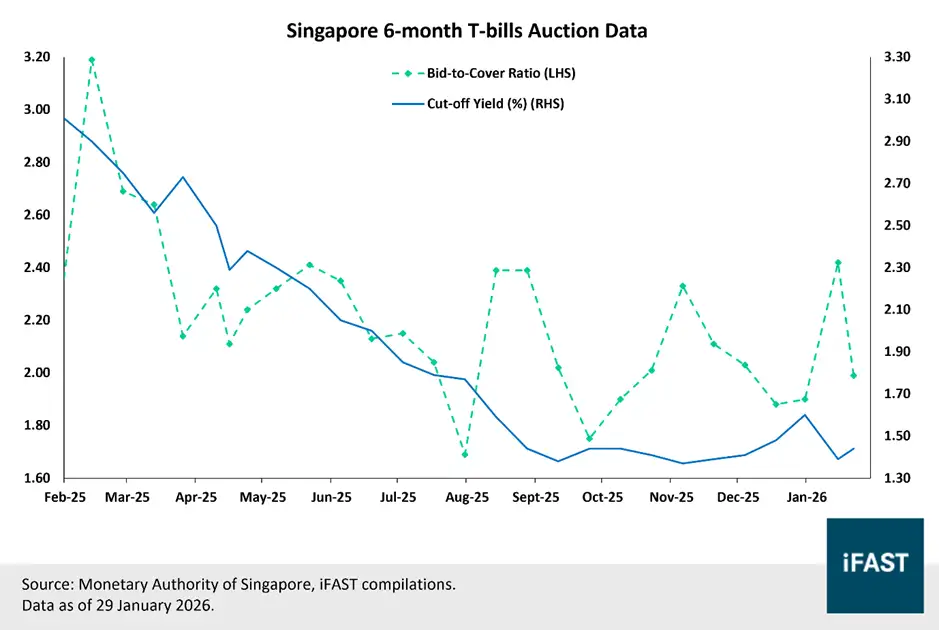
• In the recent 6-month T-bills auctions, the bid-to-cover ratio was at a low, consistently trending downwards below the 2.00x level over the past few auctions. Cut-off yields regained some ground in the latest 22 January 2026 auction, which saw rates increase slightly to 1.44%.
Singapore Banks Bond Investment Ideas
DBSSP 4.403% 21Mar2028 Corp (USD)
For the third quarter ending 30 September 2025 (3Q25), DBS reported resilient results, with net profit rising 5% year-on-year (YoY) to S$2.95 billion. While a declining net interest margin (1.96%) caused net interest income to soften YoY, this was effectively offset by a 20% YoY surge in fee income, spearheaded by the wealth management division. Although operating expenses rose 6% due to performance-linked bonus accruals, the bank maintained a disciplined cost-income ratio of 40%.
Management’s 2026 guidance anticipates continued resilience, with total income and net profit expected to remain stable or slightly below 2025’s record highs. Management expects a high-single-digit growth in fee income, which should provide some buffer against interest rate headwinds. We like the progress DBS has shown in diversifying from its net interest income through the wealth management segment, enhancing revenue stability.
Overall, DBS maintains a strong investment-grade credit profile, with credit ratings of AA- (S&P), Aa1 (Moody’s), and AA- (Fitch Rating). Asset quality remains a core strength, evidenced by a stable 1.0% non-performing loan (NPL) ratio and a manageable loan-loss rate of 15 bps.
The bank’s solvency and liquidity buffers remain robust. The CET1 ratio held steady at 15.1%, significantly surpassing both the 9.0% regulatory requirement and management’s 12.5% to 13.5% target. This capital strength is complemented by a healthy 6.2% leverage ratio, strong liquidity coverage (149%) and net stable funding ratio (114%), underpinning DBS’s solid credit profile.
We highlight DBSSP 4.403% 21Mar2028 Corp (USD). This issue provides a yield-to-worst (YTW) of 3.85% with a tenor of 2.15 years. We think this issuance is suitable for investors seeking high-quality, stable income from a familiar bank with a strong fee-income franchise.
Table 1:
|
Bond Issue |
Years to Maturity |
Yield to Worst (%) |
Ask Price |
Credit Rating (S&P / Moody’s / Fitch) |
|
2.13 |
3.80% |
101.23 |
- / Aa2 / AA- |
|
|
Source: Bondsupermart, Bloomberg, iFAST Compilations. Data as of 2 February 2026. |
||||
OCBCSP 4.550% 08Sep2035 Corp (USD)
OCBCSP 3.900% Perpetual Corp (SGD)
OCBC management is cautiously optimistic for 2026, projecting a mid-single-digit loan growth that should help mitigate compressed net interest margins. Steady contributions from its wealth management and its Great Eastern insurance arm should further support earnings. Additionally, management is implementing a digitalisation programme which should drive productivity and help manage costs. Like DBS, we find comfort in OCBC’s ability to grow its non-interest operating segments and the income contribution from Great Eastern’s strong insurance presence.
Overall, OCBC maintains a strong investment-grade credit profile, with credit ratings of AA- (S&P), Aa1 (Moody’s), and AA- (Fitch Rating). Asset quality remains a core strength, evidenced by a stable 0.9% NPL ratio and a manageable loan-loss rate of 16 bps.
The bank’s solvency and liquidity buffers remain robust. The CET1 ratio declined slightly to 15.0% (compared to 15.3% in 2Q25), surpassing both the 9.0% regulatory requirement and management’s 14.0% target. This capital strength is complemented by a healthy 7.2% leverage ratio, strong liquidity coverage (141%) and net stable funding ratio (114%). These healthy leverage and coverage ratios provide a buffer against short-term shocks and long-term funding disruptions.
While OCBC has a couple of outstanding USD and SGD bonds, we highlight OCBCSP 4.550% 08Sep2035 Corp (USD) and OCBSP 3.900% Perpetual Corp (SGD). The former USD issue offers a YTW of 4.66% with 4.62 years to call, with a decent coupon of 4.550%. The latter SGD issue offers a YTW of 2.10% with 1.36 years to call.
Table 2:
|
Bond Issue |
Years to Call |
Yield (%) |
Ask Price |
Credit Rating (S&P / Moody’s / Fitch) |
|
4.60 |
4.63% |
99.56 |
BBB+ / A2 / A |
|
|
1.34 |
2.00% |
102.50 |
BBB- / Baa1 / BBB+ |
|
|
Source: Bondsupermart, Bloomberg, iFAST Compilations. Data as of 2 February 2026. |
||||
UOBSP 3.863% 07Oct2032 Corp (USD)
UOBSP 2.550% Perpetual Corp (SGD)
Table 3:
|
Bond Issue |
Years to Call |
Yield (%) |
Ask Price |
Credit Rating (S&P / Moody’s / Fitch) |
|
1.68 |
4.31% |
99.28 |
BBB+ / A2 / A |
|
|
2.39 |
2.16% |
100.91 |
BBB- / Baa1 / BBB+ |
|
|
Source: Bondsupermart, Bloomberg, iFAST Compilations. Data as of 2 February 2026. |
||||
Hot New Issues:
|
Issue |
Issuer |
Issuance Date |
New Issue View |
|
Singapore Airlines Limited |
30 Jan 2026 |
New Issue: Take flight with SIA’s new 10-year bond yielding 2.950% (IPG)! |
|
|
AIMS APAC REIT |
21 Jan 2026 |
New Issue: 4.4% yields (IPG) offered by SGX-listed logistics specialist |
|
|
Standard Chartered PLC |
15 Jan 2026 |
Standard Chartered announces SGD NC5.5 AT1 perpetuals at an IPG of 4.7% |
|
|
Credit Agricole SA |
15 Jan 2026 |
New Issue: Leading French bank issues SGD bonds at 3.05% IPG |
Declaration: For specific disclosure, at the time of publication of this report, IFPL (via its connected and associated entities) holds OCBCSP 3.900% Perpetual Corp (SGD) and UOBSP 2.550% Perpetual Corp (SGD). The analyst who produced this report holds NIL positions in the abovementioned securities.