Due to significant fundamental changes in the Chinese Real Estate Industry, many investors prefer avoiding the Asian High Yield Bonds for fear of entering traps. In this article, we will summarize some of the key points about Asian high yield bonds and how investors can take advantage of bond selection to avoid the credit traps.
1. Chinese High Yield Issuers face Difficulty in Offshore Bond Issuance
The default rate on Chinese high yield bonds has risen sharply since the Chinese real estate crisis. As the market became more concerned about the credit condition of Chinese companies, the weighted average yield on Chinese high yield USD bonds (excluding Chinese real estate) rose to more than 12%. It harms the refinancing ability of these companies, making it difficult for them to issue offshore bonds.
For most Chinese companies with offshore debt, offshore bond issuance is one of the important financing channels. For most Chinese issuers, USD bonds account for at least 5% or more of the total debt (see Table 1). If companies are unable to issue bonds in the offshore market for refinancing, they need to repay both the principal and the coupon when the bonds mature, which significantly increases the liquidity pressure on the company.
Table 1: Chinese High Yield Issuers’ Debt Structure
|
USD Bonds as of Total Debt (%) |
Issuers* |
No of Issuers |
|
<5% |
China Grand Automotive Services, CALC, Yankuang Energy Group, New Oriental Education & Technology Group |
4 |
|
5% - 20% |
Fosun International, China Huarong, China Hongqiao, China Water Affairs, H&H International, Wens Foodstuffs Group, ENN Natural Gas |
7 |
|
>20% |
China Oil & Gas Group, West China Cement, Anton Oilfield Services |
3 |
|
*Exclude non-listed companies, Chinese real estate companies, Hong Kong and Macau Companies Sources: Bloomberg Finance L.P., iFAST compilations Data as of 16 January 2024 |
||
In addition, it means that these companies have to take advantage of other financing methods (such as equity financing, bank loan or other debt instruments, except the bond issuance), the cash level, asset disposal or/and operating cash flows to repay the bonds, these involve higher operational risks and execution risks, resulting in a higher uncertainty in bond repayment. Thus, the risks of bond default or extension for Chinese high yield issuers are significantly higher than in the previous period.
2. Select Issuers with More International Background
Based on the above views, we believe that selecting issuers with more international backgrounds could mitigate the risk. A company with a larger proportion of its revenues coming from overseas means that it has more business and assets outside the country.
In addition to more diversified revenues and assets, these companies have wider financing methods, as they can be financed in both onshore and offshore markets.
In the event of a liquidity crisis, these companies have more flexibility in terms of responses and execution. They also have the option of selling assets either onshore or offshore when they wish to sell assets to pay off their debts.
Under the current environment, selling onshore assets to peers might not be an easy task, given that the liquidity of non-SOEs in each industry might not be as strong as in the past. The peers might suspend the transaction during the due diligence for fear of acquiring some distressed assets. SOEs usually involve a longer period of due diligence and getting approvals. The procedures are generally more complicated. Even if a company successfully disposes of its onshore assets, it could take time to convert the local currency to foreign currency due to China’s foreign exchange control, which adds some uncertainty.
In contrast, the sale of offshore assets might be simpler. The proceeds of the disposal are offshore funds that can generally be used to repay USD bonds after settling the payment at the project level.
Therefore, we believe that issuers with more international backgrounds (see Table 2) are more resilient. They might have certain advantages over purely Chinese companies in terms of debt repayment.
Table 2: Issuers with More International Backgrounds
|
Issuers with more than 20% Revenues or Assets from Overseas |
Related Bonds |
Yield To Maturity |
|
Global Logistics Properties (GLP) |
GLPCHI 4.974% 26Feb2024 Corp (USD) |
8.5% |
|
GLPSP 3.875% 04Jun2025 Corp (USD) |
29.3% |
|
|
Fosun International |
FOSUNI 6.850% 02Jul2024 Corp (USD) |
9.2% |
|
FOSUNI 5.950% 19Oct2025 Corp (USD) |
12.6% |
|
|
CALC | CHNAAR 5.500% 08Mar2024 Corp (USD) |
7.9% |
|
CHNAAR 4.850% 23Dec2024 Corp (USD) |
6.4% |
|
|
H&H International |
BTSDF 5.625% 24Oct2024 Corp (USD) |
7.6% |
|
BTSDF 13.500% 26Jun2026 Corp (USD) |
13.7% |
|
|
Anton Oilfield Services |
ANTOIL 8.750% 26Jan2025 Corp (USD) |
13.7% |
|
Sources: Bondsupermart, iFAST compilations Data as of 16 January 2024 |
||
3. Investors Should Take a More Conservative Approach towards Chinese Real Estate bonds and Not Pick Chinese Real Estate Developers with Traditional Business Models
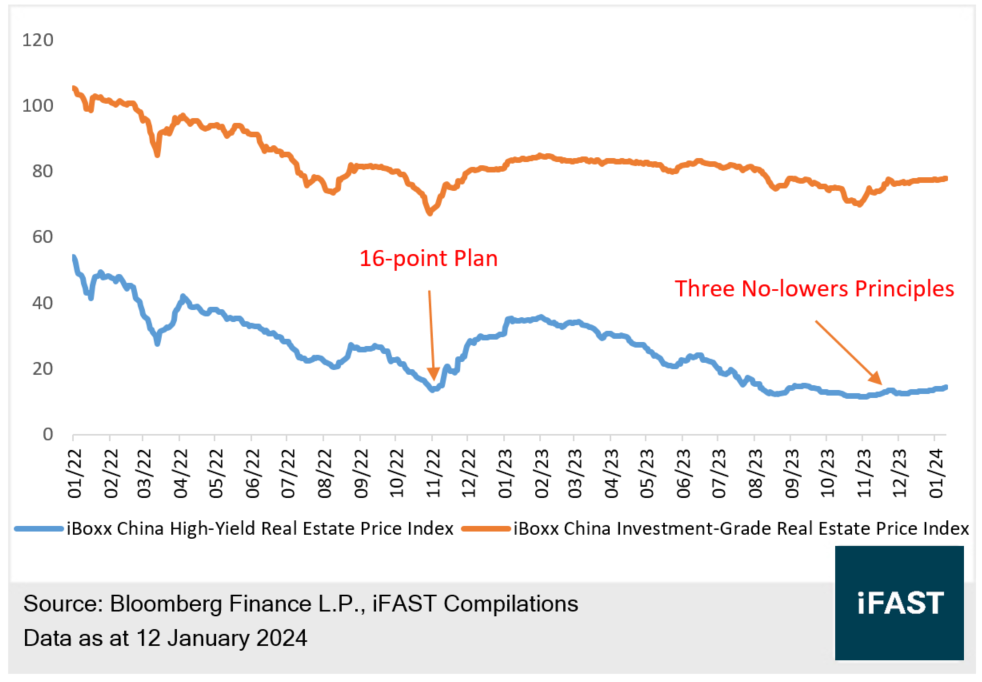
The Chinese real estate industry is still facing a relatively large-scale debt maturity and confidence crisis. Even though the mainland regulators announced the "Three No-lowers principles" policy recently, and it could be like last year’s “16-point Plan”, which led to a short-term rebound of the Chinese Real Estate bonds, we believe that the overall uncertainty is still quite high. The new policy only aimed at improving the financing of property developers. It is still yet to tackle the issues of a lack of confidence in homebuyers and a lack of investment nature in the real estate market.
Chart 1: iBoxx China High-Yield Real Estate Price Index and Investment-Grade Real Estate Price Index
Besides, we believe that the Chinese real estate debt crisis mainly focuses on the developers with “high liabilities, high leverage and high turnover” business model (“traditional Chinese property developers”) (see Chart 2). The features of traditional Chinese property developers have higher liability to asset ratios and lower interest-bearing debt to total liability ratios. Most non-SOE developers (or even some SOE developers) already defaulted in the open market.
Chart 2: Comparison between Indicators of Chinese Developers and Hong Kong Developers
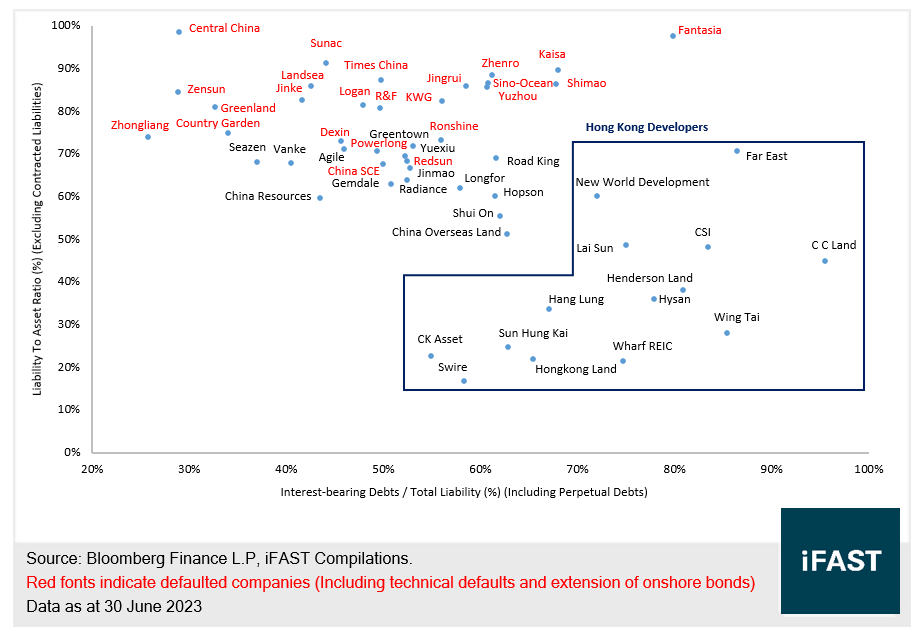
These traditional Chinese property developers take advantage of more leverage at the operating level. The derived operating risks would be higher due to more payables on construction bills, amounts due to JVs and associates, land and tax payables etc. Furthermore, those aggressive Chinese property developers would take advantage of more debts, off-balanced sheet debts, disguised equity, commercial papers, non-traditional financing methods and wealth management products to raise funds, which greatly increased their operating and credit risks.
We believe that investors should take a more conservative approach towards Chinese real estate bonds. Those traditional Chinese property developers which have a better credit profile might gradually deplete their liquidity. Thus, investors should avoid the bonds issued by traditional Chinese property developers.
4. Liquidity Pressure is NOT High for Hong Kong Developers and Investors could consider Bond Sell-offs as a “Buy” Opportunity
Following Chart 2, in contrast to traditional Chinese property developers, Hong Kong developers’ liability-to-asset ratios are generally low. Most of them are below the 50% level. Even for those Hong Kong developers with higher liability-to-asset ratios, their interest-bearing debt-to-total-liability ratios are higher, reflecting they incur simpler debt structures.
In terms of industry outlook,
Hong Kong's property market is undergoing a down cycle. The Centa-City Leading
Index CCL (Chart 3), a proxy for Hong Kong residential property prices, dropped
by more than 20% cumulatively from its high in mid-August 2021 to the current level
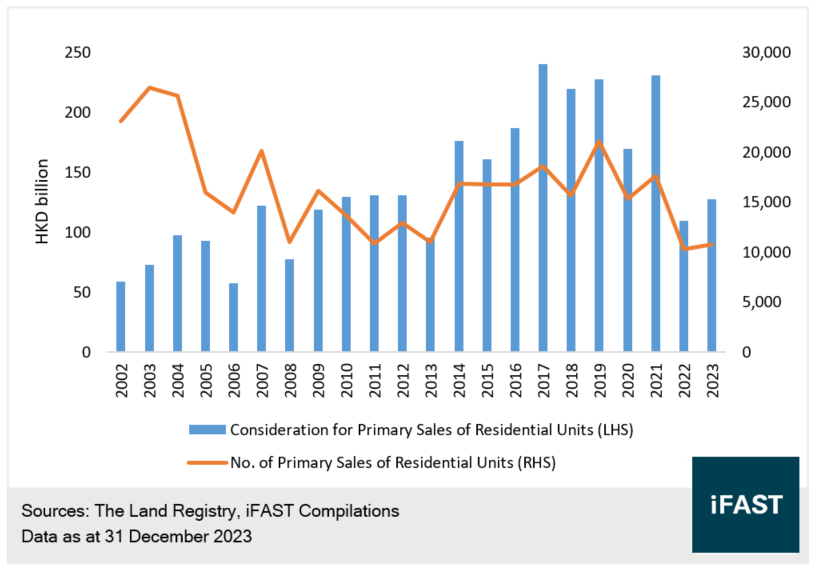
of 148. The trading turnover and volume of first-hand residential properties were
only about HKD 128.0 billion and 10,800 cases respectively (Chart 4) in 2023,
falling back to the level of the period between 2009 and 2013.
Chart 3: History Movement of the Centa-City Leading Index CCL
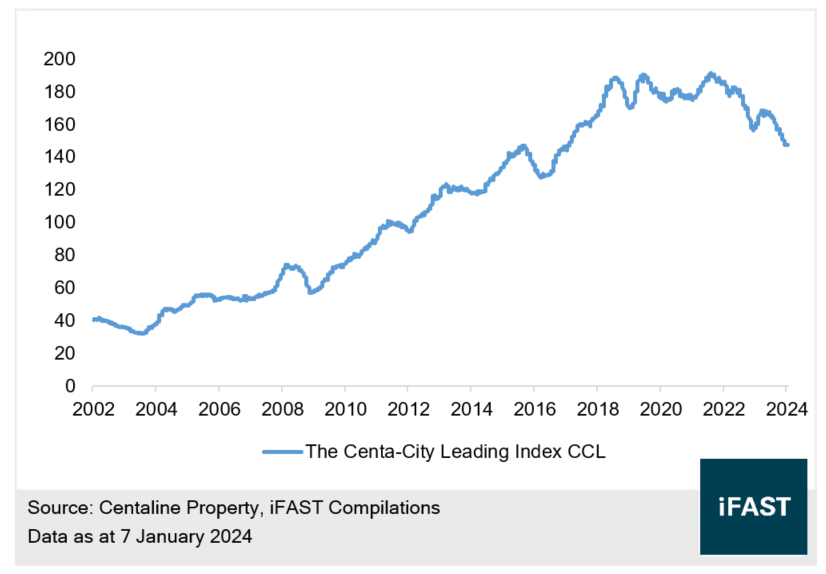
Chart 4: The Trading Turnover and Volume of First-hand Residential Properties
However, Hong Kong developers could adopt the strategy of lowering the property prices in exchange for higher volumes in order to recycle the capital quickly and stabilize their balance sheets. The CK Asset’s Coastline project in Yau Tong and the Sun Hung Kai Properties’s Yoho West in Tin Shui Wai are actual examples that as long as developers are willing to sell their properties at a discount of about 10% to 20%, it is not too difficult to dispose the assets in the market.
Meanwhile, thanks to Hong Kong developers’ advantage in the gross margin of projects (which generally were higher than 40% in the past), even if they sell the properties at a discount, it is just making less profits instead of making losses.
According to Reuters, some of Hong Kong’s major banks have cut off fresh financing to some local developers with a high leverage. This does not mean that the banks call their loans (i.e. repaying the loans in advance), but this is simply a risk management activity by some banks to control the real estate exposures. We believe that some banks might require some individual developers to increase the collaterals, but they can still refinance their outstanding loans. The local banks would still continue to provide stronger support to developers' financing.
It is worth mentioning that despite the negative news about New World Development in the past year, none of the banks withdrew New World Development’s credit lines. This indirectly reflects that the financing channels for local developers are still fluent with fairly good credit conditions.
In conclusion, if there is an irrational sell-off in Hong Kong real estate bonds (such as the plunge of New World Development bonds in August and September last year), investors could take the opportunity to buy the bonds. However, investors should still pay attention to the credit profiles of individual issuers.
Table 3: Some Hong Kong Real Estate Bonds which we are Bullish On
|
Bond Name |
Issuer / Guarantor |
Ask Price (Investors Buy) |
Yield To Maturity |
Related Articles |
|
HENLND 2.375% 27May2025 Corp (USD) |
Henderson Land |
96.3 |
5.1% |
Click Here |
|
NWDEVL 5.875% 16Jun2027 Corp (USD) |
New World Development |
91.5 |
9.0% | Click Here |
|
CCLAND 5.200% 20Sep2025 Corp (USD) |
C C Land |
89.2 |
12.7% |
Click Here |
|
CSIPRO 5.450% 21Jul2025 Corp (USD) |
CSI Properties |
83.5 |
19.0% | Click Here |
|
Sources: Bondsupermart, iFAST compilations Data as of 16 January 2024 |
||||
5. Japanese High Yield Issuers are Worth Investors’ Consideration
Japan could be able to get rid of the deflation issue that has plagued the country for more than two decades. Over the past few years, the falling prices caused residents to delay spending and investment, thereby stifling economic growth. The transition from deflation to inflation is a new phase of structural change. The consumption and investment patterns of residents and businesses should evolve from negative to positive, creating a virtuous cycle.
Additionally, inflation drives local investors to seek more investment opportunities in the capital market, which can lead to capital inflows into the local capital market, indirectly increasing the debt and equity financing abilities of the companies.
We have a strongly positive view on the Japan’s long-term economic outlook. The local companies could be able to benefit from it. There are only three high yield issuers with international ratings – Rakuten, Nissan Motor and Softbank. We are positive about the credit fundamentals of these Japanese high yield issuers. The credit risks of their short to medium term bonds are under control, with a yield to maturity of 5.5% to 7.7%. Investors could refer to our analytical articles for more details on individual companies’ credit analysis.
Table 4: Japanese High Yield Bonds and Related Articles
|
Bond Name |
Issuer / Guarantor |
Ask Price (Investors Buy) |
Yield To Maturity |
Related Articles |
| NSANY 3.522% 17Sep2025 Corp (USD) | Nissan Motor |
96.7 |
5.5% |
Click Here |
| SOFTBK 5.125% 19Sep2027 Corp (USD) | Softbank |
95.8 |
6.5% |
Click Here |
|
Rakuten |
101.9 |
7.7% |
Click Here | |
Sources: Bondsupermart, iFAST compilations Data as of 16 January 2024 |
||||
6. Be Selective on Highly Leveraged Downstream Companies of Commodities
On the commodities side, in terms of structures, the capital expenditures by global upstream oil and gas producers remain at a lower level in the past decade. The prolonged underinvestment in the industry gradually impacts the supply side. With oil companies continuing to "lay flat", we can expect the tighter supply to continue going forward. It is difficult for oil prices to fall significantly.
OPEC+ might also face the dilemma of increasing production due to years of underinvestment in the past. In addition, while OPEC+ hopes oil prices would remain high, it provides strong support for oil prices.
In addition, the medium to long-term outlook for metals is quite positive, mainly because the energy transformation is becoming an important issue for countries. Metals, such as copper, nickel and lithium, are important for the development of renewable energy technologies, which will drive demands for metals and support their demands and prices.
Due to the extreme weather continuing in Brazil, Latin America and Africa, the prices of agricultural commodities (cocoa, live cattle, coffee, sugar, soybeans, soybean oil etc.) are still hovering at high levels. These show signs of aggravating the supply constraints, resulting in higher prices of food for a longer period.
Meanwhile, to a certain extent, the war between Russia and Ukraine, which are major exporters of some foodstuffs (wheat, corn, etc.), also supports the prices of these agricultural commodities.
The rise of food protectionism in developing countries and global restrictions on exports of grains and staple foods resulted in the prices of most agricultural products being higher than their historical averages over the last five years. These supply-related factors might not be resolved in the short term.
Given our positive view on most commodity prices, upstream companies that produce or help produce these commodities will benefit (e.g., oil and coal producers, food producers, oilfield service companies, etc.). However, as commodity prices might remain elevated for a longer period of time, these could lead to significant cost increases for some downstream industries (see Table 5), eroding their profit margin.
If this situation persists over a long period of time, it might increase the credit risk over time for some downstream companies with weak balance sheets, high levels of debt and weak pricing power where they are unable to transfer the costs to customers. Therefore, we believe that investors should be selective in highly leveraged downstream companies of commodities to mitigate the potential risk. If investors still wish to invest in related bonds, they should choose shorter-tenor bonds to control the uncertainty.
Table 5: Downstream industries and Examples that are More Sensitive to Changes in Commodity Prices
|
Commodities |
Agricultural Commodities |
Oil & Gas |
Coal |
Non-ferrous metal |
Ferrous Metal |
|
Corresponding Downstream Industries |
Agriculture, Forestry, Fishery and Animal Husbandry Food and Beverage |
Petroleum Gas Supply Traffic & Transportation |
Electricity Generation Cement |
Non-ferrous metal Appliance |
Steel Real Estate Construction |
|
Some Issuer Examples (For reference only, not meaning the company faces credit crisis) |
WENS |
China Oil And Gas Group Towngas Smart Energy |
West China Cement |
China Hongqiao |
JSW Steel Shandong Iron and Steel |
|
Source: iFAST compilations |
|||||