- Credit Suisse’s operating results fell on a year-on-year basis but its credit ratios have been improving.
- The CS 5.625% Perpetual Corp (SGD) looks attractive with a yield-to-call of 4.32%.
- Other bonds from other banks may be worthy investments too, for example, SOCGEN 6.125% Perpetual Corp (SGD) and UBS 4.850% Perpetual Corp (SGD).
Perpetual bonds of Swiss banks have declined slightly but with high probabilities of being called, the bonds look attractive. This article examines the credit profiles and the current valuations of Additional Tier 1 (“AT1”) instruments of UBS Group, Credit Suisse and Julius Baer.
UBS Group AG (“UBS”) has performed tremendously so far with all segments growing well. Credit loss releases (reversal of credit losses) also helped to improve their bottom line, compared to large credit loss expenses in a tumultuous 2020. While Julius Baer did not grow as much as UBS, they recorded their highest half-year profit in the company’s history thanks to higher assets under management (“AuM”) and higher commission/fee income.
Credit Suisse fared the worst among the three banks as they continued to exit positions related to the Archegos saga. However, even after excluding for Archegos and significant items, adjusted pre-tax income in 2Q21 declined by 13.3% YoY to CHF 1.3b. Credit Suisse reported stellar results from the Sales & Trading segment in 2Q20 which they were unable to repeat. Investment bank revenues excluding Archegos dropped by 23% to USD 2.3b in 2Q21. The investment bank segment made a loss of USD 86m.
Table 1: Operating results for the 3 Swiss banks
|
1H21 results |
Credit Suisse |
UBS |
Julius Baer* |
|
Net revenue |
CHF 8308m |
USD 17681m |
CHF 1992.9m |
|
YoY Growth |
-25.2% |
15.3% |
7.68% |
|
Net interest income |
CHF 3070m |
USD 3241m |
CHF 308.4m |
|
YoY Growth |
-1.10% |
19.07% |
-7.50% |
|
Commissions & Fees Earned |
CHF 6895m |
USD 12210m |
CHF 1292.1m |
|
YoY Growth |
18.73% |
19.62% |
12.53% |
|
Operating profit before tax |
CHF 56m |
USD 4891m |
CHF 706.9m |
|
YoY Growth |
-97.97% |
36.20% |
22.47% |
|
Net income |
CHF 16m |
USD 3838m |
CHF 606m |
|
YoY Growth |
-99.35% |
35.47% |
23.42% |
Source: Respective companies’ financial statements, iFAST compilations
Credit ratios for all three banks improved as common equity tier 1 (“CET1”) capital increased across all three banks. Risk-weighted assets (“RWA”) also increased for UBS and Julius Baer but RWA for Credit Suisse dropped by CHF 19b due to investment banking risk following the events in 1Q21.
Table 2: Credit ratios for the 3 Swiss banks
|
Julius Baer |
Credit Suisse |
UBS |
||||
|
2Q21 |
2020 |
2Q21 |
2020 |
2Q21 |
2020 |
|
|
CET1 ratio (%) |
16.7 |
14.9 |
13.7 |
12.9 |
14.5 |
13.8 |
|
Tier 1 Capital ratio (%) |
22.2 |
20.3 |
19.4 |
18.6 |
20.2 |
19.4 |
|
Total Capital ratio (%) |
22.8 |
21.0 |
19.8 |
19.0 |
35.6 |
35.2 |
Source: Respective companies’ financial statements, iFAST compilations
The AT1 bonds
Figure 1: Yield-to-call of AT1 instruments
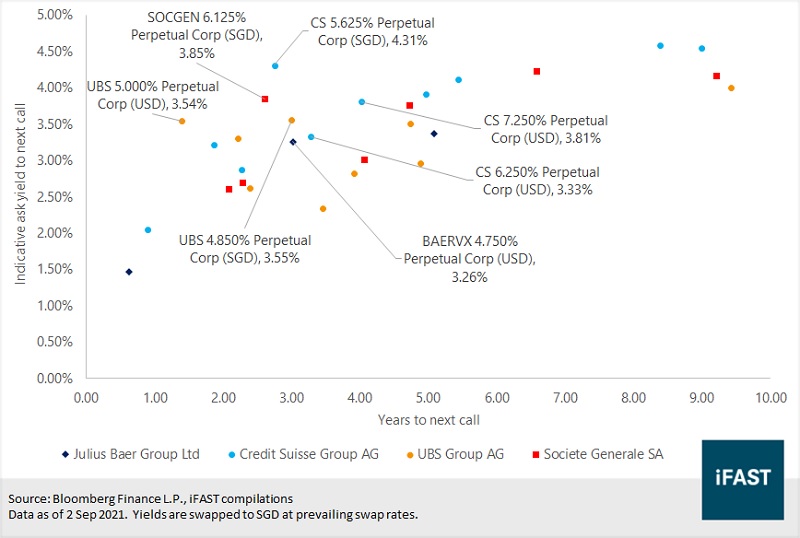
Looking at Figure 1, there are a few attractive options. The CS 5.625% Perpetual Corp (SGD) offers the highest yield-to-call (“YTC”) relative to other AT1 bonds with similar call dates. Part of it may be due to its slightly weaker credit ratios. The UBS 5.000% Perpetual Corp (USD) is also an attractive option, offering a relatively high YTC with a call date of 31 January 2023. The high YTC and lower bond price may be due to its lower initial spread of 2.432%, thus carrying a risk of lower yields if the bond were to be reset.
On a side note, hedging costs for USDSGD are also extremely low – investors who do not wish to bear losses from currency fluctuations can consider purchasing currency forward contracts to protect their yields. For example, the 2-year forward rate for USDSGD is at 1.3435, 0.10% higher than the spot rate of 1.3421. By entering into this forward contract, one will ensure no losses from USDSGD. However, if you are bullish on USDSGD, then you should not purchase any contracts.
Table 3: Reset rates of AT1 instruments
|
Reference rate |
Initial spread |
Call date |
|
|
BAERVX 4.750% Perpetual Corp (USD) |
5Y UST |
2.844% |
12Sep2024 |
|
CS 5.625% Perpetual Corp (SGD) |
5Y SOR |
3.767% |
06Jun2024 |
|
CS 6.250% Perpetual Corp (USD) |
US 5Y Swap Rate |
3.455% |
18Dec2024 |
|
UBS 5.000% Perpetual Corp (USD) |
US 5Y Swap Rate |
2.432% |
31Jan2023 |
|
UBS 4.850% Perpetual Corp (SGD) |
5Y SOR |
3.372% |
04Sep2024 |
|
SOCGEN 6.125% Perpetual Corp (SGD) |
5Y SOR |
4.207% |
16Apr2024 |
Looking back at history, the three banks have called every AT1 bond that has matured in the past despite a lower reset rate. However, for UBS, they have also issued new perps with lower coupon rates. For example, they refinanced UBS 6.875% Perpetual Corp (USD) with the UBS 4.375% Perpetual Corp (USD) earlier this year.
Intuitively, if a company can issue new bonds at lower yields/spreads, they will almost certainly do so. Interestingly, Julius Baer chose to call the BAERVX 5.900% Perpetual Corp (SGD) and issued the BAERVX 4.875% Perpetual Corp (USD) in October 2020, although the former will reset to a rate of 3.32%.
It may be too early to tell whether the banks will call the above bonds but their track records point to them doing so. Based on this thought-process, the CS 5.625% Perpetual Corp (SGD) looks the most attractive. The SOCGEN 6.125% Perpetual Corp (SGD) is another decent option.
(Related article: Societe Generale – one of the unnoticed high yield opportunities in Europe)
Examining the UBS 5.000% Perpetual Corp (USD), it was issued on 31 January 2018 which was also near the peak of its stock price before it went on a downward trend. Net income also rebounded strongly in 1Q18. Optimism was probably at its peak too, which allowed UBS to issue the perp at a low initial spread of 243.2 basis points (“bps”).
Figure 2: Stock price and net income of UBS 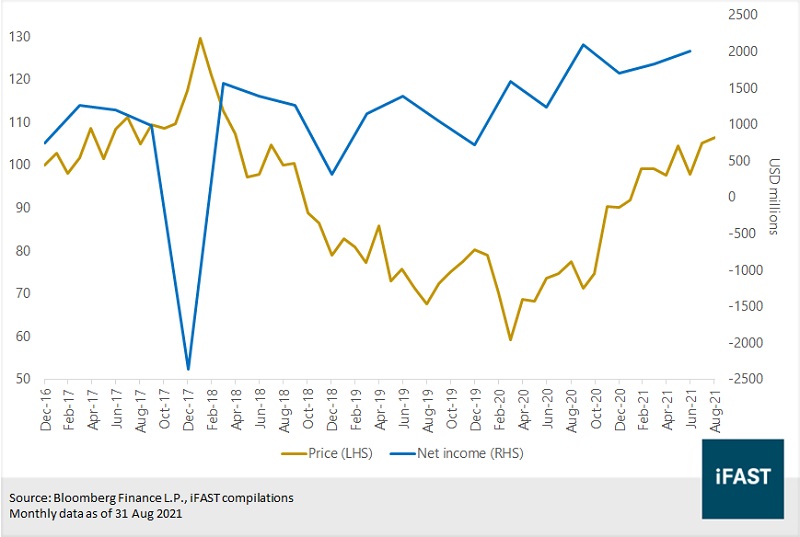
Thus, there is some chance that UBS will be unable to issue new perps at similar or lower spreads, unless their earnings continue to grow on a strong upwards trend. On the other hand, its CET1 ratio is climbing back to the 4Q17 level of 14.9%, one month before the 5% perp was issued. The bank can also follow Julius Baer’s footsteps and call the 5% perp while refinancing it with new perps that have slightly higher yields as compared to not calling.
If its earnings growth remain supported, then both the UBS 5.000% Perpetual Corp (USD) and the UBS 4.850% Perpetual Corp (SGD) will be good buying opportunities as spreads will possibly decline.
On the flip side, if UBS does not call the UBS 5.000% Perpetual Corp (USD), prices will most probably drop to compensate for the much lower coupon rate (depending on the new expected call date). Assuming a new coupon rate of 3.32% and that the bond will be called in the next year, its price will have to decrease to about 98 to give the same YTC of 3.46% (in USD). Currently, its indicative ask price is at 102.25. Investors may thus suffer an extra 2 cents loss if the bond were not to be called, almost negating a year of coupons.
Some extent of the lower probability of call has certainly been priced in as seen by the perp’s similar YTC when compared to the UBS 4.850% Perpetual Corp (SGD). Investors who invest in the 5% perps should still be aware that the price may fall further in the event of a non-call.
Declaration: For specific disclosure, at the time of publication of this report, IFPL (via its connected and associated entities) holds positions in CS 5.625% Perpetual Corp (SGD) and UBS 5.875% Perpetual Corp (SGD), and the analyst who produced this report holds a NIL position in the abovementioned securities.