
Key Points
- JB Cocoa’s revenue fell 29.8% YoY to USD557.9 million in 1HFY2027 as lower cocoa bean prices pulled down selling prices, while profit before tax dropped 27.7% to USD52.5 million.
- Despite the lower earnings, net profit margin edged up to 7.7%, showing that the cost-pass-through model continues to protect profitability.
- The credit profile remains solid. Net gearing rose slightly to 0.83x, mostly due to trade bills, while the current ratio stayed healthy at 1.30x.
- Cocoa bean prices have bounced back to around USD5,300/MT on El Niño concerns, so we expect gearing to stay elevated as the Group needs more financing to buy beans.
- We remain positive on JB Cocoa and prefer the JBCOCO 5.950% 13Nov2029 Corp (MYR), which offers a yield of about 5.52%.
JB Cocoa is a premium cocoa ingredient brand under JB Foods Limited (SGX: BEW). The Group’s principal activities comprise the production and sale of cocoa ingredients, namely cocoa mass, cocoa butter and cocoa powder. Today, it is one of the world’s leading producers of cocoa ingredients.
Over the past two years, we have provided regular updates on JB Cocoa’s credit profile. Despite the significant surge in cocoa bean prices, the company has demonstrated resilience in its profitability, largely supported by its cost-pass-through business model, which allows additional costs incurred to be passed on to its customers.
Following the release of JB Cocoa’s 1HFY2027 financial results (ended September 2026), both revenue and profitability declined on a year-on-year (YoY) basis. Does this signal a weakening in the company’s underlying earnings profile?In this article, we will assess JB Cocoa’s latest financial performance, credit profile and the potential impact of El Niño on its gearing.
Industry Outlook
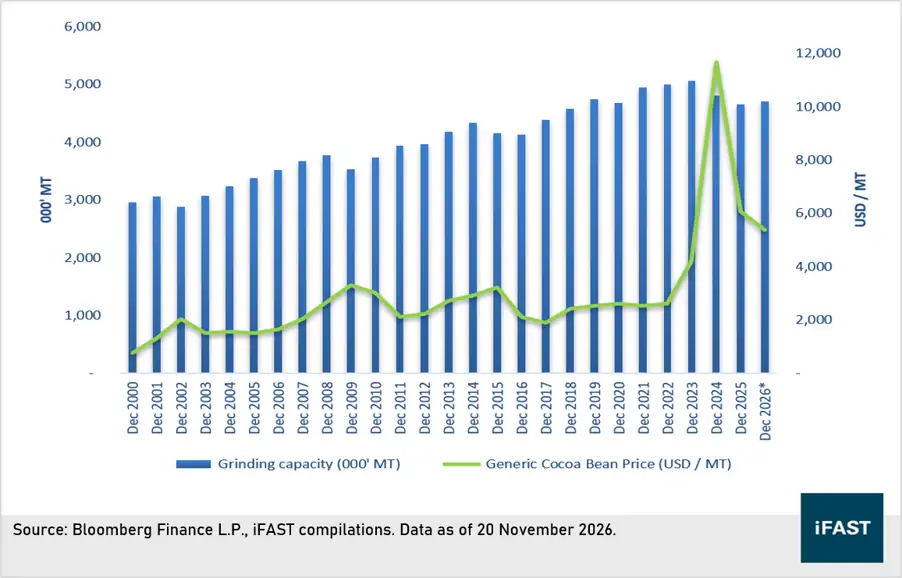
Cocoa bean prices experienced significant swings in 2026, declining to a low of around USD3,000/MT in March 2026 amid softer demand and expectations of improved weather conditions and stronger harvests following previous supply shortages. However, prices subsequently rebounded to around USD5,300/MT as of 30 September 2026, driven by growing market concerns over the potential adverse effects of El Niño on cocoa harvests.
Against this backdrop, we expect cocoa grinders’ gearing to remain elevated, as higher cocoa bean prices necessitate greater financing for bean procurement. Nevertheless, the impact on their profit margins is expected to be relatively contained, given their ability to pass on higher raw material costs to customers through their cost-pass-through business model.
Chart 1: World Cocoa Grindings and Cocoa Bean Price (000’ MT and USD/MT) as of 30 September 2026 (*cocoa crop year – 1 October to 30 September)
Financials
In 1HFY2027, JB Cocoa’s revenue declined by 29.8% YoY, primarily attributable to lower average selling prices of cocoa products following the moderation in cocoa bean prices.
During the period, the Group continued to be affected by foreign exchange losses of USD2.2 million arising from unfavourable movements in the EUR and GBP against the USD.
Meanwhile, selling and distribution expenses increased by 79% YoY to USD6.3 million from USD3.5 million in 1HFY2026, mainly due to higher outward freight and warehousing costs associated with overseas shipments, alongside prolonged transit times amid global shipping uncertainties.
On a positive note, finance costs declined by 23% YoY to USD10.2 million. We believe this was partly attributable to relatively lower cocoa bean prices during the period, which reduced the Group’s trade financing requirements for bean procurement.
Overall, the Group reported a lower profit before tax (PBT) of USD52.5 million, representing a 27.7% YoY decline, primarily reflecting lower revenue contribution amid moderating cocoa bean prices. Nevertheless, its net profit margin remained resilient, improving marginally to 7.7%, suggesting that the decline in absolute earnings does not necessarily reflect a deterioration in its underlying profitability.
Table 1: Profitability indicators (USD million, unless otherwise stated)
|
|
1HFY2026 (Ended Sep 2025) |
1HFY2027 |
Change in % |
|
Revenue |
794.5 |
557.9 |
(29.8%) |
|
Cost of sales |
(692.0) |
(478.0) |
(30.9%) |
|
EBITDA |
89.9 |
66.3 |
(26.3%) |
|
Profit before tax |
72.6 |
52.5 |
(27.7%) |
|
Net margin (%) |
7.5% |
7.7% |
- |
Source: Company Reports, iFAST Compilations. Data as of 30 Sep 2026.
Credit Highlights
Despite the volatility in cocoa bean prices, JB Cocoa’s credit profile remained resilient, although its net gearing ratio increased marginally to 0.83x. As highlighted previously, its elevated gearing is largely attributable to the nature of its business, where the majority of its borrowings comprise trade bills (69.1%), followed by sukuk (23.9%) and term loans (7%).
From a liquidity perspective, the Group continues to actively build and maintain its cash reserves. Its current ratio of 1.30x also indicates that its current assets remain sufficient to cover its short-term liabilities.
While operating cash flow remained relatively low at USD4.6 million, this is not a major concern at this juncture, given that cash flow fluctuations are typical of the cocoa grinding business due to its working capital-intensive nature.
Overall, we maintain our view that JB Cocoa’s credit profile remains resilient despite the significant volatility in cocoa bean prices over the past few months. Looking ahead, we expect the Group’s gearing to remain elevated, given the rebound in cocoa bean prices from around USD3,000/MT in early 2026 amid growing concerns over the potential impact of El Niño on cocoa harvests.
Table 2: Credit metrics (USD million, unless otherwise stated)
|
2022 |
2023 |
2025 |
2026 |
1H FY2027 |
|
|
Short-term Debt (excluding trade lines) |
19.8 |
4.0 |
44.1 |
42.3 |
42.2 |
|
Long-term Debt (excluding trade lines) |
18.8 |
41.7 |
88.6 |
54.2 |
51.3 |
|
Total Debt (excluding trade lines) |
38.5 |
45.7 |
132.7 |
96.5 |
93.5 |
|
- Trade lines |
138.3 |
225.4 |
64.3 |
173.3 |
208.8 |
|
Cash and bank balances |
21.6 |
26.3 |
36.7 |
48.4 |
44.2 |
|
Current ratio |
1.35x |
1.18x |
1.21x |
1.31x |
1.30x |
|
Operating cash flow |
49.2 |
(41.1) |
147.9 |
(25.1) |
4.6 |
|
Net gearing ratio (x) |
0.87x |
1.38x |
0.80x |
0.79x |
0.83x |
|
Interest Coverage Ratio (times)* |
5.05x |
1.60x |
2.19x |
5.62x |
2.37x |
Source: Company Reports, iFAST Compilations. Data as of 30 Sep 2026.
Gearing is expected to remain elevated amid El Niño-driven cocoa price volatility
The 2026 El Niño is expected to be one of the strongest on record, potentially bringing adverse weather conditions to Southeast Asia, West Africa, Australia, India and parts of South America.
Against this backdrop, cocoa bean prices are likely to experience heightened volatility amid growing market concerns over potential disruptions to cocoa production and deterioration in bean quality, particularly in Ivory Coast and Ghana, which collectively account for approximately 60% of global cocoa supply.
Consequently, we expect JB Cocoa’s gearing to remain elevated, given its continued reliance on trade bill financing for cocoa bean procurement, particularly if rising cocoa bean prices lead to higher working capital requirements.
Key Risk
Prolonged supply chain disruptions: If supply chain disruptions arising from adverse weather conditions persist for an extended period, such as El Nino, this may adversely affect the group’s financial performance and credit metrics.
Our view
At this juncture, there have been no material changes to JB Cocoa’s credit profile since our previous FY2026 update. We continue to hold a positive stance on JB Cocoa, primarily underpinned by its cost-pass-through business model and longstanding partnerships with major players in the cocoa industry.
Although cocoa bean prices are likely to remain volatile amid growing market concerns that El Niño could adversely affect cocoa harvests and drive prices higher, we do not view this as a major concern from a profitability perspective, given JB Cocoa’s ability to pass on additional raw material costs to its customers. Nevertheless, higher cocoa bean prices could keep its working capital requirements and gearing elevated.
Hence, we recommend that investors consider JBCOCO 5.950% 13Nov2029 Corp (MYR), which offers a YTM of approximately 5.52%. We prefer this bond over its shorter-dated counterparts, as we believe the yields offered by the latter are less compelling after factoring in the fees.
Table 3: Existing bonds
|
Bonds |
Years to Maturity |
Yield to Maturity |
|
4M |
3.86% |
|
|
1Y |
4.72% |
|
|
3Y |
5.52% |