Highlights:
- HSBC's revenue increased by 9% YoY to USD 56.36 billion; the 32% increase in statutory pre-tax profit included the base effect of the absence of legal provisions last year.
- HSBC Hong Kong's non-performing loan stock in commercial real estate decreased, but related expected credit loss provisions and collateral-to-value ratios increased. The core tier 1 capital ratio fell to 13.9%, slightly below the group's medium-term target, but liquidity and deposit base remained strong.
- Several HSBC-issued bonds are available on our platform, including senior unsecured, tier 2 capital, and additional tier 1 capital bonds. Currently, the yield on additional tier 1 capital bonds can be as high as 7%. Investors should choose bonds suitable for their individual preferences and risk tolerance and understand the characteristics and terms of different bonds.
HSBC Holdings, one of the world's largest international banking groups, operates in Hong Kong, the UK, corporate and institutional banking, and international wealth and prestige banking. The Group completed the privatization of Hang Seng Bank in January 2026 and continued to streamline non-core businesses in the third quarter. This article assesses profitability, asset quality, capital and liquidity based on the third-quarter financial report released on October 27 and compares different tranches of US dollar bonds.
HSBC Benefits from Strong Momentum in Non-Interest Business, Revenue Up
HSBC's revenue for the first three quarters was USD 56.36 billion, an increase of 9% YoY (see Chart 1); statutory pre-tax profit was USD 29.15 billion, an increase of 26%. The approximately USD 3.7 billion increase came from favorable YoY changes in special items, mainly including approximately USD 2.1 billion in dilution and impairment losses from the investment in Bank of Communications last year, the cessation of approximately USD 1.4 billion in legal provisions, and lower restructuring costs, partially offset by losses from the sale of businesses this year. Looking at the Group's net profit, the first three quarters saw a net profit of USD 22.89 billion, a significant increase of 27.6% compared to the relatively weak performance in 2025, with net profit also returning to the 41% level. In summary, HSBC's operations once again demonstrated strong momentum.
Chart 1: HSBC YTD Operation Performance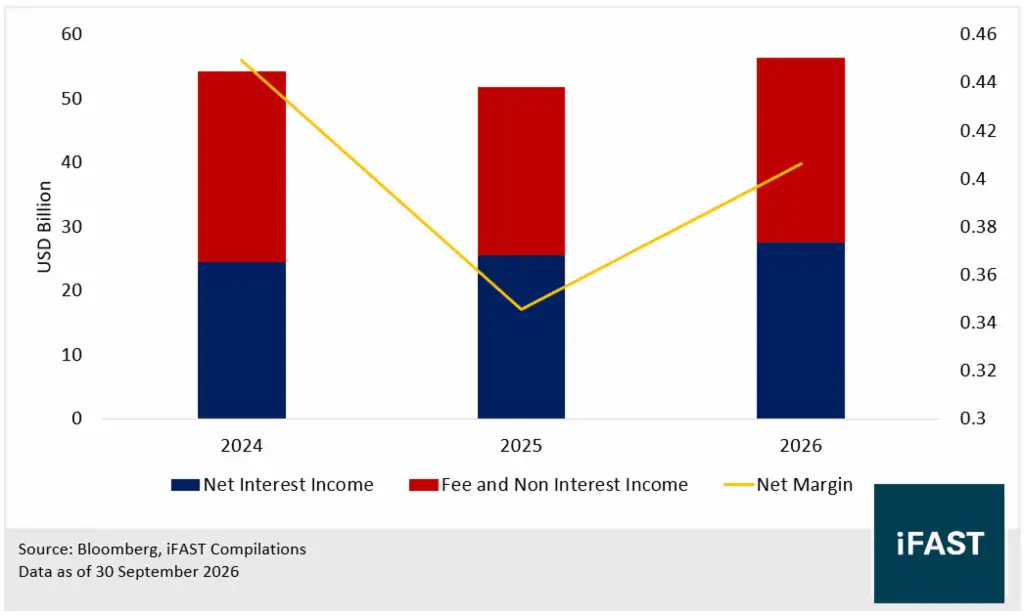
The improved revenue was mainly driven by deposit growth and reinvestment of structured hedge portfolios at higher yields. Net interest income from banking operations in the first three quarters was USD 34.55 billion, an increase of USD 2.19 billion YoY; net interest income in the official financial statements was USD 27.54 billion, an increase of USD 1.94 billion YoY. The two figures have different calculation scopes and should not be used interchangeably. The average net interest margin in the first three quarters widened to 1.60% from 1.57% in the same period last year, but the third quarter alone saw a decrease to 1.57%. Therefore, whether the full-year interest rate spread can maintain an improvement compared to last year remains to be seen.
Non-interest business provided significant incremental growth: wealth management fees and other income increased by 13% to USD 8.15 billion, driven by investment distribution, private banking client activities, and insurance business; transaction banking service-related income increased by 8% to USD 8.92 billion, or 6% at constant exchange rates. At the end of September, wealth management assets reached USD 1.6 trillion, with a net increase of USD 105 billion in the first three quarters, of which USD 95 billion came from Asia. By segment, revenue from corporate and institutional banking in the first three quarters was approximately USD 23.18 billion, Hong Kong business USD 12.23 billion, international wealth and premium banking USD 11.49 billion, and UK business USD 9.95 billion; the Hong Kong business includes Hang Seng Bank.
On the cost side, statutory operating expenses in the first three quarters decreased by 3% to USD 26.25 billion, mainly benefiting from the cessation of legal provisions and higher restructuring expenses last year. On a management-target basis, expenses increased by 2% to USD 25.47 billion, reflecting investments in technology and wealth management businesses, inflation, and compensation expenses. Management has realized approximately USD 1.9 billion in annualized savings, approaching the action target of approximately USD 2 billion by the end of 2026; however, some savings will be reinvested in growth businesses. Excluding special items, the annualized return on tangible equity in the first three quarters was 18.8%, an increase of 1.1 percentage points compared to the same period last year.
Hang Seng integration brings synergistic benefits, but the risks associated with existing real estate assets remain unresolved
HSBC completed the privatization of Hang Seng Bank on January 26. The Group currently expects to achieve annual pre-tax revenue and cost synergies of USD 500 million from its two Hong Kong brands by the end of 2028, with related restructuring costs of approximately USD 600 million. An additional annualized potential opportunity of approximately USD 400 million is a management target and has not yet been realized. Hang Seng was already consolidated into the Group's financial statements prior to privatization, therefore the transaction does not suddenly introduce a new risk associated with the entire commercial real estate loan; however, the acquisition of a minority stake occupies HSBC's capital, and any future profits or losses of Hang Seng will be borne entirely by the Group's shareholders.
HSBC expects credit loss expenses of USD 830 million in the third quarter, a decrease of approximately 17% YoY (see Chart 2); however, at constant exchange rates, this represents an increase of approximately 5%. Net expenditure on Hong Kong commercial real estate decreased to USD 300 million from approximately USD 700 million in the same period last year, but this improvement was offset by an expenditure of approximately USD 500 million from a UK-related fraudulent subprime securitization exposure, coupled with provisions for Middle East uncertainties. The average annualized credit loss rate for loans in the first three quarters was about 41 basis points, similar to the same period last year; management still expects about 45 basis points for the full year 2026 (including loans held for sale), higher than the medium-term planning range of 30 to 40 basis points.
Chart 2: HSBC Expected Credit Loss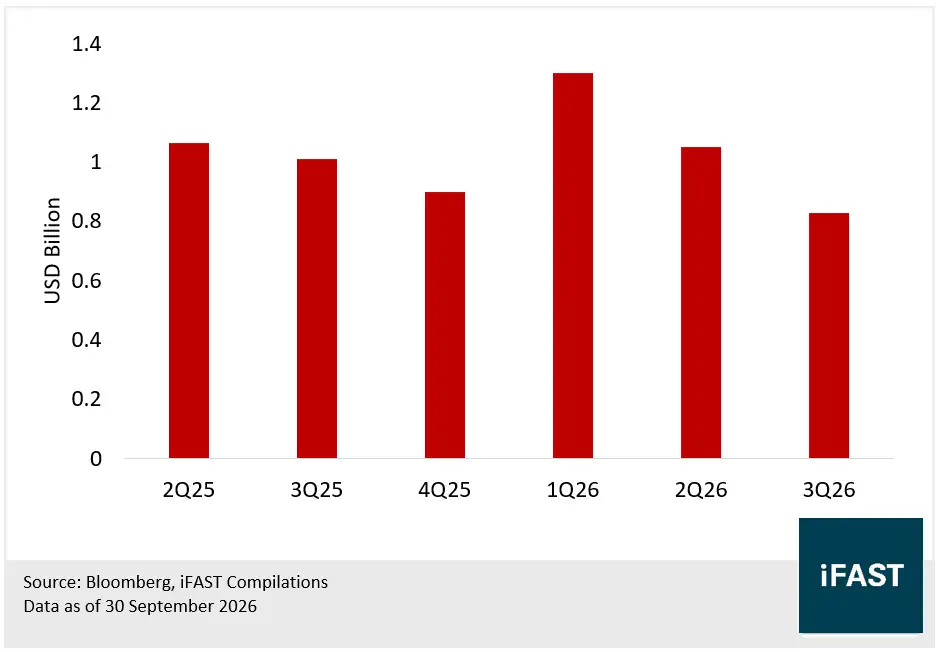
The third phase of lending decreased by approximately USD 710 million compared to the end of last year, but the expected credit loss provision balance for this commercial real estate portfolio increased by approximately USD 330 million; the loan-to-value ratio rose, reflecting pressure on collateral valuation. The company stated that 95% of the substandard and credit impairment exposures are secured, but collateral does not guarantee full recovery. We believe the decline in new spending on Hong Kong commercial real estate in the first three quarters is good news; however, existing risks have not subsided, and the rental, valuation, and refinancing situation of non-core office and retail properties still need to be observed.
HSBC's capital is slightly below the lower limit of its target, relying on deposits and liquidity to maintain a buffer
As of the end of September, HSBC's Core Tier 1 capital ratio (CET1) was 13.9%, a decrease of 1.0 percentage point from 14.9% at the end of 2025, and below the lower limit of the Group's medium-term target of 14% to 14.5%. The privatization of Hang Seng Bank had a net capital ratio impact of approximately 110 basis points in the first quarter; profits during the year partially offset the capital consumption from transactions, dividends, and loan growth. Risk-weighted assets at the end of September were USD 922.4 billion, an increase of approximately USD 33.8 billion from USD 888.6 billion at the end of 2025; the total capital ratio decreased from 20.5% to 19.2%. In the third quarter alone, declining bond valuations and the completed USD 1 billion share buyback also dragged down CET1.
Even with CET1 still below the 14% target (see Table 1), the Group announced a further share buyback of up to USD 1 billion. We believe earnings and liquidity are sufficient to support near-term debt repayments, but shareholder returns and loan growth will slow the pace of capital recovery, which should be particularly noted by holders of Tier 2 and Tier 1 capital bonds. Management anticipates that the implementation of Basel 3.1 in early 2027 may bring a positive CET1 impact of approximately 40 to 50 basis points; however, this is only a model estimate, and the actual figures are yet to be released.
Table 1: HSBC Credit Metrics
|
4Q25 |
1Q26 |
2Q26 |
3Q26 |
|
|
Net Cash (USD Billion) |
461.2 |
389.4 |
382.1 |
336.3 |
|
Leverage Ratio |
5.3% |
5.0% |
4.9% |
4.9% |
|
CET1 Ratio |
13.9% |
14.0% |
14.1% |
14.9% |
|
Liquidity Coverage Ratio (LCR) |
137% |
135% |
134% |
137% |
|
Data Source: Company’s Report, iFAST compilations Data As Of 30 September 2026 |
||||
At the end of September, customer deposits were approximately USD 1.84 trillion, up from approximately 1.79 trillion at the end of last year; net loans were approximately USD 1.03 trillion, with a loan-to-deposit ratio of 56.1%. The liquidity coverage ratio is 132%, down from 137% at the end of 2025, but high-quality liquid assets are approximately USD 719.4 billion, and the foundation of deposits and liquid assets is still strong. We believe that short-term debt repayment pressure is limited, and the key is whether subsequent earnings can rebuild the capital buffer with continued dividend payments and buybacks.
Bond Investment
Although the share price fell slightly after the earnings release, the bond market reacted relatively calmly, with credit spreads not widening significantly. As of September 22, 2026, HSBC Holdings' long-term/senior bonds were rated A+ (stable) by Fitch and A- (positive) by S&P, reflecting continued investor confidence in HSBC bonds.
Investors may consider several bonds issued by HSBC (see Tables 2 and 3), but should pay attention to the priority of repayment: senior unsecured bonds take precedence over Tier 2 capital bonds, which in turn take precedence over Additional Tier 1 (AT1) bonds. It is important to note that AT1 bonds are contingent convertible bonds, which trigger a loss absorption mechanism earlier in the event of a bank crisis, making them suitable for investors with higher risk tolerance. Furthermore, the 2030, 2044, and all subordinated bonds have loss absorption mechanisms; investors should choose bonds according to their individual risk appetite.
Table 2: HSBC Senior Unsecured and Subordinated Bonds
Bond | Currency | Tenor | Bond Rating (S&P / Fitch) | Yield to Maturity |
USD | 3.3 | A- / A+ | 5.1% | |
AUD | 5.5 | A- / A+ | 5.7% | |
HSBC 5.741% 10Sep2036 Corp (USD) (Subordinated) | USD | 9.8 | BBB+ / A- | 6.0% |
HSBC 6.000% 29Mar2040 Corp (GBP) (Subordinated) | GBP | 13.4 | BBB+ / A- | 6.3% |
USD | 17.3 | A- / A+ | 6.0% | |
Data Source: Bondsupermart Data As Of 10 November 2026 | ||||
Table 3: HSBC AT1 Bonds
|
Bond |
Tenor |
Next Call Date |
Yield to Worst |
|
Perpetual |
24 September 2031 |
6.9% |
|
|
Perpetual |
24 March 2036 |
7.1% |
|
|
Data Source: FSM Global Data As Of 10 November 2026 |
|||
Related Risks
First, the collateral value of Hong Kong commercial real estate remains under pressure, potentially causing provisions to rise even as non-performing loan balances decline.
Following HSBC's privatization of Hang Seng, Hang Seng's accounts will be consolidated into the group's financial statements. Hang Seng is alleged to have lent a significant portion of its loans to companies with liquidity risks; if not handled properly, this could adversely impact HSBC's finances.
Finally, individual securitization exposures in the UK and uncertainties in the Middle East suggest that wholesale banking risks are not necessarily concentrated solely in Hong Kong real estate; buybacks and loan growth will also consume capital.
Conclusion
HSBC's revenue increased by 9% YoY to USD 56.36 billion; the 32% increase in statutory pre-tax profit included the base effect of the absence of legal provisions last year.
HSBC Hong Kong's non-performing loan stock in commercial real estate decreased, but related expected credit loss provisions and collateral-to-value ratios increased. The core tier 1 capital ratio fell to 13.9%, slightly below the group's medium-term target, but liquidity and deposit base remained strong.
Several HSBC-issued bonds are available on our platform, including senior unsecured, tier 2 capital, and additional tier 1 capital bonds. Currently, the yield on additional tier 1 capital bonds can be as high as 7%. Investors should choose bonds suitable for their individual preferences and risk tolerance and understand the characteristics and terms of different bonds.
Declaration: For specific disclosure, at the time of publication of this report, IFPL (via its connected and associated entities) holds "HSBC 5.996% 26May2032 Corp (AUD)" and "HSBC 6.000% 29Mar2040 Corp (GBP)" and the analyst who produced this report holds a NIL position in the abovementioned securities.
RISK DISCLOSURE STATEMENTS FOR BONDS
Key risks of investing in bond
|
Key risks of investing in high-yield bonds
|
| Bonds with special features Some bonds may contain special features and risks that warrant special attention. These include bonds:
|
Remarks
|