• Continuity, not a reset: President Lula's re-election takes away the prospect of greater company autonomy and import-price parity, and Petrobras' shares sold off sharply. For bondholders, continued intervention is a known cost rather than a new risk.
• Record barrels offset softer Brent: Production rose 11.7% YoY to a record 3.51 million barrels of oil equivalent per day. Adjusted EBITDA fell 10.3% QoQ to USD 16.7 billion as Brent price eased but was 42.4% higher YoY.
• Intervention now carries a price tag: Export taxes cost USD 867 million in 3Q26, and fuel subsidies leave part of Petrobras’ cash flow dependent on timely government payments. Management treats the export tax as a one-off, but we have expected intervention to persist since our August update, and the election reinforces this.
• Leverage and coverage keep improving: Net debt / LTM EBITDA fell to 1.0x, and interest coverage rose to 13.5x as Petrobras used the oil windfall to repay debt.
• About the bonds: We continue to like Petrobras' 2030 to 2035 USD bonds and highlight the 2030 and 2033 issues.
We last covered Petrobras in August 2026, when we expected state intervention to persist through Brazil's October election and the fuel subsidy programme to be extended rather than wound down. Both have come to pass. Petrobras has since released results for the third quarter ending 30 September 2026 (3Q26), and voters have returned President Luiz Inácio Lula da Silva for a fourth term. In this article, we assess what the political outcome means for bondholders, review the numbers and refresh our view on the bonds.
Related articles:
Credit Update: Petrobras' 5+/6+% USD bonds are still compelling
Credit Update: Attractive USD yields of 5-6% offered by Iran conflict beneficiary-Petrobras
Idea of the Week: Locking in 5–7% Yields on a Global Energy Leader
The election delivered continuity, which matters more for shareholders than for bondholders
Brazil’s 25 October election saw the re-election of President Lula over Senator Flávio Bolsonaro, whose campaign had promised Petrobras more autonomy and a return towards import-price parity. Petrobras’ shares fell by double digits on the next trading day, a move its CEO dismissed as speculative.
In practice, a fourth Lula term likely means domestic fuel prices held below international levels when oil spikes, more cash reinvested in Brazil rather than paid out, and export taxes and subsidies kept as policy tools. None of this is new: the diesel subsidy was extended again in late September, and the Finance Ministry has signalled it could run into 2027 if Brent price stays high. Management treats these as one-offs, but we include them in our EBITDA and leverage figures, as we think they are here to stay. In short, we expect state intervention to persist, and the policy reset that markets had begun to price in is off the table.
For bondholders, our question is not how much cash reaches shareholders, but whether Petrobras keeps generating enough to service its debt, and on that measure, continuity is a known cost. A controlling shareholder that prefers retaining cash over large dividends is, if anything, mildly supportive for creditors. That said, the same instinct can steer capital towards lower-return projects such as refining, and it ties a growing slice of revenue to the federal budget, which we quantify below. Looking ahead, we expect the subsidy and export tax regime to carry into 2027.
Record barrels cushioned a softer oil price quarter
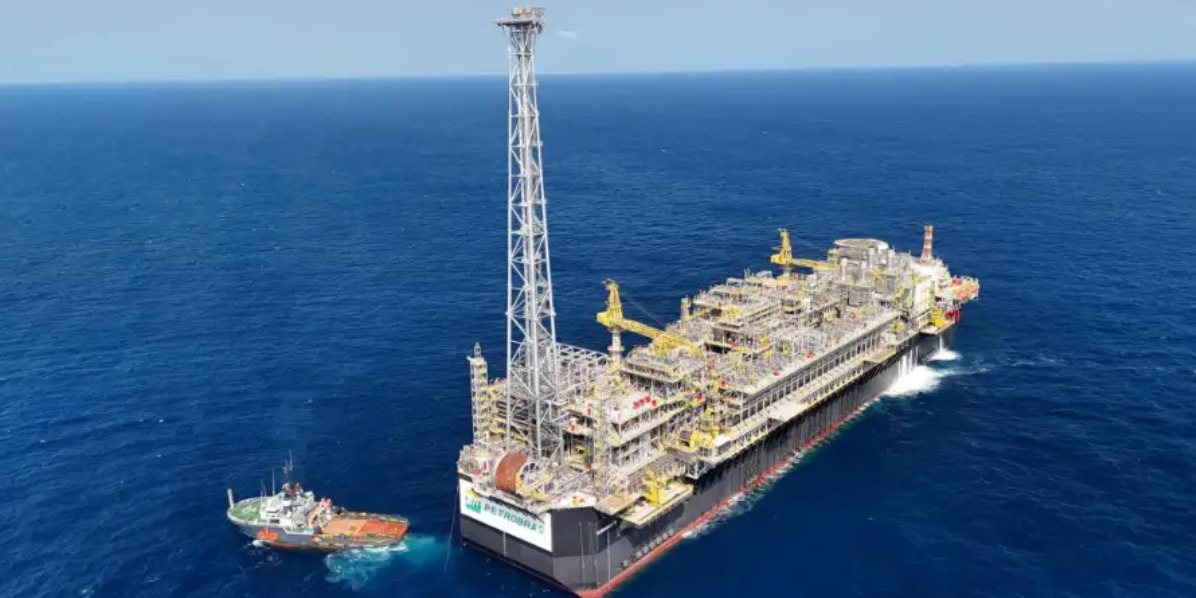
Operationally, this was Petrobras' strongest quarter yet. Total own production rose 11.7% YoY and 5.3% QoQ to a record 3.51 million barrels of oil equivalent per day (MMboed) (3Q25: 3.14 MMboed). This was driven by strong production efficiency and the ramp-up of new FPSOs at Búzios and Mero. Management now expects 2026 output of 3.3 to 3.4 MMboed, well above its earlier 3.1 MMboed guidance.
That said, the extra barrels did not fully offset softer oil prices. Brent averaged USD 97.00/bbl (2Q26: USD 104.52/bbl; 3Q25: USD 69.07/bbl), so revenue eased 1.9% QoQ to USD 33.0 billion, although it was still 40.4% higher YoY. Adjusted EBITDA rose 42.4% YoY to USD 16.7 billion, with the margin edging up to 51% from 50%. The modest margin gain, despite Brent price rising 40.4% YoY, reflects higher production taxes and the new export tax. Net income attributable to shareholders rose 28.4% YoY to USD 7.7 billion (3Q25: USD 6.0 billion).
Building on this, unit production costs kept falling. Base lifting cost (excluding government take and leases) dropped to USD 6.12/boe (2Q26: USD 6.33/boe), as pre-salt, Petrobras’ lowest-cost production, rose to 85% of Brazilian output. Pre-salt lifting cost held broadly steady at USD 4.48/boe (2Q26: USD 4.45/boe). Do note this was achieved despite BRL strength, which added about USD 0.5/boe to lifting cost.
On the cyclical side, all-in lifting cost (including production taxes and leases) eased to USD 23.36/boe from USD 26.56/boe. Lower Brent price cut production taxes to USD 4.1 billion (2Q26: USD 4.6 billion), although all-in lifting cost remains well above FY25’s USD 20.65/boe. This is the double-edged sword we have flagged before: government take moves with Brent price, while base lifting cost is what management controls.
Looking ahead, we expect this mix shift to continue. The P-80, P-82 and P-83 FPSOs, each with 225,000 barrels per day of capacity, are all destined for the pre-salt Búzios field and due to start up in 2027. Crucially for bondholders, a falling cost base is Petrobras' best buffer against both oil prices and politics.
Strong cash generation and ample liquidity keep refinancing needs light
Operating cash flow (OCF) came in at USD 12.0 billion (+22.0% YoY) despite USD 2.5 billion absorbed by working capital. This included a USD 1.7 billion increase in receivables, partly from amounts owed by the Brazilian government under its fuel subsidy programme. As bondholders, we read this as part of Petrobras’ cash generation being dependent on the government paying on time, which is manageable for now.
After cash capital expenditure (capex) of USD 5.4 billion, free cash flow (FCF) rose 33.2% YoY to USD 6.6 billion (2Q26: USD 7.7 billion). This comfortably covered USD 2.7 billion of FPSO lease payments, USD 580 million of interest and USD 1.6 billion of dividends. Petrobras also repaid USD 1.5 billion of debt, including USD 1.2 billion of international bonds, while raising USD 1.2 billion from banks. This left a net repayment of USD 0.3 billion, with most of the remaining FCF added to cash.
As a result, total liquidity (cash, deposits and short-term investable securities) rose to USD 12.1 billion, of which USD 6.9 billion is cash and cash equivalents. This compares with just USD 1.3 billion in financial debt due within twelve months. Petrobras’ debt carries a weighted average maturity of 11.8 years at an average cost of 6.7%.
Management raised 2026 OCF guidance to USD 45 billion to USD 50 billion (from USD 35 billion), and cash capex guidance to USD 21 billion to USD 22 billion (from USD 16.9 billion). Management cites faster execution and currency effects, rather than cost overruns. Against USD 14.5 billion spent in 9M26, this implies 4Q26 cash capex of roughly USD 6.5 billion to USD 7.5 billion. Moving forward, we expect FCF to moderate in 4Q26 but stay positive.
With liquidity well above near-term maturities, we see limited refinancing need in the next twelve months, and any new issuance would be opportunistic.
Leverage and coverage improved again, with the oil windfall used to repay debt
Gross debt (financial debt plus leases) eased to USD 70.0 billion (30 June 2026: USD 70.8 billion), of which USD 44.3 billion is finance leases backed by productive FPSOs. Net debt (gross debt less total liquidity) fell to USD 57.8 billion. As a result, net debt/LTM EBITDA (net debt / last twelve months' adjusted EBITDA) improved to 1.0x from 1.4x at end-2025 (see Table 1 below). Debt/capitalisation (gross debt / gross debt plus total equity) fell to 41.8%, while interest coverage (LTM adjusted EBITDA / LTM finance expenses) rose to 13.5x. FCF interest coverage (LTM FCF after mandatory dividends / LTM finance expenses) also improved to 2.8x (30 June 2026: 2.6x).
We would caution that trailing EBITDA still includes the 2Q26 price spike, so these ratios will likely drift back as Brent price normalises. If Brent returns to FY25's average of about USD 69/bbl, net debt/EBITDA would be about 1.4x on FY25's adjusted EBITDA of USD 42.5 billion. With production now over 10% higher, we think around 1.2x to 1.3x is more realistic. By our estimates, the ratio would only move above mid-1x if Brent fell towards USD 55/bbl to USD 60/bbl, especially if heavy capex pushes net debt higher. That said, Petrobras used the windfall to repay debt rather than add to it, with financial debt down to USD 25.6 billion. Importantly for bondholders, this leaves a comfortable buffer even if oil prices retreat.
Table 1: Leverage and coverage have improved since end-2025
|
Metrics |
Dec '23 |
Dec '24 |
Dec '25 |
Jun '26 |
Sep '26 |
|
Gross debt (USD billion) |
62.6 |
60.3 |
69.8 |
70.8 |
70.0 |
|
Cash (USD billion) |
17.9 |
8.1 |
9.2 |
10.4 |
12.1 |
|
Net debt / LTM EBITDA (x) |
0.9 |
1.3 |
1.4 |
1.1 |
1.0 |
|
Debt / capitalisation (%) |
44.2% |
50.4% |
47.9% |
43.2% |
41.8% |
|
LTM EBITDA interest coverage (x) |
23.2 |
6.8 |
9.9 |
12.3 |
13.5 |
|
Free cash flow (after mandatory dividends) interest coverage (x) |
7.5 |
2.2 |
2.1 |
2.6 |
2.8 |
|
*LTM free cash flow after mandatory dividends (45% of free cash flow) divided by LTM finance expenses. Data as of 30 September 2026. Source: Company data, Bloomberg, iFAST compilations. |
|||||
Recommendations
We maintain our view that Petrobras' credit profile is decent and improving. Lula's re-election extends a familiar pattern of state intervention, but Petrobras meets it from a position of strength, with record production and falling unit costs. Net debt/EBITDA of 1.0x and interest coverage of 13.5x anchor its credit standing. While Brazilian government’s hand on fuel prices remains the key credit watch, we expect Petrobras to keep generating ample cash to service its debt.
Table 2: Petrobras USD bonds
|
Issue |
Issuer* |
Ask Price |
Yield to Worst / Yield to Next Call |
Years to Maturity / Years to Next Call |
Z-spread (bp) |
|
Petrobras Global Finance B.V. |
95.65 |
6.43% / 6.46% |
3.80 / 3.71 |
196.6 |
|
|
Petrobras Global Finance B.V. |
96.93 |
6.46% / 6.51% |
4.11 / 3.86 |
199.7 |
|
|
Petrobras Global Finance B.V. |
98.56 |
6.77% / 6.78% |
6.61 / 6.36 |
231.0 |
|
PETBRA 6.000% 13Jan2035 Corp (USD) available on BSM |
Petrobras Global Finance B.V. |
94.90 |
6.83% / 6.85% |
8.14 / 7.89 |
235.1 |
|
*Bonds are issued by the financing arm of Petrobras and are guaranteed by the parent group. Data as of 23 November 2026. Source: Bloomberg, Bondsupermart, iFAST Compilations. |
|||||
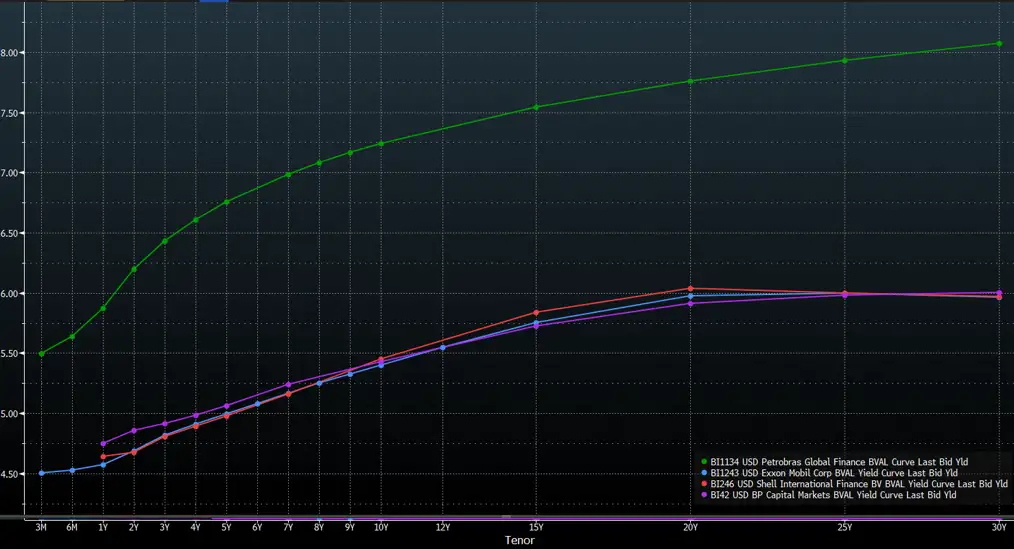
We continue to find value in Petrobras' USD bonds, as seen in Table 2 above. The 2030 to 2035 issues offer yields to worst of 6.43% to 6.83% over tenors of 3+ to 8+ years, at Z-spreads of 196bp to 235bp. As seen in Chart 1 below, compared with higher-rated oil majors such as Shell, Exxon and BP, these issues offer a yield pickup of 130+bp to 150+bp at similar tenors.
Do note that Petrobras yields more for a reason, given a difference in credit rating. Additionally, its credit cannot fully separate itself from Brazil's fiscal position. That said, we think the spread more than compensates, given Petrobras' low-cost barrels and falling leverage.
We continue to highlight the 2030 and 2033 issues. The former offers a Z-spread of 196bp for investors who prefer a shorter tenor, while the latter offers 231bp for attractive income over an intermediate horizon. Investors comfortable with the political noise that comes with a state-controlled issuer can consider these bonds for a compelling risk-reward.
PETBRA 6.000% 13Jan2035 Corp (USD) is available in bondsupermart live, which allows a minimum transaction of USD 1000 with increments of USD 1000.
Chart 1: Peer comparison
Data as of 23 November 2026.
Source: Bloomberg, iFAST Compilation.
Glossary
bbl (barrel): standard unit of volume for crude oil and petroleum products
boe: barrel of oil equivalent; the amount of energy contained in a single 42-gallon barrel of crude oil
FPSO (floating production, storage and offloading): a floating facility used by the offshore industry to process, store and transfer hydrocarbons produced from nearby wells
MMboed (million barrels of oil equivalent per day): standard metric for reporting daily production volumes for companies with a mix of oil and gas assets
Import-price parity: a fuel pricing approach in which domestic prices track the cost of importing fuel at international prices
Special participation: an additional Brazilian government levy on high-volume or highly profitable fields, calculated on net production revenue and therefore sensitive to the oil price
Declaration: For specific disclosure, at the time of publication of this report, IFPL (via its connected and associated entities) holds a position in PETBRA 6.000% 13Jan2035 Corp (USD), and the analyst who produced this report holds NIL positions in the abovementioned securities. This research report was prepared with the assistance of artificial intelligence (AI) tools. iFAST Financial Pte Ltd does not rely exclusively on AI for content generation; the content of this report – including all investment theses, ratings, price targets and conclusions – has been independently reviewed and verified by the research analyst(s) to ensure accuracy and professional integrity.