


Key Points
• FY2025 operating performance remained resilient, with revenue rising 7.7% YoY to ¥7.8T and gross profit increasing to ¥4.0T. The group’s operating businesses continue to generate recurring cash flows and dividend income, providing a stable source of liquidity which partially offsets the volatility inherent in the group’s investment portfolio.
About SoftBank Group
FY2025 Results: Stable operating businesses complement strong investment gains
For the financial year ending 31 March 2026 (FY2025), SoftBank reported a 7.7% YoY increase in revenue to ¥7.8T, with gross profit up to ¥4.0T (FY2024: ¥3.8T). This reflects continued contributions from SoftBank Corp’s telecommunications operations, LY Corporation’s internet ecosystem (Line & PayPay), and Arm’s semiconductor IP business.
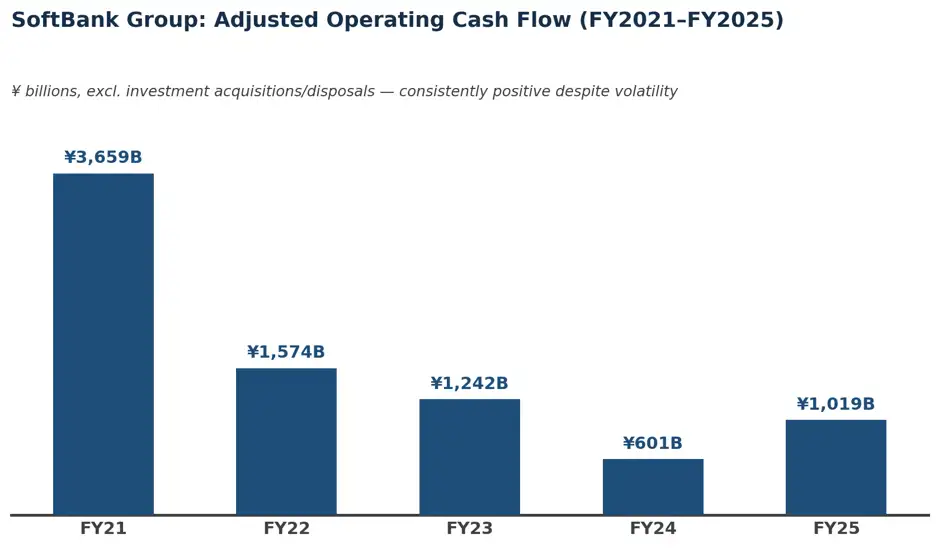
From a credit perspective, the group’s operating subsidiaries remain important contributors to recurring cash generation. Adjusting for investment acquisitions and disposal flows (classified as operating activities under IFRS accounting rules), SoftBank generated an adjusted operating cash flow (OCF) of approximately ¥1.0T for FY2025, continuing its track record of positive cash generation through market cycles (see Chart 1 below). We believe these businesses provide a relatively stable source of cash flow and dividend income that supports the group's liquidity, while partially offsetting the inherent volatility of SoftBank’s investment portfolio.
Nevertheless, the operating businesses were not the primary driver of the sharp increase in FY2025 earnings. Net income attributable to shareholders increased by ~¥3.8T, up 334% YoY, to ¥5.0T compared to FY2024’s ¥1.2T. The improvement was largely driven by investment gains recorded within SoftBank’s Vision Fund II (SVF2). Most notably, OpenAI recorded a valuation gain of ~¥6.5T, which drove SVF2’s total gain on investments to ¥6.8T for the period–OpenAI accounted for roughly 94% of the segment’s entire gain. Excluding OpenAI, net investment gains across the remainder of the portfolio amounted to approximately ¥821B. Gains on Nvidia (+¥339.1B, subsequently fully disposed) and Intel (+¥278.6B, a new acquisition) were largely offset by mark-to-market losses on T-Mobile (-¥656.8B) and Alibaba (-¥169.7B). Within SVF2’s broader portfolio, investments such as Coupang, Didi, Grab and Auto1 also recorded valuation losses during the year, underscoring that performance outside of OpenAI remained weak across both segments. We note that these losses are non-cash in nature and primarily reflect changes in fair value under IFRS accounting rules, rather than realised losses.
Overall, FY2025 highlights both the strengths and risks of SoftBank’s investment-led business model. While the appreciation of OpenAI significantly boosted earnings and net asset value (NAV), reported profitability remains highly dependent on movements in investment valuations – and in OpenAI’s case, on a private, mark-to-model valuation that has not yet been tested by public markets. This introduces an added layer of uncertainty beyond the volatility already evident in SoftBank’s listed holdings, where AI and technology valuations have shown significant swings even with the benefit of daily price discovery. Looking ahead, we expect the group’s credit profile to be increasingly influenced by developments within its AI portfolio, particularly Arm and OpenAI. Although recurring cash flows from SoftBank Corp., LY Corporation and Arm should continue to provide a stable liquidity foundation, we believe asset coverage, liquidity, and loan-to-value (LTV) metrics remain the most important indicators of credit quality.
Chart 1: Historical adjusted OCF have been positive over the past 5 years
Source: Company Data, iFAST Compilations, as of 31 March 2026.
Investment Portfolio remains the foundation of SoftBank
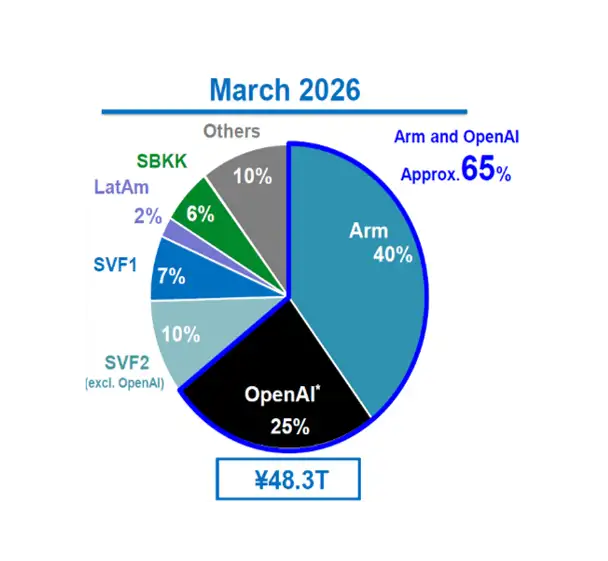
SoftBank Group’s investment portfolio remains the primary pillar underpinning its credit profile. As of 31 March 2026 (FY2025), the adjusted equity value of its holdings stood at ¥48.3T; approximately 53% of these holdings (¥25.6T) comprised publicly listed and market-observable assets, while the remaining 47% (¥22.7T) consisted of private, illiquid holdings, most notably OpenAI.
The portfolio has become increasingly concentrated in AI-related stakes. As seen in Chart 2 below, Arm represents the largest holding at approximately 40% of adjusted equity value, followed by OpenAI at 25%. Other listed and unlisted investments account for roughly 10% of the portfolio, while SoftBank Vision Fund 1 (SVF1) and SBKK contribute 7% and 6%, respectively. While this positioning provides significant exposure to long-term AI growth, it also increases dependence on a single investment theme, making portfolio valuations more sensitive to developments within the AI ecosystem.
Chart 2: Current breakdown of holdings as of 31 March 2026
 Source: SoftBank Group’s investor presentation, iFAST Compilations, as of 31 March 2026.
A History of Bold Bets — Hits and Misses
As of 31 March 2026, Arm and OpenAI represented approximately 40% and 25% of adjusted equity value, respectively, making them the two most important drivers of SoftBank’s NAV and credit profile.
Arm is a leading semiconductor intellectual property company whose chip architecture underpins most smartphones globally and is increasingly being adopted in AI servers and data centres. SoftBank’s cumulative investment cost is approximately US$32b, against a current market value of approximately US$390+b (as of 23 June 2026), reflecting the substantial unrealised appreciation that has made Arm the group’s largest single holding. However, SoftBank’s approximately 90% ownership stake limits immediate monetisation flexibility, as any large-scale disposal would likely need to be executed gradually.
OpenAI is the developer of ChatGPT and one of the leading companies in generative AI. SoftBank’s cumulative investment cost in OpenAI stood at US$34.6b as of March 2026, against an estimated fair value of US$79.6b, representing an unrealised gain of US$45b. Following the US$30b follow-on investment committed in February 2026, SoftBank’s total cumulative investment cost will reach US$64.6b upon completion of all tranches by October 2026. While OpenAI continues to demonstrate strong commercial momentum, the investment remains privately held and therefore lacks the liquidity and valuation transparency associated with listed securities.
Outlook
The principal risk remains a deterioration in AI-related valuations before these catalysts materialise. Given the growing concentration of the portfolio in Arm and OpenAI, a significant correction in AI sentiment could weaken NAV, reduce financing flexibility, and place upward pressure on leverage metrics.
Manageable liquidity position against near-term obligations, underpinned by substantial but less liquid asset coverage
As of 31 March 2026 (FY2025), SoftBank holds ¥5.4T in cash and equivalents, supplemented by approximately ¥0.8T of undrawn committed credit facilities, resulting in a total available liquidity of roughly ¥6.2T. This compares against the total interest-bearing debt of ¥24.7T, of which ¥7.3T is due within the next twelve months. After the end of its reporting period, SoftBank further tapped the bond market in April and June for roughly ¥820B. Beyond on-balance-sheet liquidity, SoftBank retains significant financial flexibility through its ability to monetise portfolio holdings and utilise secured financings.
Given that SoftBank functions primarily as an investment holding company, the key credit metrics to monitor would be its NAV and LTV. As mentioned earlier, NAV is at a record ¥40.1T, which improves the group’s asset coverage compared to FY2024. However, we stress the inherent sensitivity of this metric to market conditions and portfolio valuations. This is especially relevant today, given the growing concentration of NAV in Arm and OpenAI, whose valuations are closely tied to sentiment surrounding AI and technology markets.
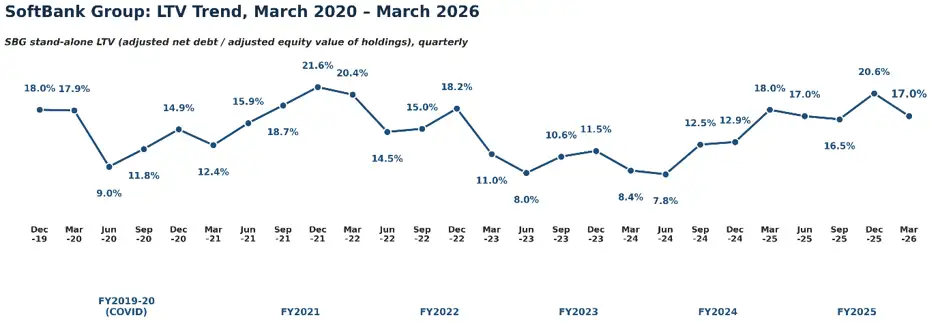
LTV (net debt/equity value of holdings) improved modestly to 17% as of FY2025, compared to 18% a year prior. We note this metric is comfortably below management’s internal target of 25% and 35% ceiling. Per our estimate, a severe increase to 35% LTV would require an approximate 79% decline in the combined value of both holdings (assuming debt levels remain unchanged)— a scenario consistent with a broad-based AI valuation collapse rather than an idiosyncratic issue at either company. Importantly, SoftBank has demonstrated a consistent commitment to maintaining LTV within these parameters across multiple market cycles (look at Chart 3 below). During periods of market stress, including the COVID-19 pandemic and the subsequent technology sector correction, management actively reduced leverage through asset disposals, prepaid forward transactions, share-backed financings and debt reduction measures to preserve balance sheet flexibility. As a result, LTV has generally remained within management’s stated risk appetite despite significant fluctuations in portfolio valuations over the past five years. Although current LTV headroom remains comfortable, its resilience is increasingly tied to two assets: Arm and OpenAI. As OpenAI lacks independent market pricing, a correlated decline in AI valuations across both holdings would pose a more meaningful risk to NAV and LTV.
This balance sheet capacity, together with SoftBank's willingness to monetise assets when required, has historically been an important support for the credit profile. However, this mitigant is increasingly constrained by the limited liquidity of its largest holdings: Arm's roughly 90% SoftBank ownership limits disposal flexibility without market impact, while OpenAI's private, pre-IPO status materially limits monetisation flexibility absent a listing or strategic transaction. As the portfolio shifts further toward these two concentrated, less liquid positions, asset coverage and LTV sensitivity should increasingly anchor the credit assessment, even as the historical track record shown in Chart 3 supports management's demonstrated discipline in defending its stated risk appetite.
Chart 3: Historical LTV since 2020 has been within management’s internal target of <25%
Source: Company Data, iFAST Compilations, as of 31 March 2026.
Table 1: Bond recommendations
|
Issue |
Issuer |
Ask Price |
Yield to Worst (%) |
Years to Maturity |
Credit Rating (S&P / Moody’s / Fitch Rating) |
|
Softbank Group Corp |
99.83 |
5.27% |
1.23 |
BB+ / - / - |
|
|
Softbank Group Corp |
98.17 |
5.60% |
2.03 |
BB+ / - / - |
|
|
Softbank Group Corp |
101.03 |
6.34% |
3.04 |
BB+ / - / - |
|
|
Softbank Group Corp |
104.23 |
7.24% |
5.33 |
BB+ / - / - |
|
|
Softbank Group Corp |
99.49 |
7.36% |
6.04 |
BB+ / - / - |
|
|
Softbank Group Corp |
103.15 |
7.01% |
9.04 |
BB+ / - / - |
|
|
Softbank Group Corp |
104.94 |
7.76% |
9.83 |
BB+ / - / - |
|
|
Data as of 26 June 2026. Source: Bloomberg, Bondsupermart, iFAST Compilations. Do note these bonds are issued by the group SOFTBK, not the telecommunication subsidiary SOBKCO. |
|||||
Overall, we see modest improvement in SoftBank’s credit profile as of 31 March 2026 compared to a year ago. NAV reached a record high of ¥40.1T, while LTV improved slightly to 17%, reflecting the strong appreciation of Arm and OpenAI. Liquidity remains adequate, supported by ¥5.4T of cash and equivalents, available credit facilities and the group’s proven ability to monetise assets when required.
Looking ahead, we expect SoftBank's credit profile to face increasing pressure from its AI investment strategy. Significant commitments to OpenAI and related AI infrastructure are likely to consume liquidity and increase leverage, while NAV becomes increasingly concentrated in Arm and OpenAI. Although both are beneficiaries of AI, their growing importance may reduce monetisation flexibility relative to historical anchor holdings. Consequently, while the balance sheet remains well supported today, future credit quality will become increasingly dependent on the performance and valuation of a small number of AI-related assets.
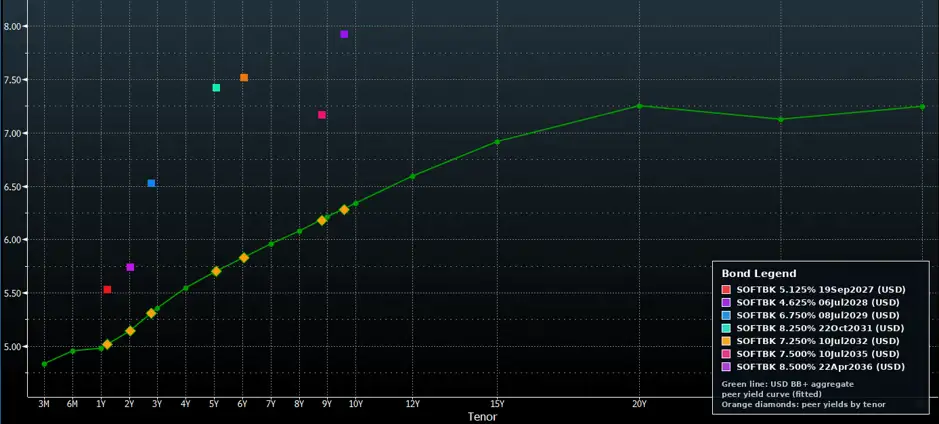
In Table 1 above, we highlight a couple of SoftBank’s outstanding USD bonds for consideration. In general, these bonds offer a yield pickup of approximately 50+ to 140+bps against comparable peers as seen in the Bloomberg chart below.
For investors comfortable with the concentration risk SoftBank has in AI, we think the two issues of SOFTBK 8.250% 22Oct2031 Corp (USD) and SOFTBK 7.250% 10Jul2032 Corp (USD) stand out. In general, they offer the highest yield pickup (~140+bps) against their peers, while also offering a compelling 250+bps yield spread over comparable US sovereigns.
Declaration: For specific disclosure, at the time of publication of this report, IFPL (via its connected and associated entities) holds NIL positions. The analyst who produced this report hold NIL positions in the abovementioned securities. This research report was prepared with the assistance of artificial intelligence (AI) tools. iFAST Financial Pte Ltd does not rely exclusively on AI for content generation; the content of this report – including all investment theses, ratings, price targets and conclusions – has been independently reviewed and verified by the research analyst(s) to ensure accuracy and professional integrity.