SpaceX (stock code: SPCX) announced its Q3 2026 results in October, with significant progress in both its Starlink and AI businesses. In our Q2 update, we noted that while the group held substantial cash reserves, the impact of capital expenditures and equipment financing on bondholders could not be ignored. The return to profitability in Q3 improved our outlook; however, with the announcement of a new round of GPU financing commitments and expansion plans, we will now break it down.
SpaceX's revenue and operating profit both increased, with Starlink remaining dominance
In the third quarter of 2026, SpaceX's revenue surged 161.4% YoY to USD 14.6 billion. Operating profit turned from a loss of USD 270 million in the same period last year to a profit of USD 2.8 billion, with an operating profit margin of 19.1%. Net profit also turned positive to USD 4.4 billion, although this included USD 560 million in unrealized gains from its investment in The Boring Company and USD 390 million in net tax benefits. We believe that the turnaround to profitability is a substantial improvement, but these non-core factors must be considered separately when assessing the sustainability of profitability.
The Connectivity segment, to which Starlink belongs, saw revenue increase 69.5% YoY to USD 5.3 billion, and operating profit increase 98.9% to USD 2.4 billion, contributing approximately 85% of the group's operating profit. Starlink consumer subscriptions rose to 13.6 million at the end of the quarter, an increase of 1.6 million from the previous quarter; average revenue per user (ARPU) also rebounded to $69 from $66, reflecting an improved user mix. However, ARPU remained lower than $83 in the same period last year, and management also pointed out that the gross margin this quarter was supported by a one-time tariff refund, and the profit margin should not be directly extrapolated.
Regarding launch services, Space segment revenue increased by 6.1% YoY to USD 1.8 billion, and operating loss narrowed to USD 7 million from USD 540 million in the second quarter. Starship successfully deployed 26 V3 Starlink satellites during the quarter, helping to increase network capacity; however, internal Starlink launches do not recognize inter-segment revenue, and their credit value mainly lies in supporting Starlink expansion and reducing future deployment costs. The launch business still needs to bear Starship's R&D expenses.
AI Business Begins to Monetize, Revenue Concentration and Contract Terms Still Require Attention
The artificial intelligence business, now renamed Super Intelligence (hereinafter referred to as "AI"), achieved revenue of USD 7.6 billion in the third quarter, a significant increase from USD 810 million in the same period last year and nearly double that of the second quarter. Operating profit turned from a loss of USD 1.3 billion in the previous quarter to a profit of USD 430 million. The growth mainly came from newly launched cloud computing power contracts. The AI programming platform Cursor, acquired on August 14, also contributed USD 610 million in revenue during the quarter, but only accounted for about 8% of SI's revenue, indicating that growth was not solely driven by acquisitions.
It is worth noting that AI's adjusted EBITDA exceeded USD 4.9 billion, far exceeding operating profit, mainly due to the reversal of USD 2.5 billion in depreciation and amortization and USD 2.0 billion in share-based payment expenses. Share-based payments do not directly consume current cash, but computing equipment still requires updates and maintenance; therefore, when assessing solvency, the focus should continue to be on cash flow after deducting capital expenditures.
The stability of revenue also warrants close examination. A single AI customer accounted for 34.5% of the Group's revenue in the third quarter. The quarterly report disclosed that cloud service contracts are typically for three years, but both parties can generally terminate them with 90 days' notice. The Group's order backlog reached USD 62.96 billion, with approximately 67% expected to generate revenue within one year, supporting short-term business. However, the revenue recognition timeline does not equate to cash received, and the termination clauses of individual contracts cannot be ignored. We believe that the commercialization of computing power has yielded results, but it remains to be seen whether customer renewals, payments, and pricing can be sustained.
SpaceX's cash reserves remain ample, but free cash flow has not yet turned positive
The Group's operating cash flow in the third quarter was approximately USD 9.6 billion, while expenditures on the purchase of property, plant, and equipment reached USD 19.59 billion, of which AI accounted for approximately 84%. Calculated by subtracting the above expenditures from operating cash flow, the free cash flow for the quarter was still an outflow of over USD 9.9 billion, with a total outflow of USD 35.0 billion in the first three quarters. AI-related capital expenditures surged nearly tenfold from USD 4.2 billion in the same period last year to USD 40 billion, used to expand computing facilities (see Chart 1). The coverage ratio of operating cash flow to capital expenditures improved significantly, rising from about 12% in the first half of the year to about 49% in the third quarter, but the investment gap remains large.
Chart 1: SpaceX YTD Capex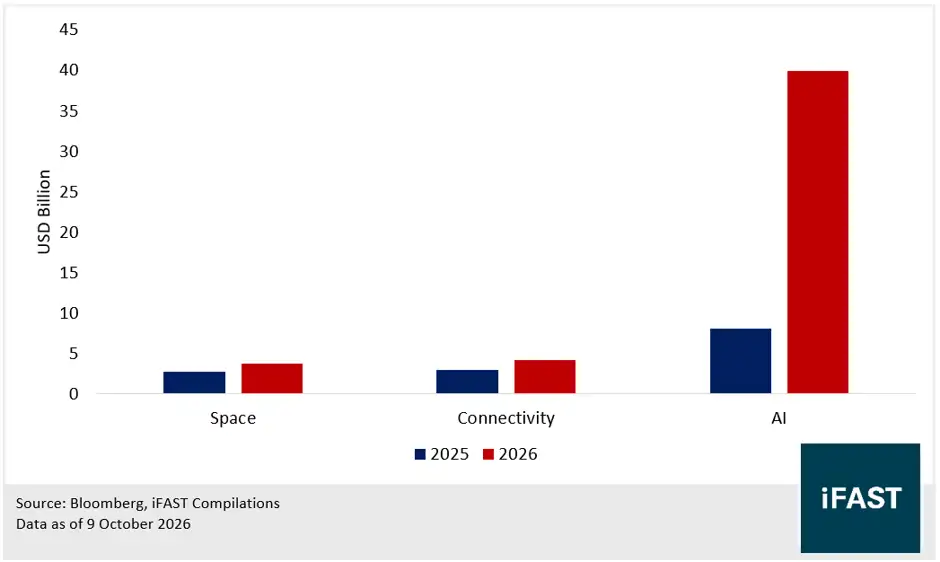
In terms of liquidity, as of the end of September, cash, cash equivalents, and short-term marketable securities totaled USD 89.86 billion, a decrease of 10.2% compared to the end of June. During the period, some cash was reinvested in short-term marketable securities; therefore, both should be considered together. The Group's principal debt plus finance leases amounted to USD 39.0 billion, remaining in a net cash position of approximately USD 50.9 billion. An additional USD 5 billion of unused revolving credit facility was also available. Compared to USD 2.7 billion of debt and finance leases maturing within the next year, the Group has a sufficient short-term repayment buffer (see Table 1).
Table 1: SpaceX Credit Metrics
|
USD Billion |
2026 Q2 |
2026 Q3 |
|
Cash Reserve |
10.0 |
9.0 |
|
Short Term debt |
2.5 |
2.7 |
|
Net Cash |
60.5 |
50.9 |
|
Operating Cash Flow |
2.4 |
9.6 |
|
EBITDA (YTD) |
5.1 (2025) |
13.5 (2026) |
|
Data Source: Company's Report, iFAST compilations Data As Of 30 September 2026 |
||
SpaceX's $40 billion GPU financing adds flexibility but will become a fixed cash outflow
Following its earnings release, SpaceX announced on October 26th that it had secured binding commitments for approximately USD 40 billion in financing leases of GPUs and related equipment. The equipment, including NVIDIA's next-generation Vera Rubin chips, will be provided by an entity managed by Apollo. The arrangement is expected to be completed by the end of the year, with leases commencing in the first half of 2027 upon equipment delivery, subject to closing conditions. While this financing helps alleviate the financial pressure of equipment acquisition, subsequent rental payments will constitute a fixed cash outflow.
According to the disclosed terms, each batch of equipment will be leased for approximately five to five and a half years. Quarterly prepayments typically include one-twentieth of the equipment financing cost, plus interest and related fees. Roughly estimating based on the full lease commencement of the USD 40 billion equipment, annual principal payments will be approximately USD 8 billion, plus interest and fees; actual payments will depend on delivery and lease commencement arrangements.
Fitch subsequently stated that the arrangement is consistent with its original rating assumptions, and its BBB+ rating remains unaffected. However, from a creditor's perspective, the difference between cloud revenue contracts with a 90-day notice period and multi-year equipment payment obligations still warrants attention. The Group's existing USD 13.0 billion in "other financing" is largely secured by specific machinery and equipment and is already included in the aforementioned total debt; the relevant mortgagees have priority protection over the mortgaged assets, and unsecured bond investors should also be aware of the scale of such arrangements.
Bond Investments
SpaceX's public issuer ratings are Moody's Baa1, S&P BBB, and Fitch BBB+, all investment grade. Improved operations in the third quarter and substantial liquid assets support existing USD bonds (see Table 2); however, future capital expenditures, equipment payments, and AI customer concentration are concerns. Therefore, we believe investors should carefully weigh the coupon return against the aforementioned risks and decide on investments based on their own maturity tolerance, rating restrictions, and liquidity needs.
Table 2: SpaceX USD Bonds
Bond | Tenor | Net Ask YTM |
4.7 | 7.0% | |
6.7 | 7.2% | |
9.7 | 7.5% | |
19.7 | 8.0% | |
29.7 | 7.8% | |
Data Source: Bondsupermart Data As Of 5 November 2026 | ||
Related Risks
AI Demand and Pricing Risks: Customer concentration and early termination clauses may cause revenue to decline faster than the rate of decrease in equipment payment obligations; GPU upgrades may also increase ongoing investment needs.
Expansion and Execution Risks: The Q4 capital expenditure guidance has been significantly increased. Delays in Starship mass production, power supply, and data centre construction may postpone revenue realization and widen the funding gap.
Corporate Transaction Risks: The quarterly report disclosed on October 22nd revealed that SpaceX and Tesla have each established special committees to assess a potential merger, but no decision has been made, or a definitive transaction has been reached. If the merger proceeds in the future, the impact on bondholders will need to be reassessed based on the pricing, financing, and debt arrangements.
Declaration: For specific disclosure, at the time of publication of this report, IFPL (via its connected and associated entities) and the analyst who produced this report hold NIL positions in the abovementioned securities. This research report was prepared with the assistance of artificial intelligence (AI) tools. iFAST Financial Pte Ltd does not rely exclusively on AI for content generation; the content of this report – including all investment theses, ratings, price targets and conclusions – has been independently reviewed and verified by the research analyst(s) to ensure accuracy and professional integrity.
RISK DISCLOSURE STATEMENTS FOR BONDS
Key risks of investing in bond
|
Key risks of investing in high-yield bonds
|
| Bonds with special features Some bonds may contain special features and risks that warrant special attention. These include bonds:
|
Remarks
|