Receive first-hand news on the latest bond issues, credit updates and special events when you join us on our Telegram channel at https://t.me/bondsupermart!
Highlights:
- Given by ongoing shortage of semiconductor chips, Jaguar Land Rover's total sales number for 1HFY23 declined by roughly 20%. The company moves very slowly on electrification, with a low portion in electric vehicles, and further operational results may continue to be weak.
- In terms of credit profile. The moderate leverage and relatively small amount of outstanding borrowings suggest a low pressure from debt repayment.
- Investors could give consideration to bond due in 2025, which is yielding approximately 10% with manageable investment risk. It’s a good choice from Europe high yield market.
Yield to maturity for bonds issued by Jaguar Land Rover used to trade at around 5%, but now it doubles for bond due in 2025, which is becoming more attractive.
Operation Performance Deteriorates
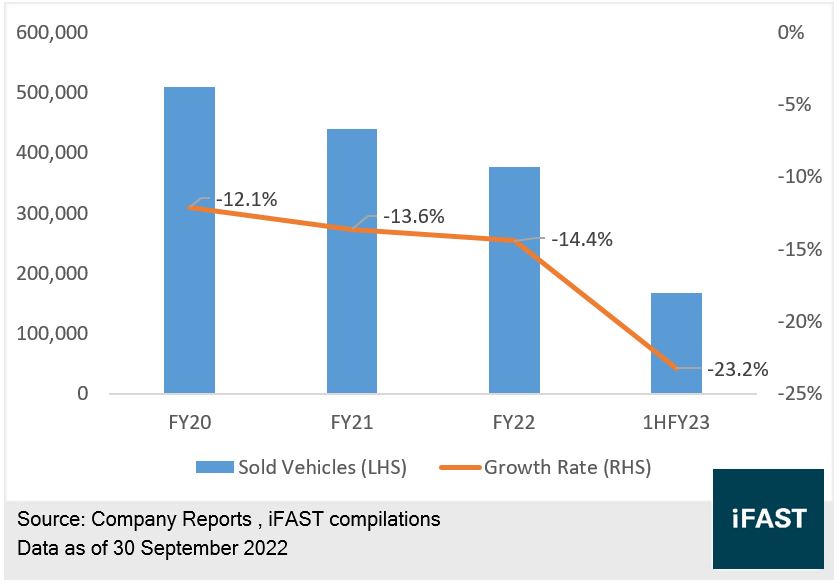
Owing to the shortage of semiconductor chips, the total number of sold vehicles in FY22 (from April 2021 to March 2022) stood at 376,000, down 14.4% YoY (Chart 1). Sales in the first half of FY23 marked a 23.2% slump to 167,000 as the shortage of semiconductor chips persists.
Chart 1: Sold Vehicles by Jaguar Land Rover
Subpar vehicle sales weighed on Jaguar Land Rover’s operating results (Table 1). The company's revenue and EBITDA for FY22 were GBP 18.3 billion and GBP 1.9 billion respectively, down to varying degrees from FY21, resulting in a net loss of approximately GBP 800 million. In 1HFY23, revenue rose by 10.2% YoY to GBP 9.7 billion, but the net loss still stood at GBP 580 million owing to high production cost.
Table 1: Operation Results of Jaguar Land Rover
|
Billion GBP |
FY20 |
FY21 |
FY22 |
1HFY23 |
|
Revenue |
23.0 |
19.7 |
18.3 |
9.7 |
|
EBITDA |
2.1 |
2.5 |
1.9 |
0.8 |
|
Net Income |
-0.5 |
-1.1 |
-0.8 |
-0.6 |
|
Source: Company
reports, iFAST compilations |
||||
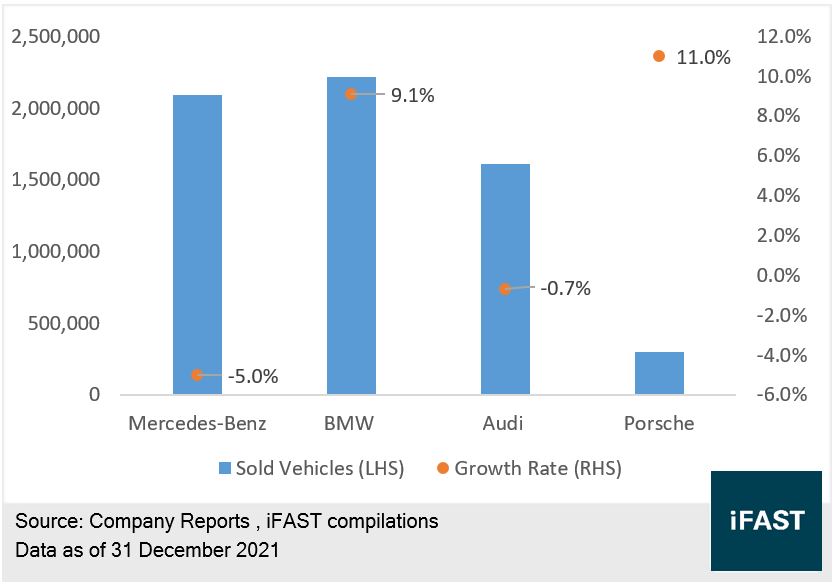
We find that the global chip shortage is a fact, while other European luxury vehicle manufacturers are not significantly affected (Chart 2), with Mercedes-Benz's 2021 sales dropping by just 5% and BMW and Porsche even managing to maintain growth. The shortage of chips is not the main reason for the decline in sales of Jaguar Land Rover.
Chart 2: Sales of European Luxury Vehicles Manufacturers in 2021
We witnessed a double-digit drop in sales in FY20 and FY21 when there was no chip shortage. Prior to 2015, the large-size luxury SUV market was dominated by Land Rover, and it could even be said that Land Rover was synonymous with large-size luxury SUV. However, in the past few years, traditional luxury vehicles manufacturers have launched large-size SUV, such as Mercedes-Benz GLS, BMW X7, and Audi Q8. In addition, ultra-luxury vehicles manufacturers also engage in large-size SUV, for example, Rolls-Royce introduced Cullinan and Bentley introduced Bentayga. We thus believe that increasing competition in the industry is one of the main reasons for Jaguar Land Rover's declining sales.
Slow Pace of Electrification
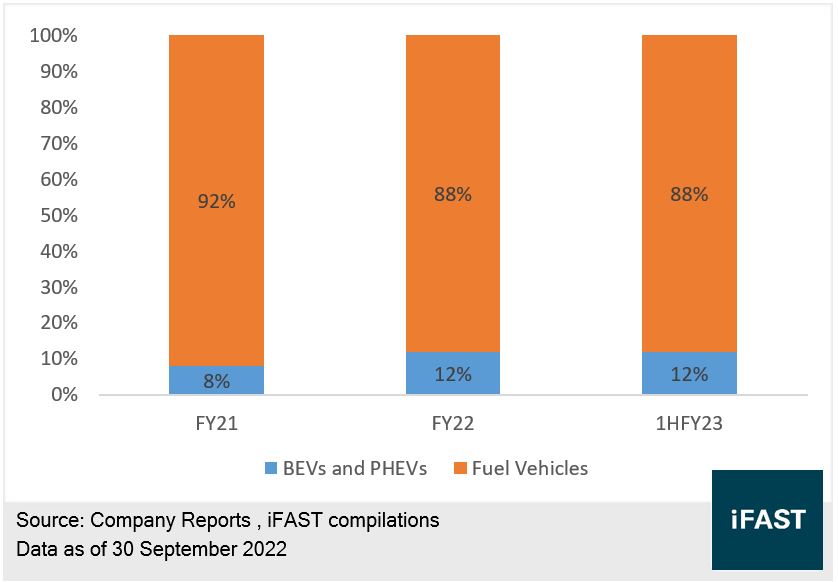
Apart from the impacts of increasing competition, Jaguar Land Rover's slow pace of electrification also drags down the operation performance. The company introduced the first EV Jaguar I-pace in 2018, but has not rolled out any new one since then, as of 1HFY2022, EVs and PHEVs accounted for 12% of total sold vehicles, respectively, leaving the percentage of electrification much lower than the industry average. Considering that Jaguar Land Rover's three major markets, Europe, US, and China, all have strict carbon emission policies, and are expected to phase out traditional vehicles after 2030. It implies that the further sales volume might get weaker if Jaguar Land Rover fails to speed up the electrification.
Chart 3: Sales Breakdown of Jaguar Land Rover
In
summary, the sales performance of Jaguar Land Rover looks unsatisfying as the
result of increasing competition and the slow pace of electrification. We
estimate the operation results to be at an underwhelming level in the future.
Downsizing Investment Amount and Upsizing Cash Balance
Jaguar Land Rover's cash flow from operating moves down along with declining vehicle sales (Table 2), from GBP 2.3 billion in FY20 to GBP 430.0 million in FY22, to GBP -45 million in 1HFY23.
While the company's cash and cash equivalents from FY20 to FY22 were less affected, and even marked increased over the past two years. The main reason for such a contradictory situation is due to the downsizing of cash flow from investing. As the company's operating results are not quite robust in recent years, the senior management significantly reduced the amount of investment, including the purchase of manufacturing equipment and financial assets. The relatively conservative business strategy will dampen the future growth potential on the one hand but it will also enable the company to have more cash reserves, resulting in a stronger risk-resisting capability and solvency.
Table 2: Credit Metrics of Jaguar Land Rover
|
Billion GBP |
FY20 |
FY21 |
FY22 |
1HFY23 |
|
Short-term Borrowing |
0.5 |
1.2 |
1.8 |
1.9 |
|
Cash and Cash Equivalents |
2.3 |
3.8 |
4.2 |
3.7 |
|
Cash to Short-term Debt |
4.3X |
3.1X |
2.4X |
1.9X |
|
Net Gearing Ratio |
46.9% |
45.6% |
62.4% |
67.8% |
|
Total Debt/ EBITDA |
2.5X |
2.4X |
3.7X |
4.5X |
|
Cash Flow from Operating |
2.3 |
2.3 |
0.4 |
-0.05 |
|
Cash Flow from Investing |
-3.2 |
-1.5 |
-0.4 |
-0.5 |
|
Cash Flow from Financing |
0.3 |
0.8 |
0.3 |
-0.4 |
|
Source: Company reports, iFAST compilations |
||||
Credit Remains Decent
Looking into credit indicators, as of 30 September 2022, the net gearing ratio gained from 62.4% in FY22 to 67.8%, concurrently, the total debt/ EBITDA ratio moved up to 4.5x, representing growing leverage. Objectively speaking, Jaguar Land Rover's gearing is still at a reasonable level, and the debt burden is still not considered large. However, given that the company's operating status is unlikely to improve in the near term, we expect the gearing to further rise.
As of 30 September 2022, the total borrowing of Jaguar Land Rover stood at GBP 7.5 billion, of which short-term borrowing amounted to GBP 1.9 billion, translating into roughly 1.9x cash to short-term ratio. Besides, the company has GBP 1.5 billion of undrawn revolving credit facilities that can be used from now to 2024. Overall, the liquidity of Jaguar Land Rover looks adequate.
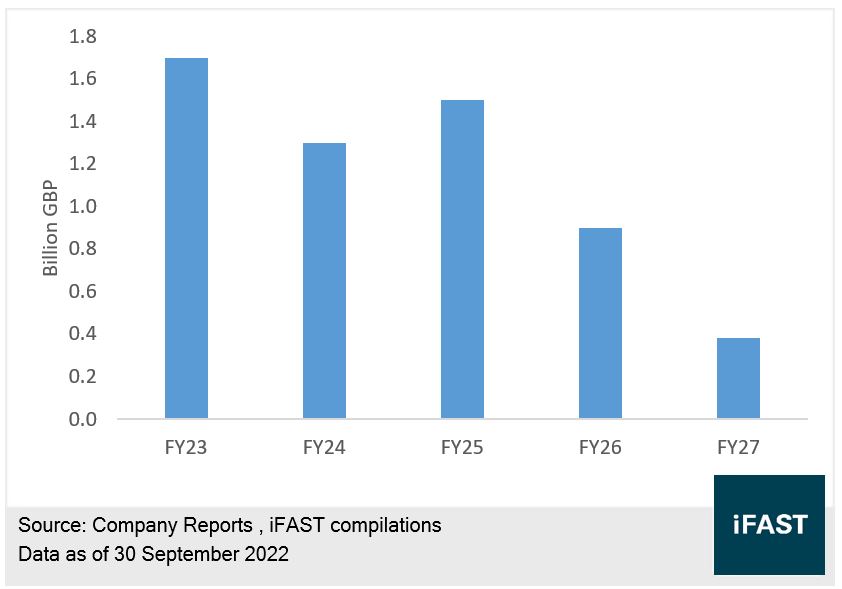
It’s noteworthy that the borrowing structure is somewhat favorable, with the debt maturity profile well spread out (Chart 4), leaving the company ample time for fundraising.
In summary, supported by its strong cash balance and moderate debt amount, Jaguar Land Rover's current credit profile is quite healthy, particularly given the company's conservative business strategy, we expect the cash flow to be sufficient to meet obligations in the coming years.
Chart 4: Debt Maturity Profile of Jaguar Land Rover
Yields and Investment Attractiveness Move Up
In relation to bond investment, there are three USD bonds issued by Jaguar Land Rover on our platform. The bond credit rating is B+ by S&P. The company's credit quality is comparable to some BB-rated peers based on its good credit metrics.
However, as operating results are not quite as good as they could be, and long-term credit quality may turn worse, investors thus can give priority to short-duration bonds, like TTMTIN 7.750% 15Oct2025 Corp (USD), which yielded only 5% at the beginning of the year and has now risen to 10%, making it a more attractive for investment. Looking at bonds issued by European automobile manufacturers, most of them are yielding less than 6%, thus giving Jaguar Land Rover a good alternative to the European high-yield market.
Table 3: Bonds issued by Jaguar Land Rover
|
Bond |
Bond Credit Rating |
Years to Maturity |
Ask Price |
YTM |
|
TTMTIN 7.750% 15Oct2025 Corp (USD) |
B+ (S&P) |
2.9 |
94.4 |
10.1% |
|
TTMTIN 4.500% 01Oct2027 Corp (USD) |
B+ (S&P) |
4.9 |
75.8 |
11.2% |
|
TTMTIN 5.875% 15Jan2028 Corp (USD) |
B+ (S&P) |
5.2 |
76.1 |
12.5% |
|
Source: Bondsupermart Data as of 18 November 2022 |
||||
Corporate Risk
Investors should be mindful of the following risk. Firstly, As the largest consumption market, China contributes over 25% of the total sales of Jaguar Land Rover. But the demand for luxury vehicles in China is expected to fall as China's economy slows down, and Jaguar Land Rover might face a larger downside risk in sales volume.
Furthermore, USD-denominated borrowings constitute a large portion of total debt, both the euro and the British pound have depreciated considerably this year, which has increased the company's debt repayment obligations, and then weakened the credit profile.
Conclusion
Given by ongoing shortage of semiconductor chips, Jaguar land rover's total sales number for 1HFY23 declined by roughly 20%. The company moves very slowly on electrification, with a low portion in electric vehicles, and further operational results may continue to be weak. In terms of credit profile, the moderate leverage and relatively small amount of outstanding borrowings suggest a low pressure from debt repayment. Investors could give consideration to bond due in 2025, which is yielding approximately 10% with manageable investment risk. It’s a good choice from Europe high yield market.
Declaration: For specific disclosure, at the time of publication of this report, IFPL (via its connected and associated entities) and the analyst who produced this report hold a NIL position in the abovementioned securities.
Our podcast series, Yield Hunters, is available on Spotify, iTunes Podcasts and Google Podcasts. We share our thoughts on new bond issues and hold discussions on the fixed income space. Listen to our latest episode below and follow us!