Introduction
Lifestyle International Holdings Limited (‘Lifestyle International’) is a Hong Kong-listed company that operates in the consumer retail sector, managing a number of mid- to upper-end department stores in Hong Kong. The company is best known for operating two SOGO-branded department stores — its flagship outlet in Causeway Bay and another in Tsim Sha Tsui (‘SOGO TST’). Like most department stores, each outlet offers a plenitude of merchandise with significant variety, from daily necessities such as soap and food items, to high-end luxury merchandise like branded leather shoes. The SOGO-branded department stores also offer shoppers a range of personal care services — beauty salons, for instance — in a refined and comfortable setting.
Although the department stores operate under the SOGO banner, the trademark is actually owned by the Sogo & Seibu Company, Limited, with Lifestyle International utilizing the trademark under license. In December 2018, the prevailing licensing agreement was renewed by both parties for a further 20 years. Under the terms of the licensing agreement, Lifestyle International has the sole and exclusive right to operate department stores under the ‘SOGO’ brand in Hong Kong.
Besides its two existing outlets in Causeway Bay and Tsim Sha Tsui, Lifestyle International is developing a new outlet in the East Kowloon area. The development has been baptized ‘Kai Tak Project’, aptly named given its proximity to where Hong Kong International Airport was once located.
Groundbreaking work commenced in end-2017 and construction of twin commercial blocks are currently underway; they are scheduled to be completed in 2022. The development will host a spanking new SOGO-branded department store, which will be joined by an extensive range of entertainment, dining and lifestyle options. According to the company, the Kai Teck Project is poised to become a new landmark in the East Kowloon region, one that will capture the rising purchasing power in the region.
Readers familiar with Hong Kong would have heard that the government is currently undertaking a massive redevelopment project in the area. A complex project spanning a total area in excess of 320 hectares, which encompass the former airport site and the districts of Kowloon City, Wong Tai Sin and Kwun Tong, the redevelopment initiative will provide a conducive living environment for over 100,000 residents. Among the amenities planned, the most notable is the upcoming Kai Tak Station that will form part of the new Shatin-Central Link.
Lifestyle International is a publicly listed company whose shares are traded on the Hong Kong Stock Exchange. It has a market capitalization of approximately HKD 12.0 billion.
Macroeconomic environment
The best managed company can be stifled by a hostile operating environment, and we would be remiss if we failed to discuss the key macroeconomic trends currently shaping Hong Kong’s retail sector. In 2018, China — the world’s second largest economy and the most populous with nearly 1.4 billion people – recorded its slowest rate of economic growth in almost 30 years. Gross domestic product grew by just 6.6%, slightly below the 6.8% registered the year before.
Ostensibly, the ongoing China-US trade dispute put a dampener on business and consumer sentiment, which translated into reduced capital expenditure and lower consumer spending. Retail sales of consumer goods grew by just 9% in 2018, down from the 10.2% increase registered in 2017.
In Hong Kong, where the open nature of the country’s economy renders it particularly vulnerable to the vagaries of the global economy, conditions worsened significantly. The city’s GDP growth for 2018 slowed to 3.0%, a marked deceleration relative to 2017 when GDP expanded by 3.8%. GDP growth dropped below 1.0% this year, coming in at a mere 0.5% for the second quarter.
One bright spot last year was tourism. Tourist arrivals to Hong Kong increased 11.4% to reach 65 million in 2018, driven by the improved accessibility resulting from newly opened infrastructure projects such as the Hong Kong-Zhuhai Macau Bridge and the recently opened high-speed railway line that links Hong Kong to 44 cities in the mainland.
Even though mainland tourist arrivals grew during the period, retail sales failed to keep pace. Hong Kong retail spending rose by only 8.8% YoY in 2018, which market participants attributed to the weaker Chinese yuan. The currency ended 2018 at 1.14 HKD per CNY, down from 1.20 at the start of the year.
Figure 1: the Chinese yuan depreciates
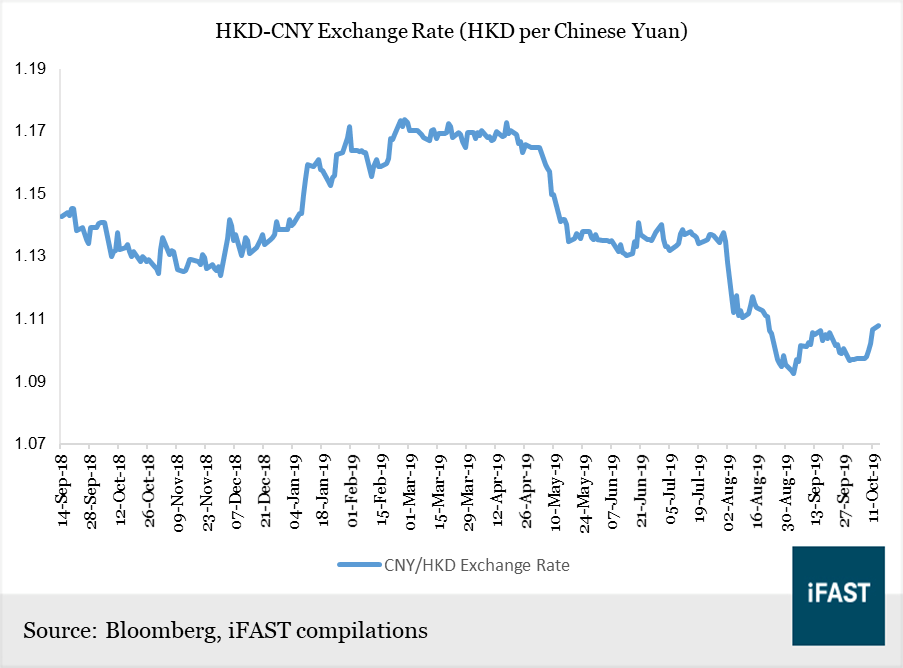
The strength of the Chinese yuan has a direct impact on the fortunes of department stores operated by Lifestyle International. A significant proportion of their shoppers hails from the mainland, and a depressed Chinese yuan cuts into the purchasing power of visiting mainland tourists.
As the Chinese yuan continues to depreciate over the course of the year, retail sales in Hong Kong flounder. For the first half of 2019, retail sales in the territory declined 2.6% YoY, compared to a double-digit increase recorded the year before.
The depreciating Chinese yuan that is the macroeconomic headwind buffeting Lifestyle International is unlikely to dissipate anytime soon. The reader would have heard about the ongoing trade tensions between the US and China — a de-facto trade war that has seen each side levying trade tariffs on the other. As long as trade tensions persist, there is significant incentive for China to retain an accommodative monetary policy to mitigate the damage resulting from the trade war.
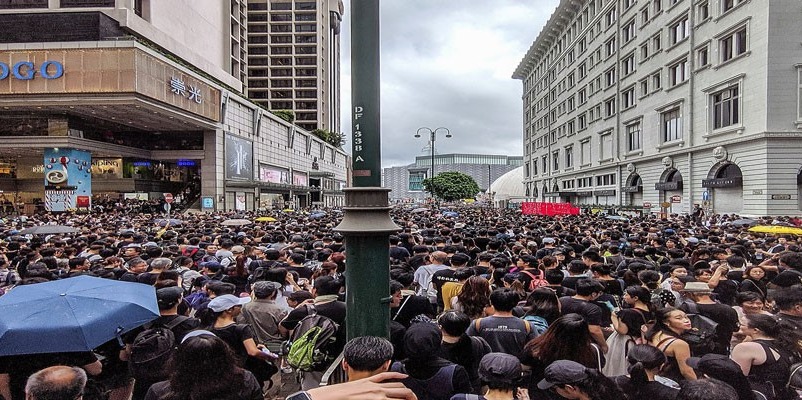
One factor that we would be hard-pressed to categorize as macroeconomic in nature, but is nevertheless relevant and important, is the ongoing street protests in Hong Kong coming under the umbrella of the Anti-Extradition Law Amendment Bill Movement. An in-depth discussion on the nascence and development of this movement is beyond the scope of the article, but given the prevailing political climate, it is entirely within the realms of possibility to see the Chinese government discouraging tourism to Hong Kong. Evidently, this could prove detrimental to the business interests of retailers including Lifestyle International. With the city in the throes of unrest, consumer sentiment is also likely to remain subdued in the near or medium term.
The next factor which we would like to discuss, which we regard as highly pertinent in the context of our discussion on Lifestyle International, is the Hong Kong dollar’s peg against the US dollar. As we will see later in this article, it is the case that Lifestyle International derives — for the most part — its revenue in HKD. A significant part of its liabilities, in particular its bonds, are denominated in USD.
In part motivated by the economic and political upheaval gripping the city, short sellers have targeted the HKD in a big way, with the currency trading around the weak side of the convertibility range. In the long history of the HKD, short sellers have never succeeded in breaking the currency’s peg against the USD. While we offer no view on the chances of the short sellers succeeding this time, bond investors should be mindful of this possibility and the effect that any resulting HKD devaluation might have on the company’s ability to repay its USD bonds.
Financial metrics and operational highlights
Turnover for the first six months of 2019 was HKD 2.10 billion, down 1.8% YoY (1H18: HKD 2.14 billion). Gross profit declined 1.3% to HKD 1.56 billion in the period, bringing the group’s gross profit margin a notch higher to 74.0% (1H18: 73.6%).
The group witnessed a significant decline in interest coverage, which could be traced to stagnant earnings and a surge in the group’s funding costs. Earnings before interest and taxes (‘EBIT’) for the six months ended June was HKD 1.19 billion (without taking into account investment gains/losses and fair value changes on investment properties), flat relative to EBIT recorded in the preceding year of HKD 1.20 billion. Finance costs surged almost 16% from HKD 133.9m in the first half of 2018 to HKD 155.1m for the same period this year, mainly due to the rise in the HIBOR during the period. As a result, the group’s interest coverage — measured by dividing EBIT by finance costs — plunged from 9.0x to 7.7x.
Lifestyle International reported a net profit of HKD 1.29 billion for the first half of 2019, an increase of 44.8% YoY. Bedazzling as the bottom-line number may be, we urge the reader to refrain from drawing quick conclusions.
When we strip out interest and investment gains and the fair value changes on investment properties, we find that adjusted profit before taxation actually declined 3.07% to HKD 1.04 billion (1H18: 1.07 billion). As an indicator of core underlying profitability, we feel that investors should rely on this metric instead of referring to the conventionally defined net profit. This is because fair value changes and investment gains — apart from being mostly non-cash in nature — have little to do with the underlying retail business of Lifestyle International.
It is interesting to note that adjusted profit before tax declined by a greater degree compared to the decline in revenue, which dropped 1.8% YoY. In our opinion, this is another sign that a significant part of the company’s bottom line was buttressed by fair value changes on investment properties and interest and investment gains.
The group saw its liquidity situation deteriorate during the period. A measure of liquidity, the current ratio (current assets over current liabilities) declined from 2.1x at the end of 2018 to 1.9x at the end of June 2019. Current assets incorporate the value of inventories held by Lifestyle International.
The inquiring reader might be curious as to whether it is appropriate for us to take inventories into account in determining the liquidity of Lifestyle International. We think that it is appropriate, due to the nature of its business. As the group is in the retail and merchandise sector, most of its inventory is highly transferable and may be easily sold at short notice, albeit at a discount, in all likelihood. This stands in contrast to inventory held by, say, an auto manufacturer, whose operates in an industry where components might be less fungible.
Inventory management is of particular importance to a retail setup such as Lifestyle International. In particular, inventory turnover can give us vital clues to the underlying health of the business.
Inventory turnover indicates how many times a company has sold and replaced inventory; a high ratio conveys robust sales. A low inventory turnover ratio, on the other hand, might indicate lackluster sales and possible overvaluation of inventory. We have defined inventory turnover as cost of goods sold divided by end-of-period inventory, even though alternative definitions exist.
An associated metric is days inventory outstanding (‘DIO’) — the product of the reciprocal of the inventory turnover ratio and the number of days during a given period. This metric measures the number of days inventory is held before being sold. Generally, we prefer a lower DIO figure.
In this regard, Lifestyle International saw its DIO rise significantly during the period. DIO in 1H19 was around 19 days, a significant increase from about 15 days registered in the corresponding period last year. The group’s inventory turnover ratio declined from 12.3x to 9.2x in the period.
The next aspect that we would like to discuss is Lifestyle International’s gearing, which is an important indicator of solvency. Solvency is a company’s ability to service its long-term obligations. As a brief aside for the benefit of readers unacquainted with the related concepts of solvency and liquidity, both indicate a company’s ability to meet its obligations. Where they differ is that solvency focuses on a company’s ability to deal with its long-term obligations, whereas liquidity looks at the company’s capacity to meet its immediate liquidity needs i.e. short-term obligations.
The go-to measure for solvency is gearing, which we define here as the ratio of total debt (including lease liabilities) over total assets. Gearing for Lifestyle International fell 2.9 percentage points to 75.7% on 30 Jun 19 (31 Dec 18: 78.6%).
The first thing we note is that its gearing is at a high level. Certainly, it is the case that the high gearing is partly due to the fact that Lifestyle International owns its store property in Causeway Bay, which is stated at historical cost less depreciation and amortization, and that its fair value has not been taken into account.
However, we are hesitant to give too much weight to this factor. Property, plant and equipment (‘PPE’) constitute 27% of the group’s total assets, and the majority of PPE comprises of development costs attributable to the Kai Tak Project — construction in progress constituted 69% of PPE at the end of last year. As such, we cannot rely on the above fact to allay our concerns about the group’s gearing.
At this juncture, we would like to provide more details on the group’s debt obligations. As at end-June, Lifestyle International had outstanding bank loans of HKD 11.51 billion and bonds payable of approximately HKD 4.65 billion. The bonds payable comprises a USD 300m note maturing in October 2022 and another USD 300m note maturing in 2025. All the company’s bonds are denominated in USD, making up about 36% of the firm’s non-current debt. Of the group’s bank borrowings, about HKD 600m are denominated in HKD.
We have alluded to our concern about the group’s high gearing ratio. Adding to this concern is the group’s lack of spare undrawn credit facilities. In its interim results release, Lifestyle International stated that as at end-June 2019, it had aggregate unutilized banking facilities in the amount equivalent to approximately HKD 7.67 billion. However, much of the undrawn available credit facilities pertained to a HKD 9 billion project loan facility, of which HKD 3.69 billion had been drawn and the remaining HKD 5.31 billion could likely only be used to fund the Kai Tak Project.
High dividend payout despite elevated gearing
Figure 2: Condensed statement of cash flows (1H19)
|
Category |
Amount (In HKD ‘000) |
|
Operating Activities |
|
|
Net cash from operating activities |
994,291 |
|
Investing Activities |
|
|
Net cash used in investing activities |
(425,023) |
|
Financing Activities |
|
|
New bank borrowings raised |
755,142 |
|
Repayment of bank borrowings |
(476,927) |
|
Dividend paid |
(555,709) |
|
Repayment of lease liabilities |
(32,933) |
|
Finance costs paid |
(259,612) |
|
Net cash used in financing activities |
(570,039) |
|
Source: Company |
|
For the six months ended 30 Jun 19, Lifestyle International generated HKD 994.3m in operating cash flow. However, HKD 555.8m was used to pay dividends to its shareholders, even as the company took on HKD 278.2m in new net debt (the difference between ‘new bank borrowings raised’ and ‘repayment of bank borrowings’). The amount of dividends paid was significantly higher than the amount of operating cash flow left after meeting investment needs and finance costs.
While Lifestyle International is a publicly listed company, it is controlled by Thomas Lau Luen Hung, who owns an equity interest of more than 70% of the company, as of end-2018. Lau currently serves as the Chairman of Lifestyle International.
The current dividend policy does seem to be beneficial to shareholders on its face. However, it could be detrimental to bondholders, especially if leverage continues to increase and an increasing proportion of operating cash flow is required to service interest expense. For bondholders, we would prefer to see a greater proportion of operating cash flow set aside as retained cash or used to retire existing debt.
Recommendation
Lifestyle International’s LIHHK 4.250% 16Oct2022 Corp (USD)matures in 2022 and carries a yield to maturity of 4.50%. A confluence of negative factors obliges us to express our reservation in relation to this bond.
Macroeconomic challenges aside, the current credit profile of the company, and its approach to cash flow management in paying dividends and incurring new debt, does not give us much comfort at the current juncture. This is not to say that the company is structurally unsound. But it does seem to us that, a yield of 4 plus percent on the LIHHK 4.25% ‘22s might not adequately compensate for the risks inherent.
Declaration:
For specific disclosure, at the time of publication of this report, IFPL (via its connected and associated entities) and the analyst who produced this report hold a NIL position in the abovementioned securities.