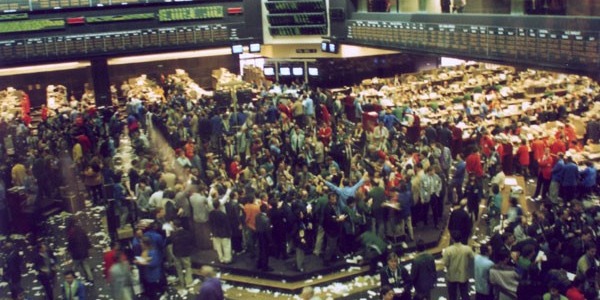
The company that couldn’t stop fudging
When Enron chief executive Jeffrey K. Skilling announced to analysts that the company was making a foray into the world of broadband trading — it would create a brand new market for trading capacity on high-speed fibre-optic networks — they were initially astonished, but only for a moment.
It was entirely logical. Enron, the product of a merger between Houston Natural Gas and InterNorth, had built a remarkably successful business trading natural gas and other commodities and was now the US’s largest energy player. If it could dominate the energy sector, why couldn’t it do the same for broadband? After all, wasn’t bandwidth just another commodity?
Skilling certainly thought so. He wanted to trade data network capacity the same way Enron traded natural gas. Broadband trading would grow quickly; it would account for one-third of Enron’s business, he so declared.
With the order given and the gospel preached, Enron’s foot soldiers jumped into action with an alacrity known only to Enron. No expense was to be spared in the company’s quest to dominate this blue ocean, even if the treasure chest had to be raided. With Skilling’s approval, the company spent more than a billion to create a 18,000-mile network of cable in the United States and overseas, which was complemented by a series of connection nodes, points at which it was linked to other networks.
The marketing geeks went into overdrive, churning out tech gobbledygook that called for an “Enron BOS” with “embedded software intelligence”, a “distributed server architecture” and a “pure IP strategy”. Skilling was more intelligible, but no less ardent, noting that, “This will mean for corporations a new generation of mission-critical broadband applications that can be delivered to internet customers in a secure, guaranteed quality-of-service manner.” Enron stock continued its unrelenting rise.
There was just one problem: precious little trading was going on. Enron tried to attract established telecommunications giants the likes of MCI WorldCom and Verizon Communications to trade with it, without much success. There was a bandwidth glut and prices were plunging; the majors had little incentive to engage in trading that would surely exacerbate the decline. More importantly, they were hard-pressed to trust a company that was known for its brash, take-no-prisoners approach.
Just when it was thought that all was lost, Enron announced a blockbuster deal with Blockbuster Inc for the company to stream its catalogue of movies through Enron’s broadband network, a deal that allowed Enron to immediately book profits of USD 110m taking twenty years (the length of the deal) of forward projections. Around the same time, Enron sold excess fibre optic connections to a private partnership known as LJM2, which was controlled by the company’s chief financial officer Andrew Fastow.
But it was all smoke and mirrors. The sale to LJM2 were valued at USD 100m, with Enron receiving USD 30m in cash and a USD 70m promissory note from LJM2. Enron immediately registered a profit of USD 67m. For the most part, LJM2 then sold the connections back to another private partnership controlled by Enron, a transaction that generated enough money to “repay” the loan to Enron.
Meanwhile, the Blockbuster partnership was not progressing well. The parties would eventually announce its termination, with Enron blaming the failure on a lack of quality and quantity of movies available.
The self-dealing and corporate shenanigans notwithstanding, Enron’s stock continued to rise. Between 2000 and 2001, Enron executives sold USD 924m of the company’s shares. Kenneth Rice, head of Enron Broadband Services, sold shares worth USD 70m in that period.
The timing was remarkably prescient. Enron’s broadband business would eventually collapse, and the company filed for bankruptcy in fall 2001.
Commodity trading demystified
Enron was an anomaly. “Creative” accounting, as practiced by Enron in the early 2000s, has been, for the most part, relegated to the past as a result of the swathe of regulatory reforms such as the Sarbanes-Oxley Act, which imposed (among others) new standards on accounting firms. And bandwidth trading is still unknown to most people.
But commodity trading — particularly in physical commodities — is a real and thriving business. It is a high-volume business with transactions in the millions, if not hundreds of millions of dollars. Transactions typically involve millions of tons of oil, natural gas, gold, copper or any other physical commodity for that matter.
The transaction structure may be complex, involving multiple parties and shipments moving from one location to another in rapid succession. Trafigura — a major player in commodity trading — traded 2.1 billion barrels equivalent of oil and petroleum products, 18.5 million metric tons (“MT”) of metals and 77.4 million MT of minerals in the year ended September 2018.
This article is a primer on commodity trading. We begin by introducing the commodity trading sector, its major players and some of the more commonly traded commodities. We continue with a discussion on oil trading, given its predominant status in the commodity trading world. We then proceed with an examination of some commonly utilised trading strategies, and look at the various factors that affect their profitability. We conclude by looking at the issue of funding: how commodity traders fund their operations.
But first and foremost, what do commodity traders do? What role do they play in modern society?
At their core, commodity traders are logistics companies that transport physical commodities like oil and metals from one location (producers) to another (end or mid-stream users). They trade in these commodities by buying and selling them in bulk, and in many instances, transform (by processing or blending) and store them as well. These activities add value to the supply chain.
We rely on commodity traders to transport physical commodities from one place to another because the commodities are rarely consumed in the place where they are produced. Most commodities also need to be processed in some form before they can be used. Crude oil pumped from the ground, for instance, cannot simply be used as fuel for our vehicles — first it needs to be refined.
In between, commodities are stored by commodity traders. Why
do commodity traders store commodities?
Supply and demand are not always in sync and there are periods where traders
see excess demand for a particular commodity. Storage reduces overall price
volatility, it also allows traders to profit from mismatches in supply and
demand. When prices are low, commodity traders may build inventory. When prices
are high due to shortages, these same traders may reduce inventory and generate
profits.
In Figure 1, the reader will find a non-exhaustive list of the top commodity trading houses.
Figure 1: top commodity trading houses
|
Energy, Metals and Minerals |
||||
|
Name |
Year of Establishment |
Commodities Traded |
Public / Private |
Market Capitalisation |
|
Trafigura |
1993 |
Crude oil, fuel oil, middle distillates, gasoline, naphtha, LPG, LNG, biodiesel, condensates chemicals, coal, iron ore, concentrates and ores (copper, lead, zinc, alumina, nickel, tin, cobalt) refined metals (copper, aluminium, zinc, blister, nickel, tin, cobalt). |
Private |
N.A. |
|
Glencore |
1974 |
Copper, zinc, lead, nickel, ferroalloys, alumina, aluminium, iron ore, cobalt, coal, oil, oil products, wheat, corn, canola, barley, rice, oil seeds, meals, edible oils, biofuels, cotton, sugar. |
Public |
GBP 34.6 billion |
|
Vitol |
1966 |
Crude oil, fuel oil, gasoline, middle distillates, naphtha, methanol, ethanol, chemicals, LPG, natural gas, LNG, carbon emissions, coal, iron ore, power, alumina, base oils, bitumen. |
Private |
N.A. |
|
Mercuria |
2004 |
Crude oil, fuel oil, middle distillates, gasoline, naphtha, biofuels, petrochemicals, natural gas, LNG, power, coal, iron ore, manganese, chrome, carbon emissions, base metals, food and feed grains, oil seeds, vegetable oils. |
Private |
N.A. |
|
Gunvor |
2000 |
Crude oil, heavy fuel and feedstock, middle distillates, gasoline, naphtha, LPG, biofuels, natural gas, LNG, carbon emissions, copper, aluminium, zinc, lead, tin, nickel, manganese, steel, coal, coking coal, iron ore, timber. |
Private |
N.A. |
|
Agriculture Focused |
||||
|
Cargill |
1865 |
Crude oil, bunker fuel, fuel oil, distillates, naphtha Gasoline, LPG, power, natural gas, cotton, grain and oilseeds, sugar, ethanol, palm oil. |
Private |
N.A. |
|
Archer Daniels Midland |
1902 |
Food (acidulates, beverage alcohol, edible beans, fiber, tree nuts, lecithin, vitamin e, oils, plant sterols, polyols and gums, proteins, rice, soy isoflavones, starches, sweeteners) animal feed, corn, oilseed, ethanol, biodiesel, industrials. |
Public |
USD 24.2 billion |
|
Louis Dreyfus Company |
1851 |
Oilseeds, grains, rice, freight, coffee, cotton, sugar, juice, dairy, fertiliser, metals. |
Private |
N.A. |
|
Bunge |
1818 |
Oilseeds, sugar, bioenergy, edible oils, wheat, corn, rice, fertiliser. |
Public |
USD 7.86 billion |
|
Wilmar International |
1991 |
Palm oil, oilseed, edible oils, sugar, specialty fats, oleo chemicals, biodiesel, fertiliser, flour, rice. |
Public |
SGD 24.6 billion |
|
Olam International |
1989 |
Cocoa, coffee, edible nuts (cashew, almonds, hazelnuts, peanuts, sesame), rice dairy, grains, palm oil, fertiliser, rubber, wood, cotton. |
Public |
SGD 6.02 billion |
|
Source: Trafigura, Bloomberg , iFAST compilations (market cap as of 8 Nov 19) |
||||
The reader would readily observe that each trading house deals with a great variety of commodities, ranging from conventional commodities like natural gas to exotic ones like cashews and vitamins. The commodity trading world groups commodities into two distinct categories: primary commodities and secondary commodities.
Primary commodities are those that are extracted directly from the ground, have not been modified and are often non-standard — their physical characteristics vary. Secondary commodities are derived from primary commodities and are usually synonymous with refined products. By their very nature, these products are standardised, with minor variations in quality.
In this article, we will be focusing on oil trading and the common strategies utilised. Clearly, we are aware that there are other commodities traded. Even though this might be the case, many of the same trading strategies utilised in oil trading apply to the broad swathe of commodities available. In other words, we intend the following discussion to be illustrative of the general principles that apply to most commodities, and not for it to be an exhaustive coverage of the entire universe.
But before we get ahead of ourselves, we first need to understand what oil really is, and its constituent components.
The constituents of oil
Oil that comes from the ground is known as crude oil, which is converted into various petroleum products by a refinery, a process that renders them suitable for use in various applications. The refining process breaks crude oil (through a multistage process that includes distillation) into its various components, each of which is further treated or blended with other substances to form new products.
Figure 2 summarises the main outputs of the refining process and their respective applications.
Figure 2: outputs of the oil refining process
|
Refining Output |
Boiling Range |
Main Applications |
|
Liquefied petroleum gas i.e. propane and butane |
<32.2°C |
Commercial and residential heating, cooking ; transport fuel |
|
Petrol (a.k.a gasoline) |
32.2°C - 104.4 °C |
Vehicle fuel |
|
Jet fuel |
104.4°C - 157.2°C |
Fuel for airplanes |
|
Diesel fuel |
157.2°C - 232.2°C |
Transport fuel, heating |
|
Fuel oil |
232.2°C - 343.3°C |
Fuel for ships, power plants and other industrial processes |
|
Bitumen |
343.3°C - 426.6°C |
Road paving, roofing |
|
Other products such as kerosene and paraffin |
>426.6°C |
Jet and rocket fuel, among others |
Commodity traders such as Trafigura bring crude oil producers (those that extract oil from the ground) and refiners together. Intuitively, we might ask ourselves why these producers would not be able to transact directly with refiners, instead opting to go through the middlemen that commodity traders are.
To understand why this might be the case, we need to appreciate that crude oil, in its natural unrefined state, has physical characteristics that vary widely, depending on where it is produced. These characteristics even vary across time. There are over 160 known grades of crude oil, with each variety having a different sulphur content, viscosity (thickness and ability to flow) and pour point (which measures the temperature at which the oil becomes semi-solid and loses its flow characteristics, thus rendering it unsuitable for transportation by pipeline).
At one end, we have oil extraction companies producing a product that varies so widely in quality. On the other side, refineries require crude input that is highly specified, due to the intricate nature of the refining process.
This is where commodity traders come in. Commodity traders purchase and blend crude oil from various sources to create suitable products for refineries. As the reader can imagine, such an endeavour would be impractical for a primary producer since he would not ordinarily have access to output from other crude producers.
For the commodity trader, various types of transformation can occur. Crude oil purchased from one supplier can be blended with other varieties to meet the octane specifications of one or more refiners. The blend can then be treated with other distillates to reduce its viscosity and improve pipeline flow. Thus, the reader will see that even though the commodity trader doesn’t extract or refine crude oil directly, it engages in a series of value-added activities that neither producers nor refiners are willing (or able) to undertake on a day-to-day basis.
Another major barrier that prevents producers and refiners from dealing directly with each other is the issue of pricing. Of course, the financially savvy reader would retort that the price of crude is readily accessible given the existence of publicly traded futures contracts on the Chicago Mercantile Exchange and NYMEX. This observation is true, but alone it reflects an incomplete understanding.
There is no single homogeneous market in crude oil. Trading in oil (and most commodities) is done through countless over-the-counter transactions. And because so many varieties of crude exist, with each variety being of a “better” or “worse” quality compared to another (in relation to sulphur content, viscosity, among other metrics), the benchmark prices on the public exchanges are just starting points for negotiation.
In deals signed between producers, traders and refiners, crude oil is not transacted at the benchmark price, but rather at a premium or discount to the benchmark. Commodity traders, through their industry connections and having undertaken countless such transactions, possess significant insight in the domain of pricing.
The astute reader might enquire, “But couldn’t a refiner simply trade on the exchange by buying a NYMEX-listed West Texas Intermediate contract, if it really wanted to?” Of course that would be possible in theory.
But remember that the NYMEX WTI contract is standardised, and it contains a specification that the underlying crude is to be delivered at Cushing in the state of Oklahoma, the United States. Not everyone wishes to take delivery of crude in Oklahoma. We could imagine if the refiner were based in India, it would have to grapple with storage and delivery logistics, something which might be unpalatable to the refiner and wholly in the realm of expertise of the commodity trader.
Probably the most important aspect in which the commodity trader adds value is in the area of storage, which deals with the problems caused by inelasticity in the supply (by crude producers) and demand (by refiners and end consumers) for oil. For the producer, building an oil rig involves significant capital expenditure and shutting it down at any time, in response to lower prices and weakening demand, could be very expensive. For this reason, producers might choose to go on producing, even at a loss. This exacerbates the supply glut.
Commodity traders help mitigate this problem by providing and maintaining significant global storage inventories. They build inventory when prices are low and reduce (sell) inventory when prices are high. This is hardly altruistic, since significant profits can be realised from helping to reduce market volatility in this fashion.
Now that we have gotten a glimpse of what commodity traders do, let us proceed to the next section, where we will deal with some of the strategies they employ.
Commodity trading strategies and factors affecting profitability
Apart from transporting and blending oil, major commodity traders also actively engage in physical arbitrage to generate outsized profits. In fact, the astute reader might have already realised that the act of blending crude oil mixtures for resale to refiners is, to some extent, a form of physical arbitrage, where one takes advantage of price differentials between untransformed commodities and transformed ones.
One common and profitable form of arbitrage, particularly in the oil trading subsector, is the “cash and carry arbitrage”. To understand how this work, we turn our focus to the futures market.
The futures market is an auction market on public exchanges, where participants buy and sell futures contracts. When one buys a futures contract, one promises to buy the commodity at some date in the future, at the price fixed when the contract is bought. When one sells a futures contract, one promises to sell the commodity at a given price as well.
The aim is easily understood. What traders are looking for is to buy the commodity cheap (on the spot market) and unload it at a higher price (on the futures market). But it is not enough for the futures price to be higher than the spot price — a contango situation.
What is needed is for the futures price to be higher than the spot price, and to the extent that the differential is able to compensate for the cost of storage to be incurred by the commodity trader. Once this is observed, the trader can buy the commodity on the spot market, store it in his own facilities and deliver it through the public futures market sometime in the future. The transaction is virtually free of market risk, which is why cash and carry arbitrage is a mainstay of the industry. Thus, a strong contango market is usually welcomed by commodity traders.
Over the past year, the oil market has been in a situation of backwardation — in which futures contracts trade at lower prices than the spot price of the commodity. Figure 1 demonstrates this. This state of affairs has impinged on the ability of commodity traders to arbitrage oil through cash and carry trades, removing a key source of profit given that oil is one of the most important commodities (by volume) traded for commodity traders.
Figure 1: backwardation of the oil market
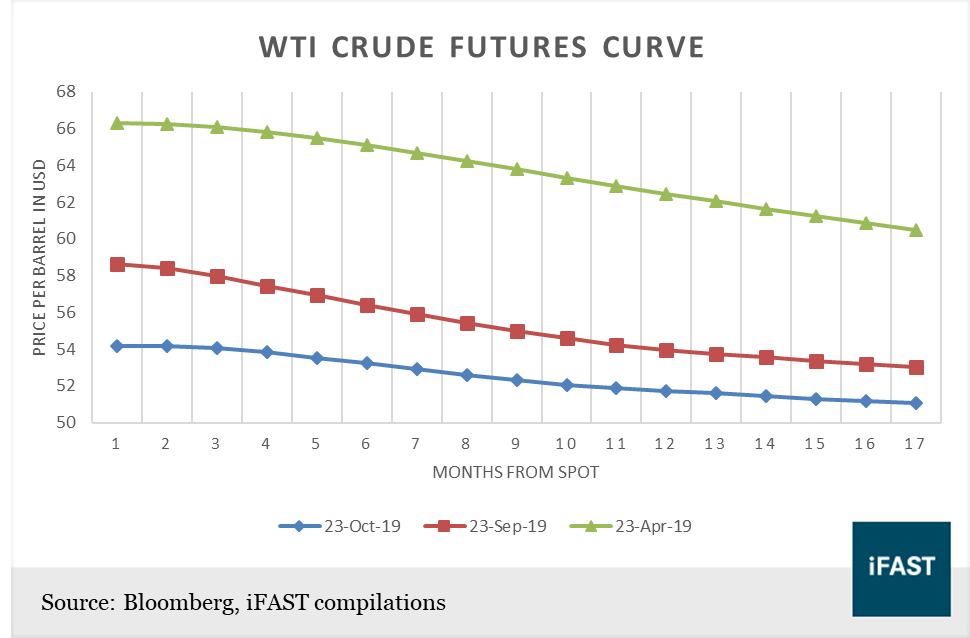
An encouraging observation is that even though the market has been in backwardation for the past year, the extent of backwardation has been in decline. As the oil market slowly returns to a normal state of contango, we anticipate the market to eventually revert to a contango state, returning a key source of profit to major oil traders like Trafigura.
Figure 2 is an extract from Trafigura’s 2019 interim report, which clearly illustrates the effect of contango and backwardation on trading margins.
Figure 2: relationship between forward curve and trading margins in the oil market (Trafigura)
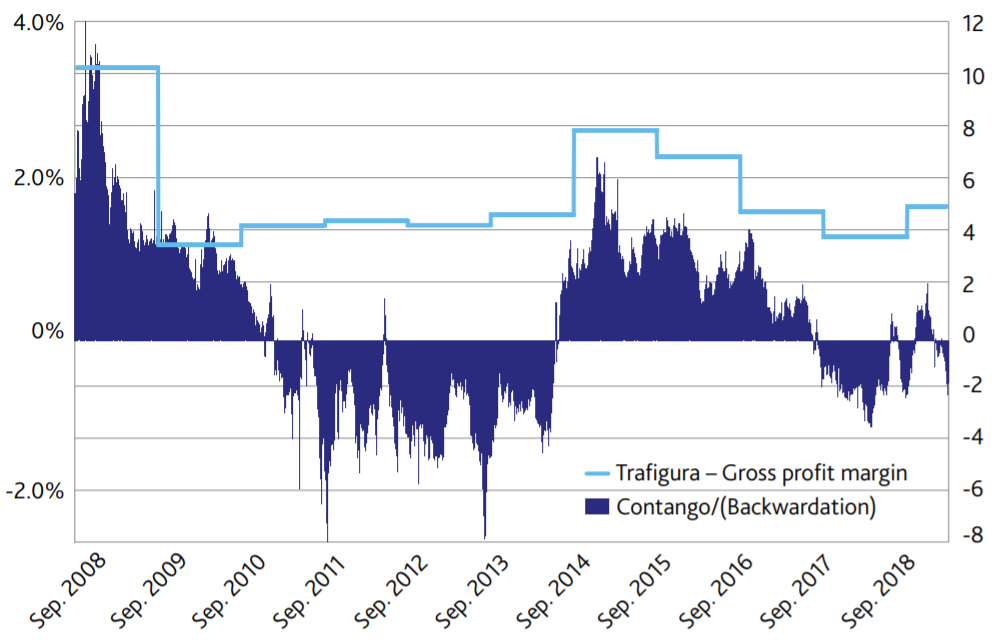
Source: Trafigura 2019 interim report
The ability to profit from contango and other types of arbitrage is only possible if the trader has access to long-term storage and economical financing (to support the financing and margin requirements for spot and futures trading respectively). That is why established traders often own their storage infrastructure.
Trafigura, for instance, has a dedicated subsidiary — Impala — that operates a global network of warehouses, oil and LNG storage tanks and company-owned port infrastructure. It does not routinely own cargo ships and barges, since these are interchangeable and readily available. In terms of access to financing, Trafigura maintained some USD 59 billion in available credit facilities in the first half of 2019.
One common misconception is that profitability is determined by underlying commodity prices. It is not uncommon to hear news anchors lamenting the dire state of commodity prices and how the situation is affecting all and sundry.
This is a misconception. Commodity traders make profits through margins, price differentials and most importantly traded volume, not absolute prices per se. Commodity traders actively hedge to eliminate flat price exposure — the risk of a change in the benchmark price for a commodity.
An oil trader might simultaneously agree with a crude producer to buy crude at 100 basis points (“bps”) over the benchmark (remember that oil trades at a premium or discount against the index) some 1 year into the future, and sell the oil to a refiner at 200 bps over the same benchmark two years into the future. The profit margin is locked in in advance. It is important to note that while margins are fixed, the final prices are only determined once the commodity is delivered, by industry convention. To eliminate the flat price risk in the intervening periods, the trader transacts futures contracts against both legs of the transaction.
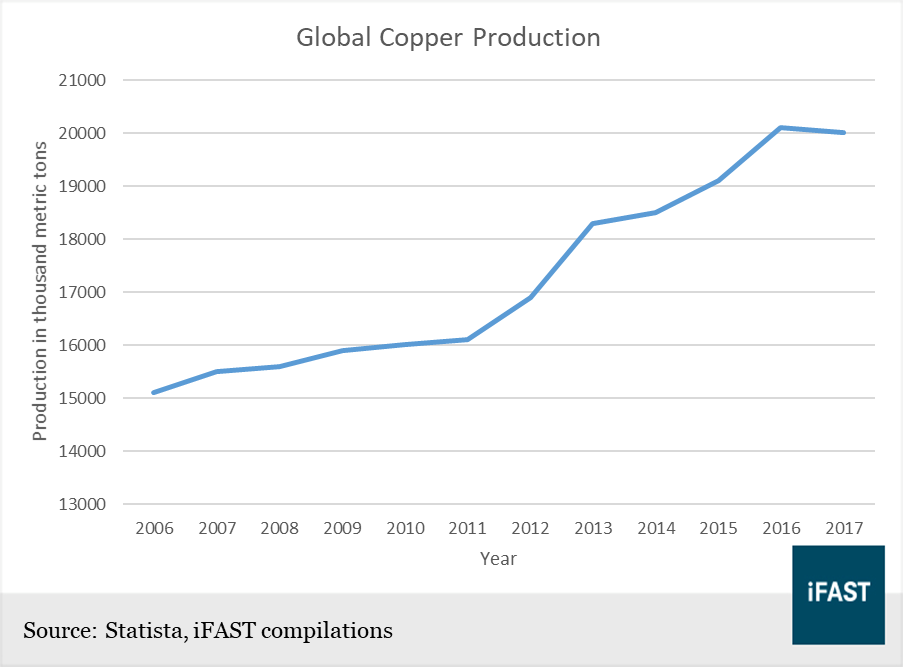
It bears mentioning again that in assessing the profitability of commodity traders, we want to focus on volumes, by using global output as a proxy to estimate the long-term viability of trading in the commodity. Taking the example of Trafigura: the commodity giant has a huge presence in oil, zinc and copper trading. The reader will see in Figure 3 the evolution of copper mine production worldwide from 2006 to 2018.
Figure 3: total copper mine production worldwide from 2006 to 2018
In Figure 4, the reader may observe how zinc production by the five largest producers has changed over time.
Figure 4: global zinc production
|
Producer |
Production in thousand MT |
|||
|
2010 |
2013 |
2015 |
2017 |
|
|
China |
3,700 |
5,000 |
4,300 |
4,400 |
|
Peru |
1,470 |
1,350 |
1,420 |
1,470 |
|
India |
700 |
793 |
821 |
833 |
|
Australia |
1,480 |
1,520 |
1,600 |
842 |
|
US |
748 |
784 |
825 |
774 |
|
Source: Statista, iFAST compilations |
||||
Not forgetting the most important commodity: oil. Figure 5 shows how global oil production has evolved over the past decade.
Figure 5: global oil production
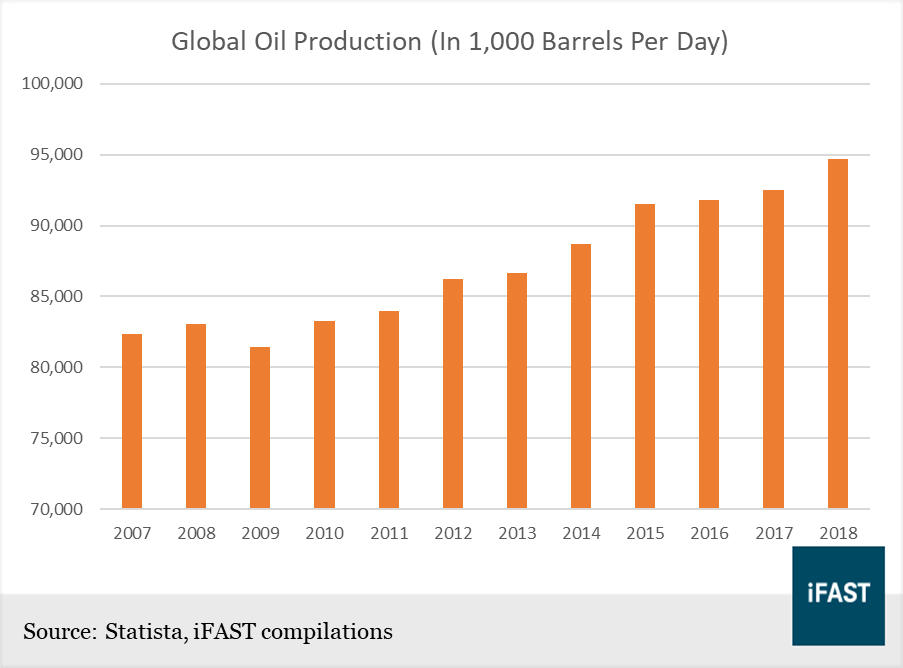
In the three main commodities that Trafigura is active in, the observant reader would observe a steady upward trend in production, one which should persist at least in the medium term.
Supply chain management
Commodity trading is a capital-intensive business. It is also a major challenge to find a reliable supply of any given commodity. How then do traders deal with these challenges? A popular method of securing supply in advance is through the use of prepayments and offtake agreements.
As its name suggests, a prepayment agreement involves the commodity firm making a prepayment to a supplier for future supply of the commodity. This mechanism is routinely employed in resource-rich but cash-poor developing countries, where producers might not have financial means to develop production infrastructure. An added benefit is that such an arrangement also allays concerns pertaining to foreign ownership of natural resources.
The reader might wonder why producers would not wish to obtain bank loans instead. Simply put, some producers are mom-and-pop operations without an established track record. Larger operations in these countries may not have sufficient collateral or creditworthiness to secure a loan of size.
Commodity prepayments fill this financing gap. As de facto loans, commodity prepayments are secured by the producer’s future production.
In the industry, prepayments are typically coupled with offtake agreements. An offtake agreement is a binding agreement between the producer and buyer (usually the commodity trader) for the buyer to purchase a specified portion of the producer’s future production. The purchase price is usually specified at the time of signing.
Such agreements work well for the producer because it guarantees the producer a minimum level of revenue before it commits to significant capital expenditure, which is necessary to produce a commodity such as copper concentrate at scale. For the commodity trader, it provides a secure, contractually guaranteed source of supply.
The incisive reader would immediately recall that we mentioned that commodity traders were not ordinarily exposed to price risk; yet we also mentioned that in such deals, the purchase price is specified in advance for goods to be purchased in the future. Commodity traders protect their interests by including escalation or top-up clauses that adjust the purchase price on the occurrence of certain specified events. In this manner, price risk is mitigated. A haircut may also be imposed on the prepayment amount vis-à-vis the total contract value.
In October this year, Trafigura announced that it would help finance a USD 450m Congolese copper and cobalt facility, as part of a consortium including the First Bank of Nigeria and Africa Finance Corporation. The mine is owned by Democratic Republic of Congo-based Chemaf, in a country that accounts for 60% of the world’s cobalt production. The metal is for the most part shipped to China and used in battery products for electric cars. The financing is secured by future cobalt supply and the factory is expected to produce up to 16,000 tons a year.
In September, Trafigura joined a group of lenders to provide a USD 1 billion loan that was secured by future oil sales. The loan was made to independent oil refiner Shandong Qingyuan, one of the non-state refineries operating in Shandong. Known as teapots due to the small size of their operations, these independent refineries account for a fifth of China’s crude imports. The deal lasts three years and is valued at approximately USD 955m, of which Trafigura has put up USD 30m.
Financing techniques
Commodity trading being the capital-intensive activity that it is, commodity trading firms require multiple sources of funding, apart from the more traditional bank loans. Here are the more common arrangements.
· Repurchase agreements: The commodity trader sells a commodity to a bank and simultaneously agrees to buy it back (at a discount).
· Pooled collateral: The commodity trader leverages on its receivables and inventory to obtain a line of credit.
· Letter of credit (“LC”): A form of short-term, transaction-specific financing that does not depend on the creditworthiness of the buyer or seller. The buyer’s bank issues an LC to the seller’s bank. Once the goods have been loaded onto the ship (where the goods are transported by sea), the seller is issued a bill of lading (“BL”), proof that the goods have been loaded and that risk of loss of goods has been transferred to the buyer. The seller then presents the BL to his bank and gets paid. Notice that in such a transaction, what matters is the creditworthiness of the banks, not the counterparties.
Conclusion
Commodity trading is a multi-faceted business with many moving parts. There remain many aspects that we have yet to discuss and we are under no illusion as to the possibility of doing so given the complex nature of commodity trading.
However, through this brief primer we hope to have informed our esteemed readers on the economic drivers of the industry and that our readers go away better equipped to evaluate the industry prospects and the prospects of its main players. Knowledge that will be put to use when we release a credit research report focused on one prominent commodity trading firm in the weeks to come. Stay tuned.
Appendix: Commodity Traders and Selected Bond Opportunities
|
Bond |
Call Date |
Time To Next Call (Years) |
Ask Price |
Ask Yield To Call |
Z-Spread (bps) |
|
TRAFIG 6.875% Perpetual Corp (USD) |
21 Mar 2022 |
2.3 |
93.03 |
10.3% |
863 |
|
TRAFIG 5.250% 19Mar2023 Corp (USD) |
19 Mar 2023 |
3.4 |
99.64 |
5.36 |
375 |
|
GLENLN 4.125% 30May2023 Corp (USD) |
30 May 2023 |
3.6 |
104.58 |
2.76 |
116 |
|
ADM 4.479% 01Mar2021 Corp (USD) |
15 Mar 2027 |
1.3 |
103.28 |
1.94 |
23 |
|
Source: Bloomberg, iFAST compilations (Data as of 8 Nov 2019) |
|||||
Declaration:
For specific disclosure, at the time of publication of this report, IFPL (via its connected and associated entities) and the analyst who produced this report hold a NIL position in the abovementioned securities.
Certain sections of this article have been adapted from a report published by Trafigura Group Pte. Ltd. - Commodities Demystified. Second Edition.
References
1. eWeek. (2002). Enron Broadband Delivered Nothing But Trouble. [online] Available at: https://www.eweek.com/it-management/enron-broadband-delivered-nothing-but-trouble [Accessed 8 Nov. 2019].
2. Behr, P. (2002). Broadband Strategy Got Enron Into Trouble. [online] The Washington Post. Available at: https://www.washingtonpost.com/archive/business/2002/01/01/broadband-strategy-got-enron-in-trouble/86ce87f6-33e6-4efe-90c5-067c795e9e8c/ [Accessed 8 Nov. 2019].
3. Schwartz, A. (2002). Enron's Missed Opportunity. [online] Center for European Studies, NYU. Available at: https://brie.berkeley.edu/sites/default/files/wp152.pdf [Accessed 8 Nov. 2019].
4. Healy, P. and Pelupu, K. (2003). The Fall Of Enron. [online] Journal Of Economic Perspectives, pp.3-26. Available at: https://pubs.aeaweb.org/doi/pdfplus/10.1257/089533003765888403 [Accessed 8 Nov. 2019].
5. Ft.com. (2019). Trafigura bets on Congo even as Glencore shuts mine | Financial Times. [online] Available at: https://www.ft.com/content/ade02c22-ec0a-11e9-a240-3b065ef5fc55 [Accessed 8 Nov. 2019].
6. Payne, J. (2019). Trafigura joins others to lend $1 billion to independent Chinese oil refiner. [online] U.S. Available at: https://www.reuters.com/article/us-trafigura-china-refinery-loan/trafigura-joins-others-to-lend-1-billion-to-independent-chinese-oil-refiner-idUSKBN1W8043 [Accessed 8 Nov. 2019].
7. Trafigura Group Pte. Ltd. (2016). Commodities Demystified. Second Edition. [online] Trafigura Group Pte. Ltd. Available at: https://www.trafigura.com/brochure/commodities-demystified-a-guide-to-trading-and-the-global-supply-chain-second-edition [Accessed 8 Nov. 2019].