Receive first-hand news on the latest bond issues, credit updates and special events when you join us on our Telegram channel at https://t.me/bondsupermart!
- AUD bank bonds are offering higher yields on Tier 2 and senior debt relative to SGD bank bonds.
- Tier 2 and senior bonds from CBA, Westpac, ANZ, and Macquarie are not only trading at attractive yields but issuer credit profile remains strong.
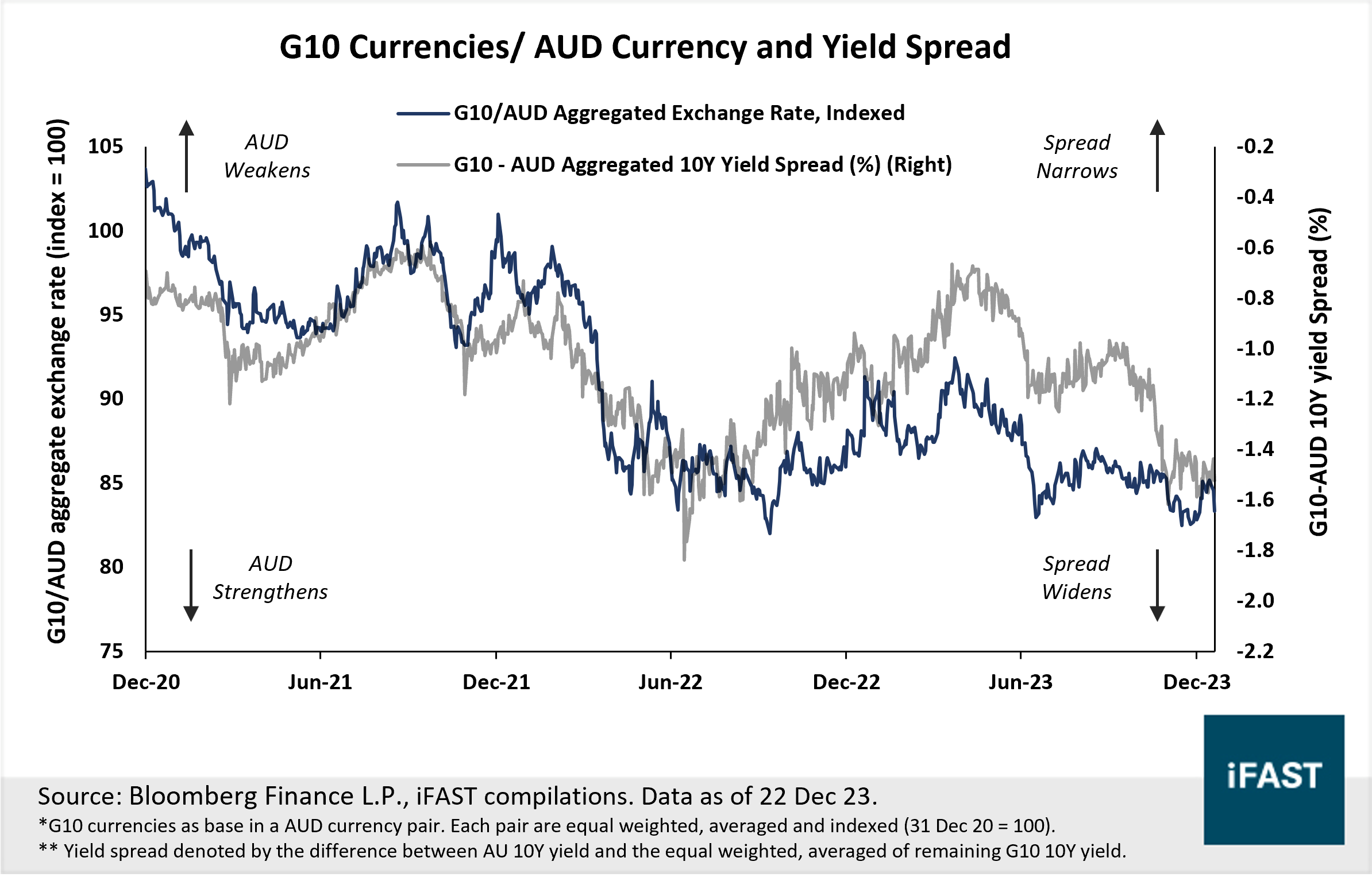
- We see greater support for AUD strength against major currencies in 2024 given the wide interest rate differential and improving demand for commodities.
Australian banks are some of the world’s most capitalised banks with one of the highest internationally comparable CET1 ratios. Since the Great Financial Crisis, the Australian financial authorities have introduced firm standards on the regulations and the banks have since strengthened their capital, funding, and liquidity position. Not only do many possess strong credit profiles, but AUD bank bonds tend to offer higher yields on Tier 2 and senior debt relative to SGD bank bonds, making them great alternatives for investors.
We have highlighted several prominent Australian banks below that offer attractive bond opportunities.
Commonwealth Bank of Australia
Commonwealth Bank of Australia (“CBA”) is Australia’s largest bank by total assets, holding 21% of the banking system assets, and nearly a fifth of New Zealand's banking system assets. The Group operates mainly across three divisions - Retail Banking Services, Business Banking, Institutional Banking & Markets and New Zealand business.
Despite a challenging macro backdrop, CBA had a decent fiscal year. For the financial year ending 30 Jun 23 (“FY23”), CBA recorded a 5% year-on-year (“YoY”) growth in statutory net profit after tax (“NPAT”) to AUD $10.2B from AUD $9.7B. In particular, the increase was driven by a 13% YoY increase in operating income which offset higher operating expenses. The Group recorded a net interest margin (“NIM”) of 2.07% in in FY23, an improvement of 17 bps from the prior year, largely due to the higher rates. Meanwhile, loan volume grew by 7.9% YoY, exceeding the banking system’s volume growth.
The Group’s portfolio credit quality remains sound as troublesome and impaired assets moderated to AUD $6.8B in 1Q24 (30 Sep 23), from AUD $7.1B previously in FY23. Meanwhile, loan impairment provisions increased to AUD $6.1B in 1Q24 from AUD $5.9B in FY23 to reflect inflationary pressure and higher interest rates. The Group maintained a strong provision coverage, with a peer leading total provision coverage ratio (“PCR”) of 1.65% (of credit risk weighted asset).
The Group retained a healthy capital position in 1Q24 with a CET1 ratio of 11.8% (as of 30 Sep), above APRA’s minimum regulatory requirement of 10.25%. Liquidity profile remains one of the strongest amongst Australian major banks with a NSFR and LCR ratio of 129% and 131% respectively, substantially above the 100% regulatory minimum. High quality liquid asset (“HQLA”) also grew by AUD $6.7B to AUD $195.3B over the past six months. CBA also has a stable funding composition with the share of customer deposit holding steady at 75% (of total funding), after a AUD $10B growth in the quarter.
Related article
Westpac Banking Corporation
Westpac Banking Corporation (“Westpac”) is Australia’s second largest bank, holding 19% of the banking system assets. The bank operates mainly across six divisions – Consumer, Business, Westpac Institutional Bank, Westpac New Zealand, Group Businesses (comprising the head office and Australian support functions), and Specialist Businesses (non-core businesses designated to be divested). The Group also has large market share in the Australian mortgage market.
Westpac enjoyed strong financial performance for the financial year ending 30 Sep 23 (“FY23”). The group recorded a 26% YoY growth in statutory net profit after tax to AUD $7.2B from the previous figure of AUD $5.7B. The strong growth was fuelled by a solid 24% YoY increase in pre-provision profit, driven by double-digit growth in net operating income and accompanied by a slight fall in operating expenses. The Group’s operating income was supported by a 2bps increase in NIM to 1.95% in FY23, growth in average interest-earnings assets, and a gain on the sale of one of its businesses (Advance Asset Management Limited).
Portfolio credit quality continue to remain resilient despite higher exposure to Australian mortgage loans. The Group raised its loan impairment provisions to AUD $4.9B in FY23 from AUD $4.6B in FY22 to accommodate higher interest rate and an increased early cycle mortgage delinquencies. Provision covered 63bps of total gross loans while PCR also rose by 19bps to 1.35% in FY23. That said, stressed loan exposure rose to 1.26% (of its total loans) from 1.07% in FY22 but remained below historical levels.
Westpac improved its strong capital position further with a CET1 ratio of 12.38% (as of 30 Sep), above APRA’s minimum regulatory requirement of 10.25%, giving the bank a larger buffer. Liquidity profile remains healthy with NSFR and LCR ratio at 115% and 134% respectively, above the 100% regulatory minimum. HQLA fell by AUD $6.5B but remains relatively sizeable, at AUD $177.6B. Funding composition remains steady as share of customer deposit held steady at 66% (of total funding). Lastly, debt maturity profile for the Group is expected to ease from FY25 onwards (AUD $33B in FY25, AUD $30B in FY26, AUD $24B in FY27) after a slight pick-up next year (AUD $41B in FY24).
Related article
Australia and New Zealand Banking Group
The Australia and New Zealand Banking Group Limited ("ANZ") is Australia’s fourth largest bank, holding roughly 13% of the banking system assets. The Group operates the largest bank in New Zealand, at around 30% of the banking system assets. ANZ operates mainly across four divisions - Australia Retail, Australia Commercial, Institutional, and New Zealand.
ANZ was able to remain operationally resilient for the financial year ending 30 Sep 23 (“FY23”), recording a flat statutory NPAT of AUD $7.1B. The Group’s operating income grew by 13% YoY in FY23, with growth across major divisions, but was dragged down by a decline in other operating income and higher credit impairment charge. NIM also dipped slightly by 3bps to 2.22% in FY23 due to home loan pricing competition, and a shift towards lower margin term deposits.
Portfolio credit quality stayed healthy as management remained prudent. The Group increased its loan impairment provisions by AUD $179M to AUD $4.0B in FY23, covering 62bps of total gross loans, while PCR also rose by 9bps to 1.16% in FY23. ANZ’s impaired assets remained flat relative to FY22, at AUS $1.5B.
The Group’s prudent stance is reflected by a healthy capital and liquidity position. CET1 ratio improved by 105 bps to 13.3% (as of 30 Sep), above the regulatory minimum of 10.25%. Liquidity profile remains healthy with NSFR and LCR ratio at 116% and 132% (second half average) respectively, above the 100% regulatory minimum. HQLA (second half average) also grew by AUD $30.4B to AUD $258.6B. Like the other big Australian banks, the Group’s share of customer deposit held steady at 66% (of total funding), reflecting a stable funding composition.
Related article
Macquarie
Macquarie Group Limited (MGL) is a global diversified financial services group headquartered in Australia. MGL operates mainly across six divisions - Commodities and Global Markets, Banking and Financial Services, Macquarie Asset Management, and Macquarie Capital. Macquarie Bank Limited (“MBL”) is a debt funding vehicle for Macquarie Group Limited (“MGL”), responsible for providing funding for its banking divisions. On the other hand, MGL provides funding mainly to the non-bank group.
Macquarie had a challenging half year ending 30 Sep 23 (“1H24”). MGL recorded a -39% YoY fall in NPAT to AUD $1.4B from AUD $2.3B. This was driven by a -8% YoY fall in net operating income alongside a 6% YoY increase in operating expenses. That said, the decline in net operating income was largely due to weaker investment income, partly as 1H23 recorded a jump in investment income. However, core revenue channels like net interest and trading income as well as fee and commission income managed to increase slightly.
In the same period, MBL recorded a -28% YoY fall in total comprehensive income to AUD $1.6B from AUD $2.2B. This was largely due to higher operating expenses and lower foreign exchanges gains (1H23 saw greater FX gains). However, the bank still managed to grow its net interest income as well as fee and commission income in 1H24. Overall, we think the weakness in Macquarie’s earnings is largely market-driven and likely near-term. We expect earnings to remain stable in the current backdrop, anchored by the diversity of the Group’s operations.
MGL and MBL maintained a healthy capital surplus. The latter has a CET1 ratio of 13.2% (as of 30 Sep), above a regulatory minimum of 9.0%. On a group level, MGL has an estimated CET1 ratio of 14.4% (as of 30 Sep), above a regulatory minimum of 10.5%. Both entities also face little near-term funding pressures as the weighted average maturity (of term funding) for MGL and MBL are 4.4 and 3.2 years respectively, with a majority of the maturities coming in after five years. MBL’s liquidity profile remains healthy and conservative with NSFR and LCR ratio at 114% and 199% respectively, above the 100% regulatory minimum, and AUD $58.6B worth of liquid assets.
Related article
Our recommendations
Table 1: AUD Senior bonds
|
Bond name
|
Issuer
|
Ask Price
|
Years to maturity/ call
|
Yield to maturity/ call (%)
|
Bond rating (S&P / Fitch)
|
|
WSTP 4.125% 04Jun2026 Corp (AUD)
|
Westpac Banking Corp
|
99.11
|
2.45/ -
|
4.52
|
AA-/A+
|
|
MQGAU 4.150% 15Dec2027 Corp (AUD)
|
Macquarie Group Limited
|
96.19
|
3.98/ -
|
5.26
|
BBB+/A
|
|
Source:
Bondsupermart, Bloomberg L.P., iFAST Compilations. Data as of 22 Dec 2023.
|
Table 2: AUD Tier 2 bonds
In sum, we think AUD bank bonds can be a good alternative for investors who seek a higher yield on Tier 2 and senior bonds relative to SGD bank bonds. These bank bonds also offer a decent yield pickup over Australian treasuries of similar duration.
For example, AUD senior bonds with maturity of 2 – 4 years provide a yield pickup of at least 80 – 160 bps over similar duration treasuries, while Tier 2 bank bonds with a maturity of between 8 – 9 years provide a pickup of at least 230bps. While the pickup largely represents the spread (relatively higher credit risk) of the bank over Australian treasuries, the former’s strong credit profile (overall low credit risk) makes the pickup attractive.
In tables 1 and 2, we highlight our recommendations for both senior and tier 2 bonds. The issuers above boast healthy credit profiles and stable earnings outlook. Additionally, we also included an AUD bond by Lloyds Bank which we have previously covered and find attractive. All of the above bonds are rated investment grade and most tier 2 bonds are currently yielding above 6%.
The Australian Dollar (“AUD”) is part of the G10 currencies which comprises of the 10 most liquid currencies in the world. For most of the year, the AUD has depreciated against major currencies but has recently found solid footing in recent months. As we enter 2024, we see greater support for AUD strength against major currencies.
First, we expect the interest rate differential between the Reserve Bank of Australia (“RBA”) and major central banks to remain wide in 2024, thereby supporting AUD strength (Chart 1). With elevated inflation that remains persistently above than RBA’s target, we expect the RBA to retain its hawkish bias amidst the growing wave of more dovish central banks. Policy rates will likely stay higher-for-even-longer, with the risk of rate hikes firmly on the table.
Second, a possible recovery in global growth (an increasingly likely scenario based on our house view) could spur renewed demand for commodities. With Australia being one of the largest producers and exporters of a range of metals and minerals globally, an improving commodity demand can support the economy’s trade account, exerting upward pressure on AUD. At the same time, higher commodity prices may re-ignite commodity-related investment and inflows to Australia, which also bolsters the AUD’s strength.
While we are positive on the outlook for AUD in 2023, we would still like to caution against currency risks as depreciation against the SGD may reduce potential returns. For Tier 2 bonds, investors are also exposed to loss absorption risk as these bonds have loss absorption features which may be triggered upon the occurrence of a non-viability trigger event. Investors who are concerned about the risk may consider the AUD senior bonds, given the higher seniority against the subordinated bonds.
Chart 1: Interest rate differential between AUD and G10 has widened on aggregate, supporting AUD strength. We expect this to continue as RBA remains hawkish.
Declaration: For specific disclosure, at the time of publication of this report, IFPL (via its connected and associated entities) holds a position in ANZ 4.500% 02Dec2032 Corp (SGD) and the analyst who produced this report holds a NIL position in the abovementioned securities.
Our podcast series, Yield Hunters, is available on Spotify, iTunes Podcasts and Google Podcasts. We share our thoughts on new bond issues and hold discussions on the fixed income space. Listen to our latest episode below and follow us!