• Two record quarters, noisy bottom line: EBITDA hit quarterly records of JPY 115.3 billion in 2Q2026 and JPY 123.5 billion in 3Q2026. A tax credit flattered 2Q2026's first net profit in six years, while one-off charges pushed 3Q2026 back to a loss.
• FinTech carries, Mobile edges forward: FinTech EBITDA rose 19.8% YoY to JPY 86.5 billion. Mobile stayed EBITDA-positive, though its capex is set to increase to about JPY 94.2 billion in 4Q2026.
• Leverage holds at parent while interest coverage improves: Non-consolidated net debt / TTM EBITDA improved modestly to 2.11x as of 3Q2026, alongside interest coverage strengthening to 5.87x.
• Refinancing at lower rates: Rakuten raised JPY 400.0 billion of 4.37% domestic JPY bonds in October to refinance its February 2027 USD bonds, which cost 7.22% after currency swaps. Once those are repaid, annual interest falls by about JPY 7.6 billion.
• About the bonds: We continue to like Rakuten's USD bonds, with RAKUTN 9.750% 15Apr2029 as our preferred pick at about 7.16%.
In our previous Credit Update, we showed how Rakuten's three-engine ecosystem was lifting EBITDA and coverage in 1Q2026. Rakuten has since reported 2Q2026 (quarter ending 30 June 2026) and 3Q2026 (quarter ending 30 September 2026). Here, we provide an update on Rakuten’s results since our last 1Q2026 credit update.
Related articles:
Credit Update: Rakuten’s improving three-engine ecosystem supports its 6+% USD bonds
Record Third Quarter for EBITDA, but the Bottom Line Remains Affected by One-Off Events
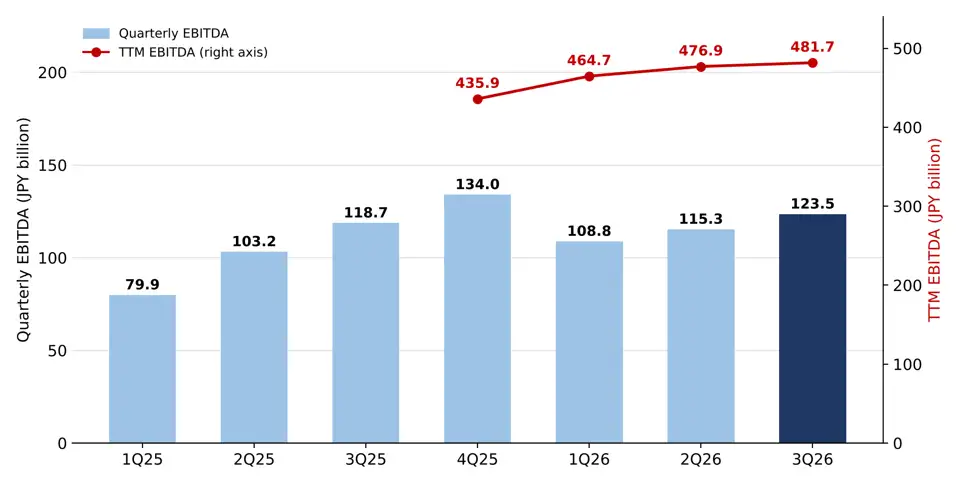
Rakuten’s growth engine kept running in 3Q2026. Revenue rose 10.9% YoY to a record JPY 697.1 billion, and EBITDA rose 4.0% YoY to JPY 123.5 billion. TTM EBITDA hit a new high of JPY 481.7 billion, more than triple its FY2023 level (see Chart 1 below). We focus on EBITDA because longer useful lives on network equipment flattered operating income by JPY 26.0 billion in 9M2026.
Chart 1: EBITDA continues to climb, reaching a record JPY 481.7 billion on a TTM basis
Data as of 30 September 2026.
Source: Company data, iFAST compilations.
Below operating income, a JPY 23.0 billion tax charge from the FinTech reorganisation and a JPY 16.7 billion swap loss widened the net loss to JPY (62.7) billion. With a 9M2026 net loss of JPY (22.1) billion, management’s FY2026 profit target leaves little room for further negative one-offs.
FinTech Carried the Quarter, but Now Sits Further From Bondholders
FinTech was again the main contributor, with EBITDA up 19.8% YoY to JPY 86.5 billion for 3Q2026. Higher interest rates lifted Rakuten Bank's operating income by 33.0% YoY and Rakuten Securities’ by 45.5% YoY. That said, higher rates cut both ways, as Rakuten Card's operating income fell 9.3% YoY on rising funding costs. Across the finance businesses, interest expenses nearly doubled to JPY 78.8 billion in 9M2026 (9M2025: JPY 40.4 billion). This is where the 1 October reorganisation comes in. Rakuten Card and Rakuten Securities are now owned by Rakuten Bank, rather than directly by Rakuten Group. Previously, both borrowed from outside lenders. Now, the bank can lend them part of its own internal bank funding instead, which should gradually lower their interest bill.
Crucially for bondholders, the new structure also changes how FinTech’s profits reach the parent. Rakuten Group owns 72.35% of the new bank group, but holds only 49.95% of the voting rights. The bank group is still included in Rakuten’s consolidated accounts. As we read it, however, the bank group’s cash serves its depositors first, and reaches Rakuten Group mainly as dividends. The move also used up some of the parent’s cash, which Rakuten cited as one reason for October’s bond issue. In short, we expect FinTech to keep growing, but its earnings support Rakuten Group’s bonds less directly than the consolidated figures suggest.
Internet Services Held Steady Beneath the Investment Write-Downs
Internet Services revenue slipped 0.7% YoY to JPY 347.3 billion (3Q2025: JPY 349.6 billion), largely because of a one-off boost last year. In 3Q2025, shoppers rushed to make “hometown tax” donations through Rakuten Ichiba before new rules on reward points took effect.
Under this Japanese scheme, taxpayers donate to local governments in return for tax deductions and local gifts. Domestic e-commerce Gross Merchandise Sales (GMS) rose just 0.6% YoY to JPY 1,687.3 billion (3Q2025: JPY 1,676.9 billion) but grew 9.0% YoY excluding these donations. Segment EBITDA fell to JPY 24.3 billion (3Q2025: JPY 33.0 billion) only because of JPY 17.5 billion of valuation losses on minority investments. Excluding these, segment EBITDA rose 11.7% YoY, following a strong 2Q2026, when segment EBITDA rose 27.4% YoY to JPY 31.0 billion.
Looking ahead, we expect the segment to remain a steady contributor, driven by GMS growth through new customers, cross-use, and AI shopping tools.
Mobile Keeps Growing, but Capex Is About to Step Up Sharply
Mobile subscribers reached 18.4% YoY to 11.05 million (3Q2025: 9.33 million), with Average Revenue Per User (ARPU) rising 2.3% YoY to JPY 2,938 (3Q2025: JPY 2,873). These factors lifted segment EBITDA 9.4% YoY to JPY 12.1 billion. In 3Q2026, net additions slowed on concerns over a roaming reduction, but improved churn in October suggests the disruption was contained. That said, the JPY 10.0 billion narrowing in Mobile’s operating loss looks flattered. Mobile’s depreciation fell JPY 8.9 billion YoY, likely reflecting the longer useful lives on network equipment, while its EBITDA rose only JPY 1.0 billion.
Capital expenditure (Capex) is the clearer swing factor. Network capex is JPY 40.3 billion in 3Q2026 (+198.5% YoY), and the FY2026 plan of JPY 200.0 billion implies about JPY 94.2 billion in 4Q2026 alone (see Chart 2 below). Looking ahead, we expect Mobile EBITDA to keep improving, but not fast enough to fund this capex on its own.
Chart 2: Mobile capex must more than double in 4Q2026 to meet the FY2026 plan
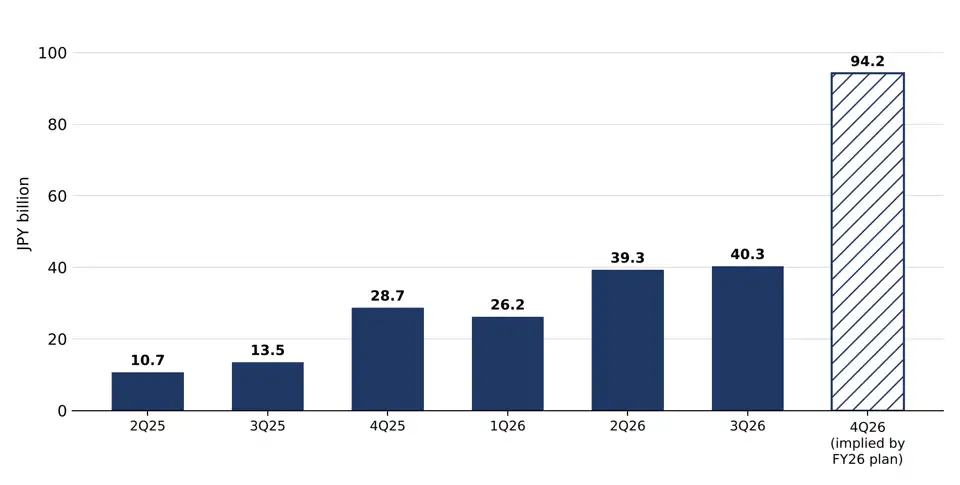
Note: 4Q2026 is the FY2026 plan less 9M2026 spend. Data as of 30 September 2026.
Source: Company data, iFAST compilations.
Consolidated Cash Flow Looks Strong, but Non-FinTech Cash Flow Turned Negative
On the surface, Rakuten's cash flow was strong in 3Q2026. Operating cash flow (OCF) rose to JPY 525.8 billion (3Q2025: JPY 52.7 billion). After JPY 89.4 billion of capex, free cash flow (FCF, or OCF less capex) was JPY 436.4 billion (3Q2025: JPY 9.4 billion). On a TTM basis, OCF rose to JPY 729.5 billion (1Q2026: JPY 674.8 billion), while FCF held steady at JPY 446.3 billion (1Q2026: JPY 452.5 billion).
We would not take these figures at face value, however, as consolidated OCF moves with customers' money. In 3Q2026, new bank deposits, brokerage inflows and a cut in the bank's lending to other banks added about JPY 692.5 billion, more than the quarter's entire OCF. None of it is cash the parent can use to repay bonds.
A better guide is Rakuten's own "self-funding" measure, which tracks cash flow at the non-FinTech businesses, mainly Mobile and Internet Services. It turned negative in 3Q2026, at JPY (21.0) billion (3Q2025: JPY 27.3 billion), as capex more than doubled to JPY 64.9 billion, led by Mobile. Over the TTM, it shows a JPY 233.2 billion surplus, but only thanks to about JPY 200.0 billion from the May securities sale and JPY 117.3 billion of asset finance at Mobile. Without these, it would have been about JPY 84.1 billion short. With Mobile capex peaking in 4Q2026, we expect the parent to keep leaning on asset finance and bond markets.
October's JPY 400.0 Billion Raise Takes the 2027 Wall Off the Table
Rakuten has been working through its maturities all year. In 2Q2026, it redeemed a USD perpetual bond (JPY 81.7 billion) at its first call in April and repaid JPY 20.0 billion of senior bonds in June. The biggest news came after 3Q2026, when Rakuten raised JPY 400.0 billion of 4.37% senior bonds due April 2032. The proceeds refinance its 2027 senior bonds at a lower rate. The USD 1.8 billion (JPY 265.6 billion) bonds cost 7.22% after swaps against 4.37% on the new issue, saving about JPY 7.6 billion a year once they are repaid in February 2027. JPY 10.0 billion of 2027 domestic bonds is also covered. A further JPY 45.0 billion is repaid from cash in December 2026. The remaining 2027 task is the first call on its EUR perpetual and JPY subordinated bonds, which management plans to refinance with new perpetuals.
Beyond 2027, maturities look manageable at about JPY 155.0 billion in 2028, and JPY 70.0 billion plus the USD 2.0 billion (JPY 319.5 billion) bonds in 2029. Meanwhile, parent-level cash of JPY 235.1 billion as of 3Q2026 (1Q2026: JPY 330.1 billion) comfortably covers the JPY 45.0 billion due in December 2026. Market access is healthy, with the October bonds pricing tighter than comparable July 2025 issues. We therefore see refinancing of these maturities as likely.
Coverage Keeps Improving, While Parent-Level Leverage Holds Steady
Leverage is steady at the parent: In our previous update, we highlighted Rakuten’s consolidated net cash of JPY 3.83 trillion as of 1Q2026. This has since fallen to JPY 2.95 trillion. However, most of this cash backs Rakuten Bank’s customer deposits, so it is not available to repay Rakuten Group’s bonds.
We therefore look at Rakuten Group, Inc., the issuer of the USD bonds, on its own. As of 30 September 2026, it held cash of JPY 235.1 billion against external bonds and borrowings of JPY 1,252.6 billion. This leaves net debt of JPY 1,017.4 billion, up from JPY 992.4 billion as of 1Q2026.
Against the group’s TTM EBITDA of JPY 481.7 billion, non-consolidated net debt / TTM EBITDA was 2.11x, improving slightly from 2.14x in 1Q2026 (see Table 1 below). EBITDA growth outpaced the rise in net debt. That said, about two-thirds of group EBITDA comes from FinTech, which reaches the parent mainly as dividends from Rakuten Bank. We would therefore not read this ratio in isolation. We also flag the possibility of net debt rising further as Mobile capex peaks in 4Q2026.
Coverage keeps improving at group level: Rakuten’s interest coverage ratio (TTM EBITDA / TTM interest expense) strengthened from 5.74x in 1Q2026 to 5.87x in 3Q2026. Group EBITDA continued to grow, outpacing interest expense, which was broadly flat at JPY 82.1 billion. Looking ahead, we expect coverage to keep improving as Mobile grows more profitable.
Table 1: Leverage held steady, while interest coverage has improved
|
Credit metrics |
FY2023 |
FY2024 |
FY2025 |
1Q2026 |
2Q2026 |
3Q2026 |
|
Non-consolidated net debt / TTM EBITDA |
7.98x |
2.95x |
2.04x |
2.14x |
1.99x |
2.11x |
|
Interest coverage (TTM EBITDA / TTM interest expense) |
3.12x |
3.84x |
5.28x |
5.74x |
5.81x |
5.87x |
|
Data as of 30 September 2026. Source: Company data, iFAST compilations. |
||||||
Table 2: Rakuten's USD senior bonds and perpetuals
Issue | Ask Price | Yield to Worst / Yield to Next Call | Years to Maturity / Years to Next Call | Rating (S&P) |
105.59 | 7.16% / - | 2.39 / - | BB | |
100.02 | - / 8.11% | - / 3.06 | B | |
92.17 | - / 8.41% | - / 4.41 | B | |
Data as of 23 November 2026. Source: Bloomberg, Bondsupermart, iFAST Compilations. | ||||
Recommendations
Overall, we maintain our view that Rakuten's credit profile remains decent, supported by record EBITDA, improving coverage and pre-funded 2027 maturities, while leverage held steady. Looking ahead, we expect coverage to keep improving as Mobile turns more profitable and FinTech continues to grow, although heavy Mobile capex in 4Q2026 is expected to add to leverage.
In Table 2 above, we spotlight Rakuten’s outstanding USD bonds. We continue to like the 2029 senior unsecured bond yielding 7.16% with a 2.39-year tenor, representing a 246+bp yield spread over comparable US Treasuries. Investors comfortable with a sub-investment-grade credit rating (S&P: BB) can consider this issue for its higher 7%+ income.
One new development affects our preferred pick. On 16 November, Rakuten asked holders of the RAKUTN 9.750% 15Apr2029 to drop two covenants that protect them by limiting asset sales and payments such as dividends. Losing these protections is a mild negative, in our view, but we find comfort from Rakuten not paying a cash dividend since early 2023. Hence, we continue to prefer this 2029 issue.
The perpetuals offer yield-to-worst ranging from 8.11% to 8.41% (339+bp to 365+bp against comparable US Treasuries), as they rank below senior debt, allow coupon deferral and depend on Rakuten choosing to call them.
Declaration: For specific disclosure, at the time of publication of this report, IFPL (via its connected and associated entities) and the analyst who produced this report holds NIL positions in the abovementioned securities. This research report was prepared with the assistance of artificial intelligence (AI) tools. iFAST Financial Pte Ltd does not rely exclusively on AI for content generation; the content of this report – including all investment theses, ratings, price targets and conclusions – has been independently reviewed and verified by the research analyst(s) to ensure accuracy and professional integrity.