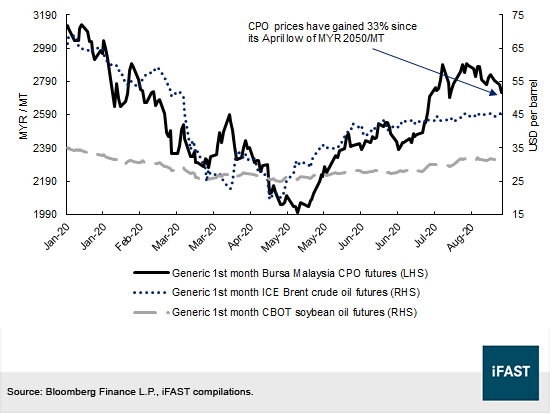
In a follow up to our January report on Golden Agri-Resources Ltd (“Golden Agri”), we retain our stable outlook for the group’s credit profile on the back of higher crude palm oil (“CPO”) prices and decent credit profile. As seen in Figure 1, CPO futures have gained more than 33% since its low in April this year.
Figure 1: Prices of commodity futures since the start of 2020
1H20 results
In the six months ended 30 Jun 20 (“1H20”), Golden Agri reported higher revenue and gross profit, coinciding with higher CPO prices. Total revenue increased 7.1% year-on-year (“YoY”) to USD 3,390.6m, while gross profit increased 12.8% YoY to USD 388.5m. However, operating results fell due to foreign exchange losses and recently enforced CPO export levies. The company announced EBITDA of USD 189.2m and a net loss of USD 146.5m for 1H20.
With respect to its performance in the three months ended 30 Jun 20 (“2Q20”), group revenue increased to USD 1,733.6m, up 5% from the first quarter. Revenue could remain around the same level as the company expected CPO prices to stay at around current levels as production slows down. Restocking activity and inventory levels are likely to be elevated among major palm oil importers, but festive demand during the upcoming Mid-Autumn Festival and Diwali celebrations could lift food consumption and create more palm oil demand.
During the first six months of the year, average international CPO (FOB Belawan) prices rose 24% YoY to USD 616 per tonne. However, Golden Agri’s production from fresh fruit bunches (“FFB”) dropped 8% YoY to 4.084m tonnes, while production from CPO and palm kernel decreased 5% and 8% to 973 thousand tonnes and 246 thousand tonnes respectively. Golden Agri attributed the lower plantation output to its replanting program and dry weather conditions in 2019.
When compared to other large palm oil players like Wilmar International Limited (“Wilmar”), IOI Corporation Bhd (“IOI”) and Sime Darby Plantation Bhd (“Sime Darby”), production yields from Golden Agri were noticeably inferior. For instance, the company’s FFB yield, defined as FFB production per area of mature estate, was 8.8 tonnes/ha in 2Q20, the lowest among peers (Table 1).
In addition, Golden Agri’s CPO and palm kernel production yields were lower than other palm oil companies. In contrast to the sector average, CPO and palm kernel yields from Wilmar were higher at 4.1 tonnes/ha and 0.99 tonnes/ha respectively. We suspect this is due to the production output from Wilmar’s plantations in Africa, which were less affected by COVID-19 than the plantations in Malaysia and Indonesia.
Table 1: 1H20 palm oil production
|
Golden Agri |
IOI |
Wilmar |
Sime Darby |
|
|
FFB production ('000 tonnes) |
4,084 |
1,497 |
1,909 |
4,588 |
|
CPO production ('000 tonnes) |
973 |
343 |
805 |
1,188 |
|
Palm kernel production ('000 tonnes) |
246 |
74 |
193 |
279 |
|
Oil extraction rate (%) |
21.6 |
21.8 |
20.1 |
21.6 |
|
Kernel extraction rate (%) |
5.5 |
4.7 |
4.8 |
5.1 |
|
Plantation area (ha) |
499,563 |
176,909 |
231,268 |
584,402 |
|
Mature area (ha) |
461,764 |
146,856 |
195,243 |
485,054 |
|
FFB yield (tonnes/ha) |
8.8 |
10.2 |
9.8 |
9.5 |
|
Estimated CPO yield (tonnes/ha) |
2.1 |
2.3 |
4.1 |
2.4 |
|
Estimated palm kernel yield (tonnes/ha) |
0.53 |
0.51 |
0.99 |
0.58 |
| Source: Company filings, iFAST estimates | ||||
Referring to Table 1, it is evident that Golden Agri owns a large plantation area, with 461,764 ha of mature palm oil estate. The size of the plantation indicates a large operating scale, which should provide the company a cost advantage over smaller producers. As at 30 Jun 20, the amount of plant area is comparable to Sime Darby, presently claimed to be the world’s biggest producer of certified sustainable palm oil. On a separate note, Golden Agri has sufficient mill capacity to harvest FFB as its extraction rates for processed CPO and palm kernel are in line with the other firms.
Stable cash flows
Net cash generated from operating activities increased to USD 295.0m in 1H20 from USD 209.6m in 1H19, due to lower working capital needs from downstream businesses. Operating cash flow before working capital changes dropped slightly from USD 192.4m to USD 175.0m. Free cash flow, which takes into account net expenditures in bearer plants and property, plant and equipment, climbed from USD 92.9m in 1H19 to USD 215.8m in 1H20.
Liquidity discussion
Cash and cash equivalents were USD 299.9m (2019: USD 207.1m) at the end of June, with ~USD 235.0m held at PT Sinar Mas Agro Resources and Technology Tbk (“SMART”), a 92.4%-owned subsidiary. SMART is a listed entity on the Indonesian stock exchange with a market capitalization of ~USD 624.6m (as at 31 Aug 20) and ~USD 582.0m of current bank loans.
The level of liquidity at the parent company is low, but we think that there are a few options available to the group to help meet its USD 1.85 billion of short-term borrowings. First, the palm oil producer may refinance up to USD 1.2 billion of secured current borrowings and use a combination of cash and USD 532.5m of short-term investments to pay down the remaining current debt. Second, and in a more unlikely scenario, the company may liquidate part of its inventory (~USD 441.2m), long-term investments (~USD 277.8m), PPE (~USD 625.1m) and bearer plants (~USD 162.9m). We understand from management that there is also approximately USD 1 billion of unutilized credit facilities that the company may tap on.
Credit highlights
Credit metrics of Golden Agri weakened slightly in 2Q20 on a trailing-twelve-month (“TTM”) basis. Our estimate for operating profit, or EBITA, increased from ~USD 313.2m in 2018 to ~USD 403.3m in 2019, but declined to ~USD 354.1m during TTM 2Q20. The group’s ability to service interest expense, defined as TTM EBITA over interest expense, fell from 2.42x in 2019 to 2.29x in TTM 2Q20 (Table 2).
Aggregate group borrowings remained at USD 3.10 billion in June, but the net debt multiple, defined as cash-adjusted borrowings over TTM EBITDA, increased to 4.15x in TTM 2Q20 from 4.08x in 2019. The percentage of debt to total assets rose from 35.4% to 36.6%, as the value of total assets fell from USD 8.78 billion in 2019 to USD 8.48 billion in 1H20.
Separately, and as a comparison to its peers, these credit measures of Golden Agri are meaningfully weaker than IOI and Sime Darby. TTM EBITA over interest for IOI and Sime Darby were ~7.95x and ~15.99x in TTM 2Q20, while their debt-to-total assets ratios were 29.4% and 26.0% respectively. The net debt-to-EBITDA ratios for IOI and Sime Darby were 3.05x and 2.85x in TTM 1H20.
Table 2: Selected credit metrics
|
2017 |
2018 |
2019 |
TTM 1H20 |
|
|
Net debt over TTM EBITDA |
5.01x |
4.80x |
4.08x |
4.15x |
|
Debt over total assets |
39.5% |
35.2% |
35.4% |
36.6% |
|
TTM EBITA over interest expense |
1.97x |
1.91x |
2.42x |
2.29x |
| Source: Company, iFAST estimates | ||||
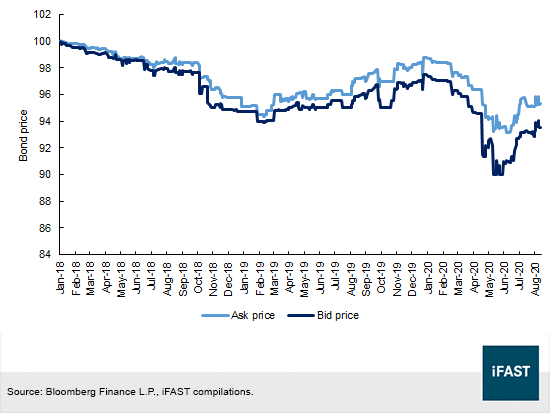
Figure 2: GGRSP 4.750% 25Jan2021 Corp (SGD)
Recommendation and summary
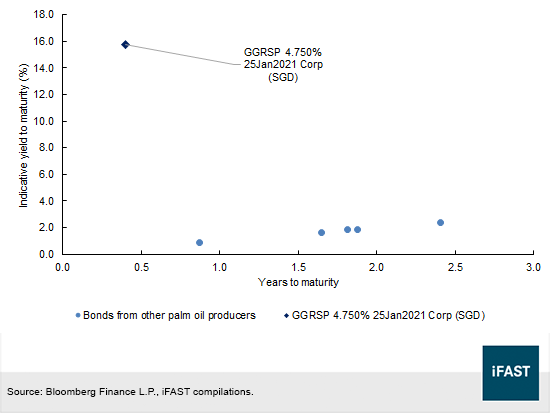
With an indicative yield to maturity (“YTM”) of 15.7% on 2 Sep 20, we think the GGRSP 4.750% 25Jan2021 Corp (SGD) offers attractive value among bonds of palm oil producers (Figure 3). The bond has an ask price of 95.5 (Figure 2) and provides the highest yield among sectoral credits. Most of the peer credits issued non-SGD bonds denominated in USD, MYR and IDR. For example, SMART has two IDR bonds – a 2.6 year bond trading at a yield of 7.4% and a 4.5-year issue with a YTM of 8.2%.
Figure 3: Relative valuation among palm oil producers
Golden Agri faces a high near-term maturity wall, with about USD 1.85 billion of borrowings due in the twelve months from June. Additionally, the group has a higher gearing measure and lower ability to service interest expense compared to its peers. However, we think that it will still be able to redeem the GGRSP 4.75% ‘21s as the palm oil company has demonstrated a good track record of accessing debt and capital markets to refinance its debt. Total gross proceeds from bond issues and new borrowings added to close to USD 2.55 billion in 1H20 and more than USD 2.16 billion during 1H19.
The default risk of the 4.75% ‘21s is manageable at this point, in our view, because the firm has the flexibility to tap the market or resort to asset sales to move it past its near-term maturities. Golden Agri may also rely on its undrawn credit lines and divest liquid assets to repay creditors as mentioned earlier.
Golden Agri is one of the largest palm oil producers in Indonesia, and a benefactor of the B30 biodiesel program. At this juncture, the company’s fundamentals are supported by Indonesia’s biodiesel consumption, which is expected to grow to 8.8m kilo liters this year (2019: 6.4m kilo liters) from 3.6m kilo liters in the first five months of 2020.
Declaration:
For specific disclosure, at the time of publication of this report, IFPL (via its connected and associated entities) has a principal position in GGRSP 4.750% 25Jan2021 Corp (SGD). The analyst who produced this report holds a NIL position in the abovementioned securities.