- Industry-wide redemption limits and significant asset write-downs in private credit are fuelling market pessimism, as seen in widening spreads and declining expected returns.
- Excessive tech exposure and 'bad PIK' usage are eroding private credit quality, escalating systemic default risks.
- Amid current volatility, investors should shift toward transparent, liquid public market bonds for more stable yields.
Private credit is a major way for financial institutions to lend to medium-sized enterprises. It has become increasingly common since the 2008 financial crisis. Companies are beginning to borrow funds from lenders through non-public channels to circumvent increasingly stringent bank scrutiny.
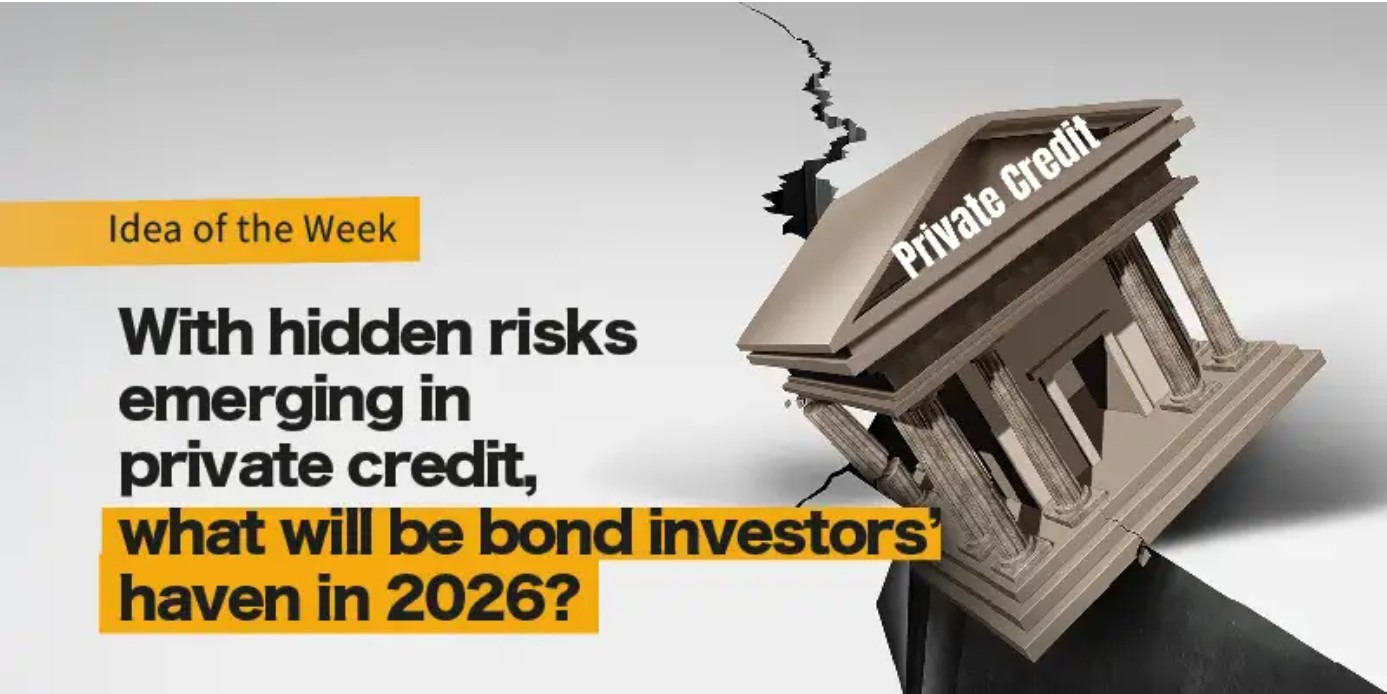
Since the end of February this year, several worrying developments have emerged in private credit market. Industry giant Blue Owl announced a suspension of redemptions and the sale of funds at par value; BlackRock's $2.6 billion private credit fund received redemption requests equivalent to 9.3% of its net asset value, triggering the 5% redemption cap for the first time and restricting investor withdrawals. Simultaneously, a $25 million loan to Infinite Commerce Holdings was written down to zero, dragging the corresponding private credit fund’s NAV down by a whopping 19%. These developments further turbulent the market, leading to differing opinions on the asset.
While redemption restrictions and asset write-downs are not uncommon in the private credit market—valuers regularly request lenders to lower the book value of loans based on changes in floating interest rates, declining peer valuations, or widening interest rate spreads—investors are increasingly concerned that these events may reflect deeper underlying pressures, given the inherently low liquidity and transparency of the underlying assets. Below, we will analyse our perspective on private credit.
The industry distribution of issuers amplifies downside risk
Private credit lenders are disproportionately concentrated in high-risk, cyclical industries, dangerously exposing portfolios to industry risks. According to BlackRock, technology and software companies account for 25% of private credit portfolios, but the release of agentic AI (such as OpenClaw) has triggered market panic about the disruption of traditional software-as-a-service (SaaS) business models. This panic resonates with credit risk, leading to events like Blue Owl and BlackRock. UBS even predicts that in the worst-case scenario, the software industry could see AI-driven default rates in the private credit sector reach as high as 15%.
The most crucial mission of lending institutions is to act as gatekeepers, conducting thorough due diligence on borrowers to reduce the chance of default. However, as competition intensifies in the market, lending institutions may lower their approval standards, leading to a wide range of borrower quality. A 2024 study by the Federal Reserve found that the recovery rate for private credit defaults was only 33%, far lower than the 52% for syndicated loans. In 2025, Fitch Ratings reported a record 9.2% default rate for private credit borrowers, with the First Brands, Tricolor, and MFS scandals causing billions of dollars in losses or collateral shortfalls, exposing loose due diligence and over-reliance on unverified borrower data.
Furthermore, the increasing frequency of borrowers using payment-in-kind (PIK) also increases the likelihood of future defaults. PIK means that borrowers can choose to defer interest payments until the entire debt matures before repaying the principal and interest. In an environment where global interest rates have not yet fallen (especially given the recent wars that have driven up oil prices and inflation), borrowers face severe cash flow pressures, and the utilization rate of this mechanism has risen from a low of 5.2% at the beginning of 2022 to 11.0% by the end of 2025. Notably, the proportion of bad PIKs (terms added only during restructuring or amendment of terms) has surged from 18.2% to 58.3% (Chart 1), indicating that the overall credit quality of borrowers is deteriorating. If these debts mature, the scale of defaults will be unimaginable.
Chart 1: Proportion of PIK in Private Credit Investments and
Bad PIK ratios change over the years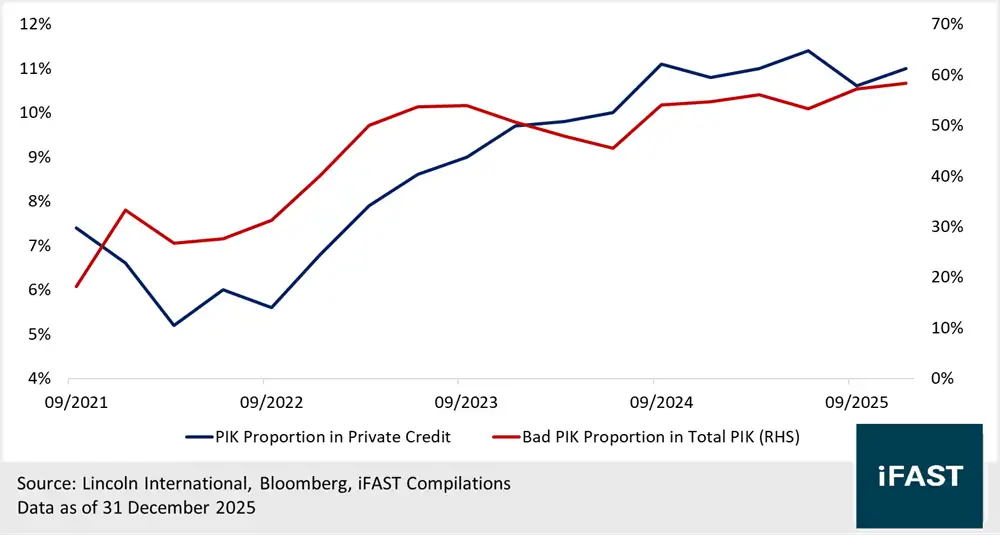 Investors should pay closer attention to bond funds and corporate bonds
Redemption gating is a standard mechanism for almost all private credit funds. A portion of the return in private credit comes from charging an "illiquidity premium," a key difference between it and the public credit market. Therefore, if market volatility continues in this sector in the coming months, we cannot rule out the possibility of other funds initiating redemption gating due to more investors requesting to withdraw capital.
In the environment of uncertainty, coupled with the fact that SOFR rates have been falling and showing declining trend (Chart 2), the floating rate yields that previously supported private credit return may no longer be as favourable. While lower benchmark rates can slightly alleviate borrowers' interest burdens, they also reduce the overall returns available to investors. Furthermore, given the uncertain macroeconomic outlook and the continued uncertainty in demand in some sectors (such as the software/SaaS industry), private credit investment may face a more severe valuation test. Assets lacking justifiable valuations are expected to be gradually eliminated by the market. Investors should fully consider the associated risks before investing in private credit, such as redemption gating, low valuation transparency, and credit risk.
Chart 2:
SOFR Rate change over the years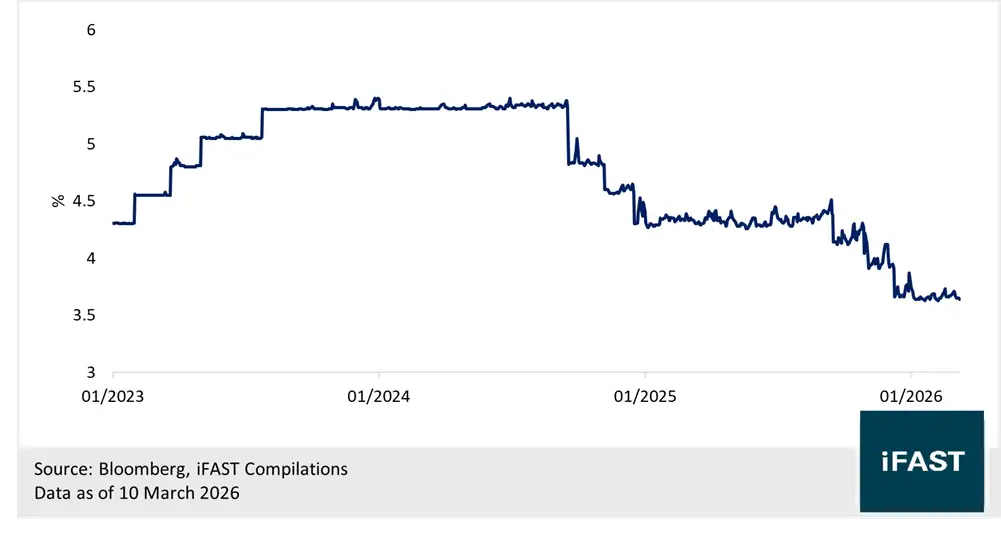 On the other hand, we have not yet observed any signs of a
large-scale spread of risk to the public bond market. The public credit market
has a more stable pricing mechanism, broader investor participation, and higher
information flow, making it easier for risks to be identified and repriced in a
timely manner. Although the public bond market has also declined recently, we
believe this is mainly due to the ongoing US-Iran conflict, which has led to an
increase in US Treasury yields and a slight widening of spreads, particularly
noticeable in high-yield bonds. Meanwhile, the default rate in the public bond
market has not surged significantly. We have observed that the scale of
defaults (in USD terms) is gradually recovering but remains at a low level.
Therefore, our recommendations remain primarily focused on the public bond market, as its fundamentals are more transparent and therefore easier to assess. Interested investors may consider our selected funds in this category, including the "PIMCO GIS - Income Fund (USD) Class E Cumulative Units" and the "Schroder Global Funds Series - Asia Bonds (USD) Class A Cumulative Units," to capture stable coupon income and capital appreciation opportunities arising from potential interest rate cuts. Also worth noting are the following investment-grade bonds (table 1):
Table 1: FSMOne Selected Investment Grade Corporate Bonds
| Bond | Issuer/ Guarantor | Net Yield to Maturity/ Call | Years to Maturity/ Call | Bond Credit Rating (S&P/ Fitch) |
| LGCHM 2.375% 07Jul2031 Corp (USD) | LG Chemical | 4.40% | 5.3 | BBB / - |
| LGENSO 5.375% 02Jul2029 Corp (USD) | LG Energy Solution | 4.20% | 3.3 | BBB / - |
| EMBRBZ 7.000% 28Jul2030 Corp (USD) | Embraer Netherlands | 4.20% | 4.4 | BBB/ BBB- |
| EMBRBZ 5.980% 11Feb2035 Corp (USD) | Embraer Netherlands | 4.90% | 8.9 | BBB/ BBB- |
| MEITUA 4.625% 02Oct2029 Corp (USD) | Meituan | 4.30% | 3.6 | A- / BBB+ |
| MEITUA 3.050% 28Oct2030 Corp (USD) | Meituan | 4.20% | 4.6 | A- / BBB+ |
| FWDGHD 5.252% 22Sep2030 Corp (USD) | FWD Group | 5.20% | 4.5 | - / BBB- |
| FWDGHD 7.635% 02Jul2031 Corp (USD) | FWD Group | 5.10% | 5.3 | - / BBB- |
| DAESEC 6.000% 26Jan2029 Corp (USD) | Mirae Asset | 4.10% | 2.9 | BBB / - |
| TPR 5.500% 11Mar2035 Corp (USD) | Tapestry | 5.10% | 9 | BBB / - |
| VALEBZ 7.200% 15Sep2032 Corp (USD) | Vale | 5.10% | 6.5 | BBB- / - |
| BNKEA 6.750% 27Jun2034 Corp (USD) | Bank of East Asia | 5.9% / 4.9% | 8.3 / 3.3 | BBB / - |
| HSBC 8.113% 03Nov2033 Corp (USD) | HSBC Holdings | 5.4% / 5.0% | 7.7 / 6.7 | BBB+ / A- |
| SOCGEN 6.691% 10Jan2034 Corp (USD) | Societe Generale SA | 5.2% / 5.0% | 7.8 / 6.8 | BBB- / BBB |
Source: FSMOne Data as of 12 March 2026 |
||||
Conclusion
Industry-wide redemption limits and significant asset write-downs in private credit are fuelling market pessimism, as seen in widening spreads and declining expected returns.
Excessive tech exposure and 'bad PIK' usage are eroding private credit quality, escalating systemic default risks.
Amid current volatility, investors should shift toward transparent, liquid public market bonds for more stable yields.
Declaration: For specific disclosure, at the time of publication of this report, IFPL (via its connected and associated entities) holds a position in FWDGHD 5.252% 22Sep2030 Corp (USD), LGENSO 5.625% 25Sep2026 Corp (USD), and the analyst who produced this report hold NIL positions in the abovementioned securities. This research report was prepared with the assistance of artificial intelligence (AI) tools. iFAST Financial Pte Ltd does not rely exclusively on AI for content generation; the content of this report – including all investment theses, ratings, price targets and conclusions – has been independently reviewed and verified by the research analyst(s) to ensure accuracy and professional integrity.