-
Employment and inflation data both exceeded expectations, and the Federal Reserve kept interest rates unchanged at 3.50% to 3.75%, significantly reducing the chances of interest rate cuts during the year.
The split of 8 to 4 votes was the first time since 1992, and the March dot plot revealed the collapse of the FOMC's internal consensus, reflecting rising uncertainty about the policy path.
The market interpreted it as "hawkish continuation", and the curve bear market became steeper. We believe investors can control the duration and focus on short- and medium-term US Treasuries.
Publish a summary of the data
Despite February's slightly weaker data, the Fed's latest nonfarm payrolls for March were 178,000, significantly exceeding market expectations of 60,000, and the overall employment situation remained resilient, with the unemployment rate falling slightly below the consensus of 4.3% (see Chart 1). On the inflation front, the headline consumer price index (CPI) recorded 3.3% year-on-year, while the core CPI recorded 2.6% year-on-year, and the energy and housing categories continued to rise due to ongoing geopolitical tensions.
Chart 1: U.S. nonfarm payrolls and unemployment rate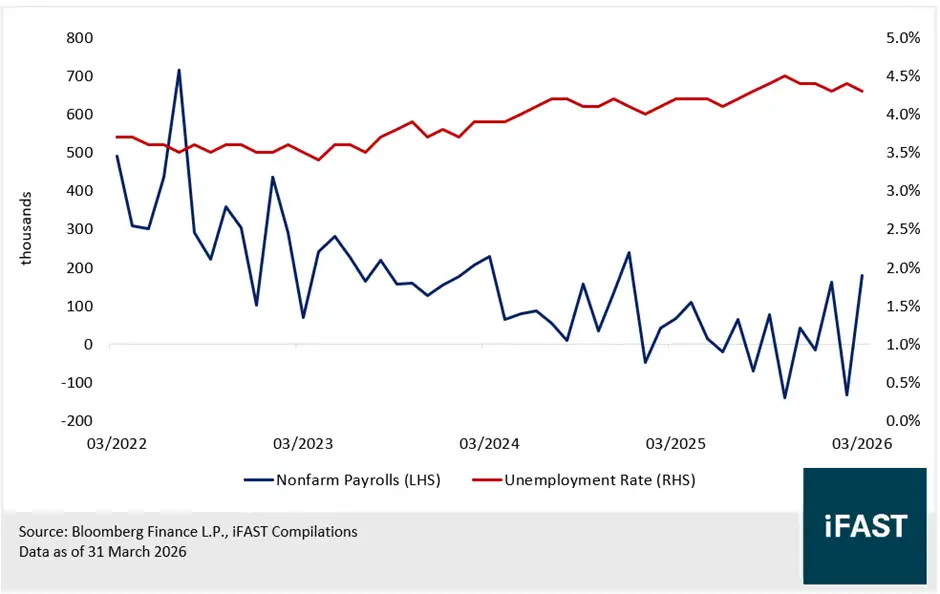
Powell said that due to the current resilience of the labor market and the persistence of energy-led inflation, the Fed will maintain its target interest rate of 3.50% to 3.75%.
Most of the results of the interest rate meeting were in line with market expectations, but the distribution of votes surprised everyone
The policy outcome of this FOMC meeting itself is not much suspense, but the "process" of the meeting is far more exciting than the "result". The Federal Open Market Committee (FOMC) kept the target range for the federal funds rate unchanged at 3.50% to 3.75% (see Chart 2), a move that has long been widely anticipated by the market, and the market has further reduced its expectations for rate cuts this year to near zero.
Chart 2: U.S. benchmark interest rate (lower range) and
neutral interest rate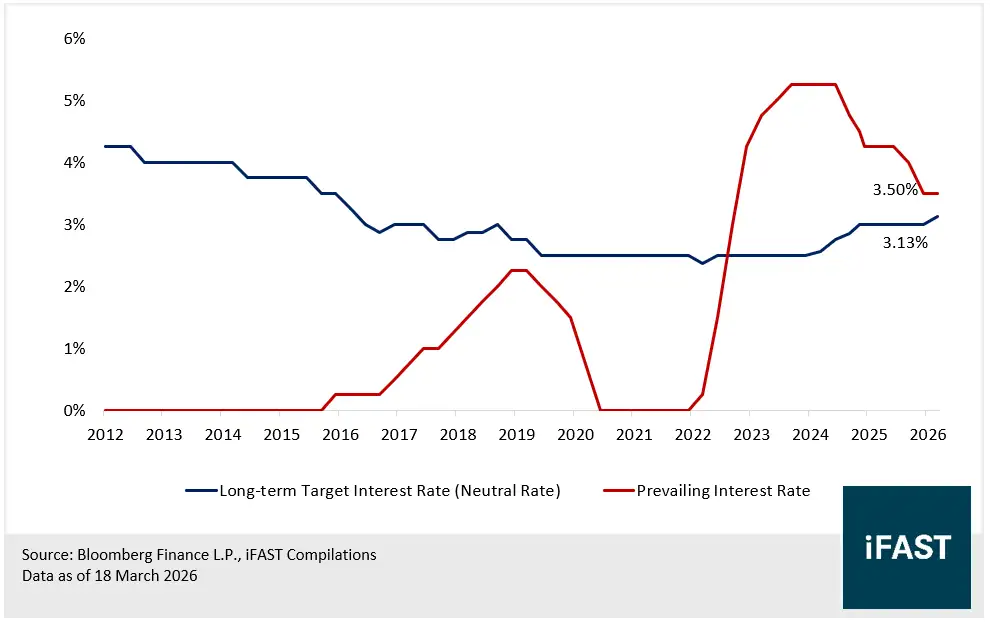
The real surprise lies in the breadth of voting differences. The market was expecting one or two dissenting votes (mainly from Stephen Miran, known for his long-term dovish stance), but the result of four votes against far exceeded expectations. This is the first time since October 1992 that four officials have voted against it at the same time, which is a structural signal for an institution that has historically been known for its "consensus culture." Below we will analyze the dot plot of the interest rate meeting.
The Dot Plot shows a clear division within the Fed, which has Stunned the market
The Fed's most recent update to the dot plot was March 2026 (the dot plot is released at the end of each quarter). The median forecast for the March dot plot shows that the federal funds rate will be 3.4% at the end of 2026, consistent with the forecast in December last year, but Powell himself made it clear after the March meeting that although the median has not changed, more governors are actually biased towards "standing still" (see the red box in Chart 3). The 8-4 vote split at this April meeting can be seen as a greater divide within the Fed since the March dot plot.
Chart 3: Dot plot of the FOMC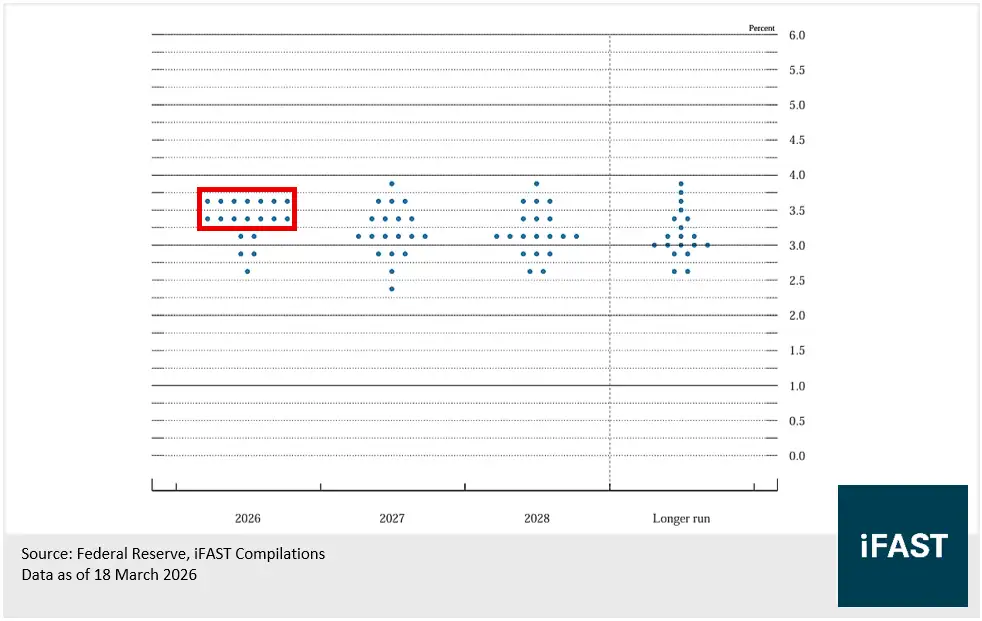
In the details of the voting structure, Governor Milan maintained his consistent dovish stance since joining the Federal Reserve, leaning towards a 25 basis point rate cut and voting against it. As Trump's former chairman of the Council of Economic Advisers, Milan has always been the most dovish voice after joining the Federal Reserve. He called for six rate cuts in 2026 at the beginning of this year, and even if the revised expectation of 3 to 4 rate cuts is maintained, it is still quite dovish, and he also believes that inflation will reach the Fed's target in 2027; The other three votes against it came from Beth Hammack in Cleveland, Neel Kashkari in Minneapolis and Lorie Logan in Dallas Fed. The key is that the three regional Fed chairmen oppose the exact opposite direction to Milan - they voted against it not because they oppose keeping interest rates unchanged, but because they believe that the language implying easing tendencies should be removed from the statement, indicating that they are not enthusiastic about interest rate cuts, reflecting that the differences between the governors on policy interest rates are actually greater than expected.
The centrists (including Powell himself) are maintaining a "cautious wait-and-see" middle stance with a narrow majority. For the bond market, this fragmentation pattern is more uncertain, as it means that the policy path may not necessarily follow the forecasted forward guidance. During Powell's tenure characterized by consensus-building and rare dissent, he ended his term with four negative votes, which is undoubtedly a heavy political legacy for the next chairman, Kevin Warsh.
Powell remains on the board, and opinions are divided
It is also worth noting Powell's decision to stay in office. Powell said at a press conference that he will continue to serve as a Fed governor after his term ends on May 15, pointing out that "what has happened in the past three months (meaning Trump's continuous intervention in the Fed with legal actions) has left him with no choice", so he decided to delay his retirement.
This statement has triggered different reactions in the market: on the one hand, the defense of the central bank's independence should reduce market expectations for interest rate cuts and lower the long-term inflation premium; On the other hand, Treasury Secretary Scott Bessent said that Powell's decision "goes against tradition". Generally speaking, the Fed chairman usually leaves the board of directors after his term ends. The last time the Fed had such unusual governance dynamics was during the presidency of Marriner Eccles, who ended his term as chairman in 1948 but remained on the board until 1951. This institutional tension is the first in 78 years, and we believe this could lead to potential volatility in long-term Treasury yields.
In addition, after the meeting, the White House and even Trump immediately responded to Powell's decision on social media, insinuating that he should be dismissed immediately, full of gunpowder. This has also raised concerns about whether tensions between the government and the Federal Reserve will add uncertainty to the already uncertain direction of interest rates.
The market's speculation on the outcome of the interest rate meeting
The market interprets this interest rate meeting as the Fed will "remain hawkish" (hawkish hold). After the meeting, the US Treasury yield curve has been impressed upwards, the yield curve is steeper than in February this year. The two-year yield has risen particularly sharply (from 3.5% to 4.0%, see Chart 4), which shows that the market expects inflation to deteriorate significantly over the next two years, which is in line with our previous inflation expectations(See "Idea of the Week: A Turn in the Interest Rate Cycle? Be Prepared For Rate Hikes”).
Some economic strategists pointed out that Powell's voice continued to be cautious after his last FOMC meeting as Fed chairman, and he did not support the Fed's reduction in the current context of resilient economic growth, stubborn inflation, and a stable job market. Unless this situation changes, the Fed will remain on the sidelines.
Chart
4: Comparison of US Treasury yield curves in February 2026 and after FOMC
meetin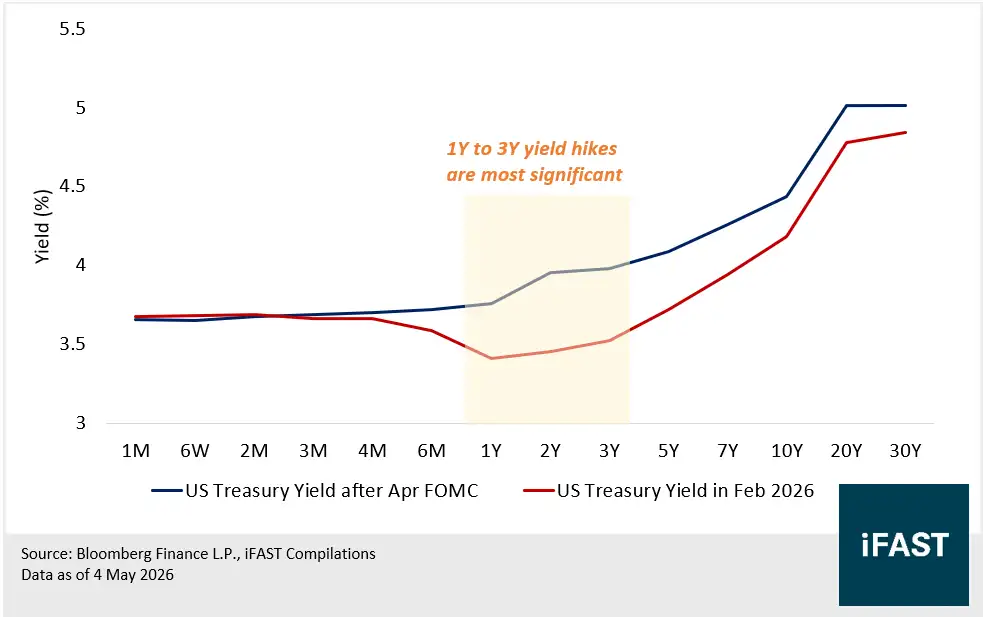
The implications of this interest rate discussion for bond investors
The recent strong labor market and persistent signs of inflation have complicated the Fed's decision-making, which must refrain from being overly aggressive and decide to keep interest rates unchanged at this meeting. Therefore, we believe bond investors should focus on controlling duration to avoid potential interest rate fluctuations, while maintaining reservations about rate cuts in the near term.
We maintain our preference for short- to medium-term investment duration, with short-year US Treasury yields currently remaining above the 3% range given the reduced scope for rate cuts in 2026, and short-term bond yields remain attractive for investors to focus on U.S. Treasury bonds with a maturity of 1 to 5 years.
Medium-term bonds still offer a yield premium over short-term bonds, which has improved again after the recent bear market of the interest rate curve. Conversely, bonds with longer durations are sensitive to refinancing risks and headwinds in the current interest rate cycle, and investors should be aware of the greater volatility of their prices. The following table 1 consolidates short- and medium-term U.S. Treasury bonds listed on our platform for investors' reference:
Table 1: Short- and medium-term U.S. Treasury bonds
|
Bond |
Tenor |
Yield to Maturity |
|
1.5 |
3.8 |
|
|
2.1 |
3.9 |
|
|
3.2 |
3.9 |
|
|
4.0 |
4.0 |
|
|
5.0 |
4.1 |
|
|
Source: FSMOne Data as of May 6, 2026 |
||
Declaration: For specific disclosure, at the time of publication of this report, IFPL (via its connected and associated entities) holds positions in T 2.250% 15Nov2027 Govt (USD), T 1.250% 30Jun2028 Govt (USD), T 2.625% 31Jul2029 Govt (USD), T 0.625% 15May2030 Govt (USD), T 1.625% 15May2031 Govt (USD), and the analyst who produced this report holds NIL positions in the abovementioned securities. This research report was prepared with the assistance of artificial intelligence (AI) tools. iFAST Financial Pte Ltd does not rely exclusively on AI for content generation; the content of this report – including all investment theses, ratings, price targets and conclusions – has been independently reviewed and verified by the research analyst(s) to ensure accuracy and professional integrity.