Adverse weather patterns, higher demand and tight supplies are creating the perfect cocktail for higher food prices.
We believe that the inflationary environment will strengthen the profitability metrics of agribusinesses including Olam International.
Yield-seeking investors may invest in the OLAMSP 5.375% Perpetual Corp (SGD), OLAMSP 5.500% Perpetual Corp (SGD) or OLAMSP 4.000% 24Feb2026 Corp (SGD).
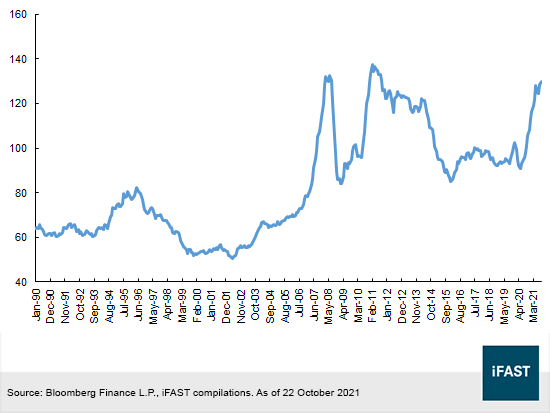
According to the Food and Agriculture Organization of the United Nations (“FAO”), food prices have risen to the highest level in 10 years. As seen in Figure 1, the FAO Food Price Index has reached 130 index points in September 2021, which is nearly equal to the 130.4 index level in September 2011.
Figure 1: UN Food and Agriculture Organization Food Price Index
The FAO attributed the price increases to tighter food supplies and strong demand, particularly for wheat and palm oil. Border restrictions, manpower shortages, and crop production issues in Malaysia also resulted in decade-high palm oil prices.
Wheat prices have increased on projected lower crop yields presumably linked to weather patterns in Russia and a drought in the US and Canada. In addition, the price of sugar has also risen significantly due to adverse weather conditions and high ethanol prices in Brazil. Raw sugar tracked by futures contracts in Table 1 show that sugar prices are up 23.2% year-to-date (“YTD”)
Table 1: Various agriculture commodities and their price changes
|
|
Price quotation |
YTD price change |
1H21 price change |
|
China Agricultural wholesale garlic prices |
CNY / kilogram |
+9.6% |
+1.3% |
|
NNS Delhi Almonds |
INR / kilograms |
+16.2% |
+12.6% |
|
NNS Peshawari Pistachios |
INR / kilograms |
+15.2% |
+3.0% |
|
ICE generic 1st month coffee futures |
USD / lbs |
+55.8% |
+24.2% |
|
CBOT generic 1st month rough rice futures |
USD / centum weight |
+8.9% |
+6.3% |
|
ICE generic 1st month raw sugar futures |
USD / lbs |
+23.2% |
+13.8% |
|
CBOT generic 1st month corn futures |
USD / bushel |
+13.2% |
+51.7% |
|
CBOT generic 1st month soybean meal futures |
USD / ton |
-10.1% |
+4.5% |
|
Bursa Malaysia generic 1st month palm oil futures |
MYR / Metric tons |
+33.3% |
-2.8% |
|
ICE generic 1st month cotton futures |
USD / lbs |
+40.4% |
+7.6% |
|
CME generic 1st month milk futures |
USD / centum weight |
+13.1% |
+7.0% |
| Source: Bloomberg Finance L.P., NNS Limited, China Ministry of Commerce, Chicago Mercantile Exchange, Intercontinental Exchange, Chicago Board of Trade, Bursa Malaysia, iFAST compilations. As of 22 October 2021. | |||
Olam International Limited (“Olam”) and other agricultural companies will benefit from rising food prices as they book higher trading volumes. Olam is the biggest private ginner of cotton in the world with market leading positions in all major cotton producing countries. Cotton futures have gained 40.4% this year and prices remain elevated. Coffee futures have surged 55.8% so far this year and this may boost earnings at Olam Coffee, which is ranked among the top 5 coffee traders in the world.
About Olam
Olam International Limited is a large food agri-business and agricultural trader, providing food and ingredients to customers all over the world. This is made possible as Olam relies on its broad supply chain that spans over 60 countries. With a SGD 6.46b market capitalisation as of 22 October 2021, the company is one of the largest 30 publicly listed firms on the Singapore Stock Exchange. Temasek Capital (Private) Limited is Olam’s immediate holding company while Temasek Holdings (Private) Limited is its ultimate holding company. Mitsubishi Corporation is also a company shareholder with a 17.36% interest in the firm. As at 18 March 2021, Temasek owns 53.42% of the Olam group.
Olam’s business segments
The Olam group has three business operating segments.
(1) OGA, or Olam Global Agri is a food, feed and fibre global agri-business that primarily operates in emerging markets, particularly Asia and Africa. OGA focuses on providing proteins to consumers in these regions and it has been operating in these markets for more than 30 years.
(2) OFI, or Olam Food Ingredients provides sustainable, natural and healthy products to end consumers. OFI caters to trending food-groups who have a growing appetite for healthier, traceable foods from sustainable sources.
(3) Lastly OIL, or Olam International Limited, also the parent company of OGA and OFI. OFI is projected to demerged from the Olam group and list on the Singapore and London Stock Exchanges in 1H22. On the other hand, OGA is slated for a potential IPO listing in 1H23. OIL is pivoted as an accelerator that will guide OGA and OFI until their carve-out, IPO and demergers are completed. Olam International Limited is also the issuer of the group’s medium term notes.
Under the 2019-2024 Strategic Plan, OIL will develop three gestating businesses – (i) Olam Palm Gabon (“OPG”), (ii) Packaged Foods and the (iii) Infrastructure and Logistics businesses. OPG is a joint venture with the Government of Gabon and the biggest RSPO-certified (“Roundtable on Sustainable Palm Oil”) palm plantation in Africa. OPG runs two palm oil mills while a biodiesel refinery is being built to help Gabon diversify away from fossil fuel.
Last year, Olam recognised an impairment charge of SGD 483.9m on its OPG investment. Production yields fell as a result of lower than usual rainfall in Gabon and a prolonged drought. To compensate for the lack of crop moisture, OPG is looking to implement a large-scale drip irrigation project in the area. However, the COVID-19 pandemic has caused further delays to the irrigation project and the group has assessed that it would be prudent to take further impairments to OPG and bring down the value of the asset to a level that is attractive to investors.
One of Olam’s other gestating businesses is the ARISE group, which consists of ARISE Port and Logistics (ARISE P&L), ARISE Integrated Industrial Platform (ARISE IIP) and ARISE Infrastructure Servcies (ARISE IS). Collectively, these three ARISE units help developing countries transition to an industrial economy through the building of large scale infrastructure and logistics assets.
ARISE P&L manages ports in West Africa, including a cargo port in Gabon, a Mauritanian port and a cargo port in Cote d’Ivoire. ARISE IIP helps to develop special economic zones in Gabon, Togo, Benin and Cote d’Ivoire. Meanwhile, ARISE Infrastructure Services is providing assistance in managing an airport in Gabon.
Apart from the ARISE group, OIL also has a number of business initiatives known as Engine 2 initiatives to drive future growth. First, there is the digital farmer services platform “Jiva”, which provides free agronomic advice, extend credit and purchase crops from farmers. This is the so-called “buy-now-pay-at-harvest” model that is currently operating in Indonesia and India.
Second, OIL manages the “Adva” consumer lifestyle app that was launched in Singapore last year. The “Adva” app helps consumers monitor their carbon footprint and gives advice on how to reduce their carbon output.
The last notable Engine 2 growth initiative by OIL is the “Re~” consumer brand business, which offers a host of tasty, healthy and 100% natural products to supermarket shoppers. “Re~” products are supplied by Olam’s food supply chains that stem from traceable and sustainable sources that include muesli, cashew butter, coffee and different nuts.
1H21 financial performance
Figure 2: Revenue breakdown by segment
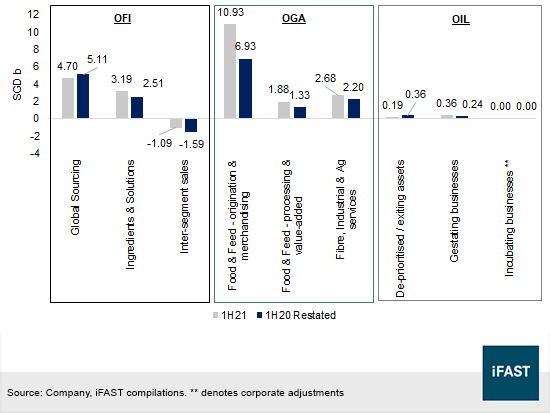
Group revenue surged by SGD 5.75b to SGD 22.83b in the 6-month period ended 30 June 2021 (“1H21”). As seen in Figure 2, this was mainly driven by a SGD 4.00b improvement in revenue from its Food & Feed - origination and merchandising arm. Within the OGA business segment, Olam reported gains in its Rice business, alongside better performance from its Fibre, Industrial and Ag Services segment underpinned by higher cotton demand in China, India, Vietnam and Indonesia. Its Edible Oils segment, which was impacted by defaults last year, also rebounded in 1H21. Revenue from its gestating businesses grew by SGD 122m from SGD 0.24b in 1H20 to SGD 0.36b in 1H21.
Figure 3: EBIT breakdown by segment
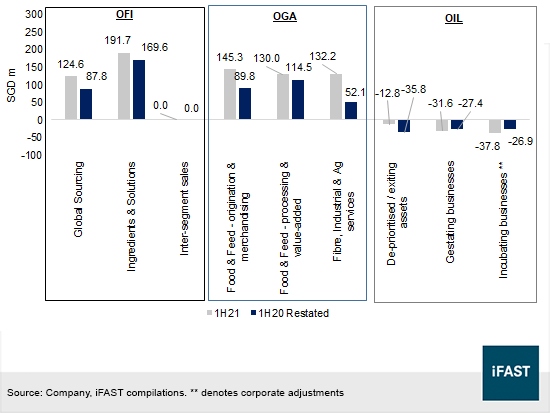
Group EBIT increased from SGD 423.7m in 1H20 to SGD 641.6m in 1H21, and this was mostly driven by gains in the OGA and OFI segments (see Figure 3). However, not all sub-segments were profitable. Losses from OIL’s gestating and incubating businesses widened during 1H21. Olam’s gestating businesses lost SGD 31.6m, while incubating businesses registered a loss of SGD 37.8m.
Credit discussion
Despite recording higher gross debt, finance costs fell slightly from SGD 288.0m in 1H20 to SGD 239.4m in 1H21. Cash flows from interest expenses also decreased from SGD 297.3m to SGD 234.5m. Consequently, group EBIT/Interest multiple amounted to 1.42x in 1H20 and 2.74x in 1H21. This is a fairly healthy interest servicing multiple although it pales against agribusiness peers such as Archer Daniels Midland Co (1H21: ~13.3x) and Louis Dreyfus Company (1H21: ~3.5x)
What is more concerning is that Olam has a high gearing ratio of ~69.6% at 1H21, defined as the ratio of total debt over total assets. Other companies such as Archer Daniels Midland Co (“ADM”) have lower debt burdens. As at 30 June 2021, ADM’s debt to total asset ratio was ~19.1% whilst the gearing ratio for Louis Dreyfus Company was ~42.7%. If we treated its perpetual notes as debt, Olam’s gearing ratio would have increased to ~76.8%.
Nevertheless, Olam still has an adequate liquidity profile, with SGD 18.6b of available liquidity as at 1H21. This comprises SGD 3.5b of cash, SGD 5.5b of readily marketable inventories, SGD 1.9b of secured receivables and SGD 7.6b of unutilised bank lines, which the group may access to support working capital and repay financial obligations.
The amount of bank lines and cash is sufficient to cover its SGD 6.7b of short-term borrowings. Overall, the combined value of total liquidity (i.e. SGD 18.6b) is more than enough to cover its total borrowings (SGD 15.0b) and SGD 1.5b of perpetual notes.
Furthermore, we believe that the group has good access to funding sources as it managed to raise JPY 9b in September via a private placement and USD 5.2b via loan facilities. On 30 September 2021, the group announced that it issued JPY 5.5b of 5-year sustainability-linked notes at a fixed coupon of 1.403%. On 6 October 2021, Olam also secured a JPY 26.7b medium-term samurai loan facility through its wholly-owned subsidiary, Olam Treasury Pte. Ltd.
Our bond recommendations
Olam has SGD 605.8m of short-term medium term notes that are maturing on or before 30 June 2022, which include the OLAMSP 0.9725% 25May2022 Corp (JPY) and OLAMSP 0.4700% 7Apr2022 Corp (JPY). The OLAMSP 5.500% Perpetual Corp (SGD) is callable on 11 July 2022 and we think that it has an attractive yield-to-worst of 3.72% (see Figure 4). If not redeemed on 11 July 2022, the coupon on these notes will step up to the prevailing 5-year SGD Swap Offer Rate + 3.685% + Step-Up Margin of 200 basis points (“bps”). Given its sufficient liquidity profile and higher post-reset rate, we think that the likelihood of a non-call event is low.
Figure 4: Bonds along the OLAMSP curve
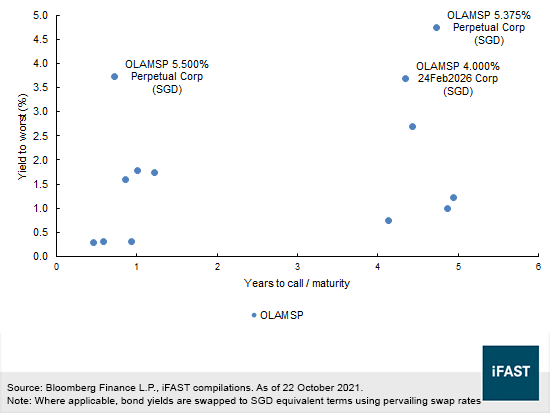
Investors looking to invest in fixed rate notes may consider the OLAMSP 4.000% 24Feb2026 Corp (SGD) at its indicative yield-to-worst of 3.69%. The bonds are senior unsecured and ranked above the OLAMSP 5.500% Perpetual Corp (SGD) and OLAMSP 5.375% Perpetual Corp (SGD).
The OLAMSP 5.375% Perpetual Corp (SGD) are first callable on 18 July 2026. If the issuer does not call back its notes, the OLAMSP 5.375% perps will reset to the prevailing SGD 5-year benchmark rate (which will likely be the 5-year SORA-OIS by July 2026) + 4.807% + step-up of 200bps. High yield seekers may invest in the OLAMSP 5.375% Perpetual Corp (SGD) which has a current yield-to-worst of 4.74%.
Our bond recommendations are based on Olam’s healthy liquidity profile, Temasek’s ownership and the group’s ability to access capital markets. However, there is a possibility of a drop in group EBIT and weaker credit metrics after OFI and OGA complete their spin-offs in 1H22 and 1H23 respectively. Olam will publish more information about their carve-outs in due course and we will update our credit opinion on the company once more details have been published. But at this juncture, we believe the Olam bonds are still worth investing given the inflationary macro backdrop and the company’s commendable 1H21 financial performance.
Declaration:
For specific disclosure, at the time of publication of this report, IFPL (via its connected and associated entities) holds a position in the OLAMSP 5.375% Perpetual Corp (SGD) and OLAMSP 6.000% 25Oct2022 Corp (SGD). The analyst who produced this report hold a NIL position in the abovementioned securities.
Our podcast series, Yield Hunters, is available on Spotify, iTunes Podcasts and Google Podcasts. We share our thoughts on new bond issues and hold discussions on the fixed income space. Listen to our latest episode below and follow us!