- Societe Generale reported excellent growth in 1H21 with substantial growth in the Financial Services and Retail Banking segments.
- Revenues registered double digit growth of 18.2% in 2Q21 when compared to 2Q20, showing a strong rebound from the pandemic lows.
- Societe Generale has a good capital and liquidity position and is comfortably above regulatory requirements.
- We recommend the SOCGEN 6.125% Perpetual Corp (SGD) as it has one of the highest yields among SGD-denominated banking peers.
Societe Generale (“SOCGEN”) reported its half-year results (“1H21”) for the financial year ending 30th June on 3 August 2021. The French bank reported excellent growth in 1H21 with substantial growth in the Financial Services and Retail Banking segments.
In an environment where interest rates are expected to rise, banks are poised to capitalise on rising interest rates as interest rate margins for banks will improve. We believe that with strong earnings coupled by a rising interest rate environment, there is value and opportunity in investing in SOCGEN.
About the Issuer
SOCGEN is headquartered in France, and operates in three main banking segments - French Retail Banking (“FRB”), International Retail Banking operations, Insurance and Financial Services (“IRB”) and Global Banking and Investor Solutions (“GBI”).
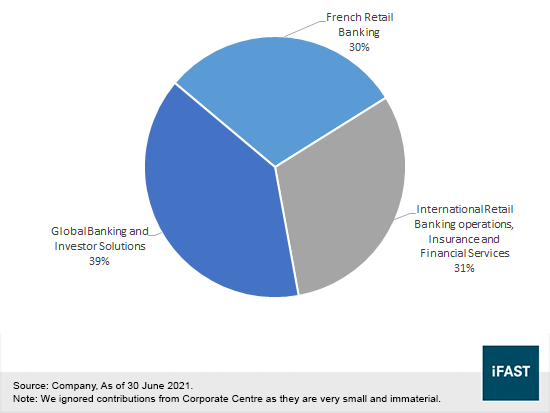
The FRB segment consists of the retail banking of Societe Generale, Credit du Nord group and Boursorama Bank in France. Credit du Nord is a large regional bank while Boursorama Bank is an online banking leader in the country. FRB accounts for 30% of net banking income in 1H21. The IRB segment operates outside of France with networks in Africa, Russia and Central and Eastern Europe. The segment accounted for 31% of net banking income in 1H21. Lastly, the GBI segment is made up of asset management, corporate and investment banking and private banking activities.
According to S&P Global Market Intelligence, SOCGEN had EUR 1,465.95b of total assets, making it the 6th largest bank in Europe and 18th worldwide when ranked by total assets. SOCGEN is rated by the three main credit agencies – S&P (‘A’ with a stable outlook), Moodys’ (‘A1’ with a stable outlook) and Fitch (‘A-‘ with a stable outlook).
Figure 1: 1H21 net banking income by segments
2Q21 Financial Results
On 3 August 2021, SOCGEN announced its 2nd Quarter 2021 results (“2Q21”) for the financial year ending 30 June. SOCGEN reported strong year-on-year (“YoY”) double digit revenue growth of 18.2% in 2Q21 when compared to 2Q20, showing a strong rebound from the pandemic lows. The company saw revenue growth for the quarter exceeding the growth in costs, resulting in positive jaws, which would set the company up for more profitability in the future. Operating costs for the group grew by 6% YoY in 2Q21.
SOCGEN has a well-diversified business model which allows the company to not rely largely on any single segment. From Figure 1, net banking income for each segment was roughly split equally between the 3 main businesses.
Figure 2: 2Q21 Net banking income
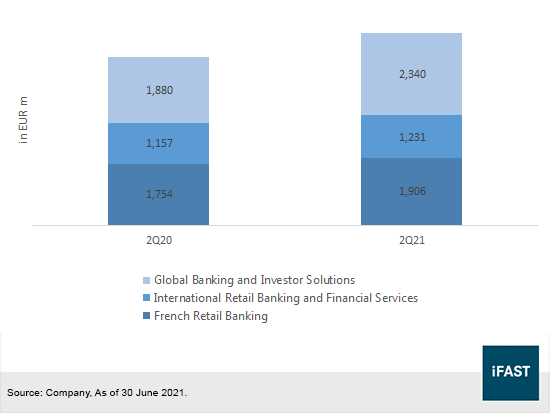
Net banking income for the group increased from EUR 5,296m in 2Q20 to EUR 6,261m 2Q21. Net banking income for FRB increased by 9% YoY while IRB increased by 14% YoY due to improved performance in insurance and financial services as it grew 35.4% YoY in revenue. GBI segment grew by 24% YoY and was driven by good momentum in equities and financing and advisory. All business segments reported strong positive jaws effects.
SOCGEN is also well-diversified across several non-banking business lines as it operates vehicle leasing and car fleet management businesses, as well as vendor and equipment finance. SOCGEN’s vehicle leasing business, ALD Automotive, has a leading position in the industry. ALD Automotive has an EcoVadis Gold medal both at the national and international level while the rating and research agency Vigeo Eiris ranked it in the top 3 in business support services. Additional income streams from its non-interest revenue channels will provide additional support to SOCGEN especially during low interest rate environment.
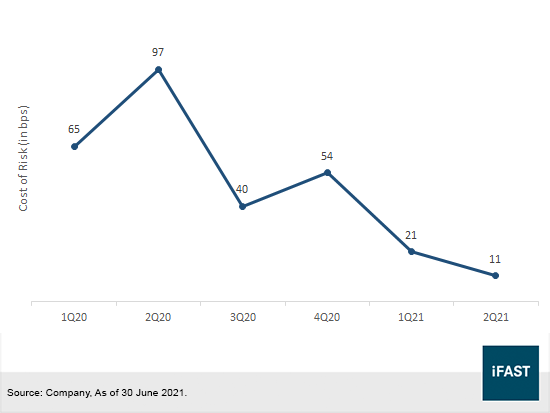
For the quarter, the group achieved a lower cost of risk (loan loss provisions) at 11 basis points (“bps”) as compared to 1Q21 at 21 bps. For FY 2021, management have lowered their forecast for cost of risk and expects cost of risk to be between 20bp and 25bp.
Figure 3: Cost of risk for SOCGEN
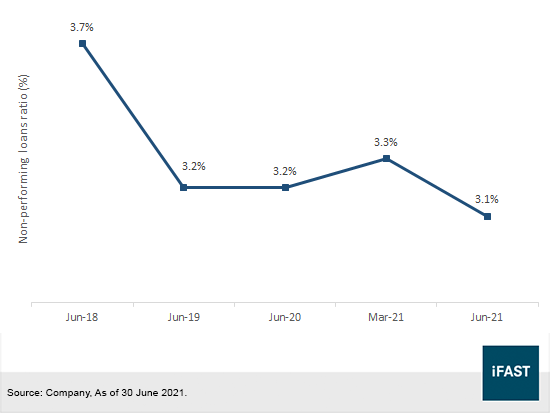
Gross outstanding loans increased during the second quarter. Gross loans for the group was EUR 536.5b in 2Q21, up from EUR 529.8b in the previous quarter. Non-performing loan decreased to EUR 16.7b in 2Q21 from EUR 17.4b in 1Q21. This resulted in Non-performing Loans (“NPL”) ratio for the group decreasing from 3.3% in 1Q21 to 3.1% in 2Q21.
Figure 4: Non-performing loan ratio for SOCGEN
We are positive on SOCGEN as we expect revenues to continue growing in FY2021. Loan performance for the group has improved as the cost of risk fell, signalling lower credit provisions have been allocated for commercial risks. Additionally, positive jaws also sets the company up for more profitability in the future. We believe that with SOCGEN’s business and geographical diversity, the company is poised to capitalise on higher future interest rates as well as income from its non-banking subsidiaries.
Capital and solvency profile
As at 2Q21, SOCGEN had EUR 68.64b of total equity and EUR 48.3b of Common Equity Tier 1. The bank accessed the ECB’s Targeted Longer-Term Refinancing Operations III (“TLTRO III”) loans with an outstanding amount of EUR 71.9b. Cash due from central banks added to EUR 160.80b in June. We find SOCGEN’s liquidity profile to be adequate with EUR 147b of central bank deposits and EUR 80b of high quality liquid asset securities (“HQLA”). Additionally, from Figure 5, its liquid asset buffer and liquidity coverage ratio is high at EUR 227b and 136% respectively as of 30 June 2021.
Figure 5: Liquid asset buffer for SOCGEN
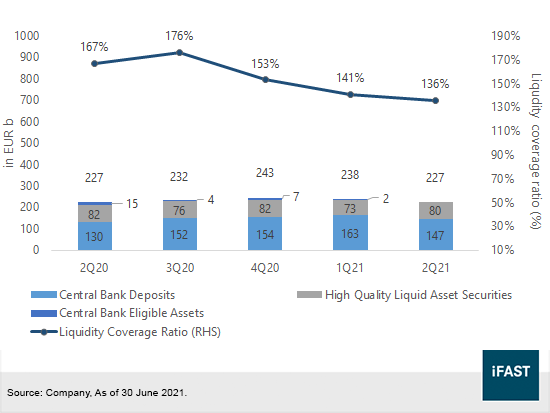
Table 1: Regulatory ratios for SOCGEN
|
Regulatory ratios |
Requirements |
End-1Q21 ratios (including IFRS9 phasing) |
End-1Q21 ratios (fully-loaded) |
|
Common Equity Tier 1 (CET1) |
9.03% |
13.50% |
13.20% |
|
Total Capital |
13.30% |
19.10% |
18.80% |
|
Leverage Ratio |
3.50% |
4.50% |
4.40% |
|
Total Loss-absorbing Capacity (TLAC) |
19.5% (% risk weighted assets) |
31.0% (% RWA) |
30.7% (% RWA) |
|
Minimum Requirements for own funds and Eligible Liabilities (MREL) |
8.51% (% of Total liabilities including own funds) |
>8.51% (% TLOF) |
>8.51% (% TLOF) |
|
Liquidity Coverage Ratio (LCR) |
>100% |
141% |
141% |
|
Net Stable Funding Ratio (NSFR) |
>100% |
>100% |
>100% |
| Source: Company, As of 31 Mar 2021 | |||
SOCGEN has an adequate capital position. The company’s capital adequacy ratios are comfortably above minimum regulatory requirements as seen from Table 1. As of the first quarter of 2021, Fully-loaded Common Equity Tier 1 (“CET1”) ratio for the company is at 13.2%, providing a buffer of 417 bps above the regulatory requirement of 9.03%. Its 4.4% leverage ratio, on a fully-loaded basis, also exceeds the minimum of 3.5%.
Bond Recommendation
Figure 6: Relative valuation among comparable SGD banking perpetual notes
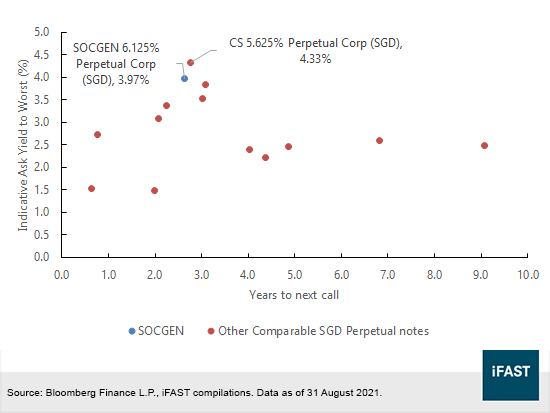
We will be recommending the higher yielding securities within the French bank’s capital structure in view of its healthy credit metrics. Its SGD perpetual note - SOCGEN 6.125% Perpetual Corp (SGD) has an indicative yield-to-worst (“YTW”) of 3.97% as of 31 August 2021. From Figure 6, when compared to other SGD denominated banking peers, we see that the SOCGEN 6.125% perp has one of the highest YTW among other banking peers. The perpetual resets on 16 April 2024 and every 5 years thereafter. If not called, the distribution rate will reset at the prevailing 5Y SGD Swap Offer Rate (“SOR”) + 4.207%. The notes may be written down in the event of a Capital Ratio Event, which occurs when the Common Equity Tier 1 ratio falls below 5.125% on a consolidated basis.
We feel that SOCGEN has sufficient buffer over its CET1 ratio and has sufficient liquidity to pay down its debts. Given a potentially higher interest rate environment in future, we expect banking revenue to grow in the coming months and we see opportunity and value in investing in the European banking industry.
Declaration: For specific disclosure, at the time of publication of this report, IFPL (via its connected and associated entities) holds a position in CS 5.625% Perpetual Corp (SGD) and the analyst who produced this report holds a NIL position in the abovementioned securities.
Our podcast series, Yield Hunters, is available on Spotify and iTunes Podcasts and Google Podcasts. We share our thoughts on new bond issues and hold discussions on the fixed income space. Listen to our latest episode below and follow us!