Highlights:
- Country Garden’s sales were less than expected. The fourth quarter will be the key for the Group. The property sales remain a key factor in supporting its liquidity and solvency. The Group's profit warning is not as terrible as it sounds, since the focus of the result should be Country Garden’s cash flow performance, which is still at a relatively healthy level.
- The Group's debt reduction is well underway. The chance of continuing "to survive" is high. It still has a wide range of financing sources, and has actively made several bond buybacks since this year to regain the market confidence.
- Given that the Group’s 2024 January and April bonds are trading at $40 level, reflecting certain credit risks. But we believe that the risk-to-reward ratio is good for these two bonds, with a potential return of up to 150%. Aggressive investors can choose to make a small bet.
We mentioned Country Garden’s sales, credit status and financing advantages etc. in “Idea of the Week: Country Garden – A Developer with Resilient Fundamentals under Real Estate Crisis”. Six months later, the real estate industry has yet to show any sign of recovery. There are more peers in liquidity distress and more bad news, including refusing to repay mortgages as a result of suspended and uncompleted properties and a resurgence of COVID-19 in China. The property bonds fell to an unprecedentedly low level.
There has been a dramatic fluctuation in Country Garden’s bonds over the past six months, showing that market views are not often consistent. It might reflect that the bond prices are mainly driven by market sentiment and short-term news. The Group has recently announced its 2022 annual results and recent sales figures, which may help investors to make better investment decisions by understanding its latest credit profile.
Sales were less than expected; the fourth quarter becomes key
As shown in Chart 1, the Group’s attributable contracted sales for the first eight months were around RMB 244 billion), representing a YoY decline of around 40%, which was lower than the peer group's decline of around 51%. The Group's monthly attributable contracted sales for the last six months were around RMB 30 billion, slightly lower than our original expectation. However, the Group's cash collection from sales reached 92% in the first half of the year, still better than the peer group's level of about 70% to 80%.
Chart 1: Country Garden’s Sales Figures
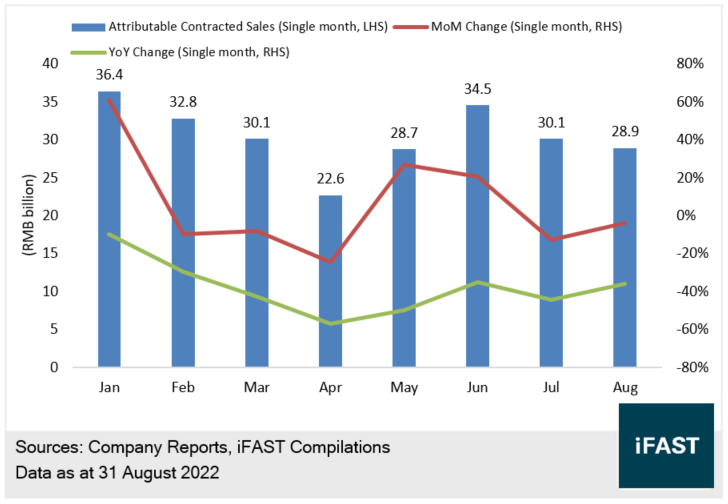
Looking forward, we believe the next quarter will be the key for the Group this year. With the policy stimulus and the gradual recovery of market confidence, the Group is still expected to record attributable sales of about RMB 400 billion (equivalent to an average monthly sales of about RMB 39 billion from September to December). Property sales are still important to support the Group’s liquidity and solvency.
Profit Warming is Not Terrible; Focus should be on its Cash Flow Performance
In the middle of August, the Group announced a profit warming, which once caused the market to worry about its profitability. As shown in Table 1, the revenue for the first half of 2022 plunged 31% YoY to RMB 162.4 billion. The core profit attributable to shareholders and net profit attributable to shareholders plunged 68% and 96% YoY to RMB 4.9 billion and RMB 0.6 billion respectively. The performance looks quite poor.
Table 1: Country Garden’s Revenue and Profit Indicators
|
|
1H 2022 |
1H 2021 |
YoY |
2021 Full Year |
|
Total Revenues (RMB billion) |
162.4 |
234.9 |
-31% |
523.1 |
|
Core Profit Attributable to Shareholders (RMB billion) |
4.9 |
15.2 |
-68% |
26.9 |
|
Net Profit Attributable to Shareholders (RMB billion) |
0.6 |
15.0 |
-96% |
35.0 |
|
- Gross Margin (%) |
10.6% |
19.7% |
-910 bps |
17.7% |
|
- Operating Margin (%) |
4.3% |
13.7% |
-940 bps |
11.5% |
|
Operating Cash Flow (RMB billion) |
5.3 |
10.4 |
-49% |
10.9 |
|
Sources: Company’s Reports, Bloomberg Finance L.P, iFAST compilations Data as at 30 June 2022 |
||||
However, the decline in profits was due to one-off factors such as slow delivery of property projects due to COVID-19, which results in the Group's failure to recognise revenues from some projects, and foreign exchange loss (RMB 4.9 billion) due to RMB depreciation against USD. Therefore, this profit warning is not as terrible as it sounds.
A more important factor related to earnings was the decline in the gross margin, which was a result of the high land acquisition cost in 2018 to 2019, coupled with lower average selling prices of recognised projects caused by the promotion discount to improve the sell-through rate. This results in a lower gross margin of 10.6% in this result (2021 1H: 19.7%).
Another key point to note is the Group's cash flow performance. Although its operating cash flow dropped to RMB 5.3 billion in the first half of 2022, it is still at a relatively healthy level. A positive operating cash flow means that the Group is at least able to cover its operating expenses with sales proceeds and does not need to invest in project operations from its own funds. This also provides some protections for debt repayment.
The Group continued to make small land acquisition during the first half of the year, with attributable land costs totalling around RMB 6.1 billion, indirectly reflecting that it still has some financial resources.
As of the end of June 2022, the Group's attributable saleable resources are estimated to be approximately RMB 1,510 billion, including around RMB 1,220 billion acquired from attributable saleable resources and RMB 290 billion in potential attributable saleable resources. Based on the sales in 2021 and the current saleable resources, we estimated that the land bank to sales ratio is about 3.2 times, which is still sufficient for the Group's development in the next three years even if the Group does not make any land purchase.
The Group's Debt Reduction is Well Underway with Higher Chance of Continuing to Survive
As of the end of June 2022, Country Garden’s net gearing ratio was 48.1% and its adjusted gearing ratio dropped to 72.1% (see Table 2). The credit position remains stable. We believe that the Group will be able to meet all three red lines by the end of this year (only the adjusted gearing ratio is not met now). In addition, the total debt decreased by 7.6% to RMB 293.7 billion compared to six months ago. The Group’s debt reduction is well underway.
Table 2: Country Garden’s Credit Indicators
|
2022 1H |
2021 |
2021 1H |
Three Red Lines Requirement |
|
|
Net Gearing Ratio (%) |
48.1% |
45.4% |
50.0% |
< 100% |
|
Cash to Short-term Debt (times) |
2.03 |
2.49 |
2.14 |
> 1.0 times |
|
Non-restricted and Non-regulatory Cash to Short-term Debt (times) |
1.06 |
1.26 |
1.25 |
/ |
|
Adjusted Liability to Asset Ratio (%) |
72.1% |
75.7% |
78.5% |
< 70% |
|
Average Cost of Borrowing |
5.3% |
5.2% |
5.4% |
/ |
|
Total Debt (RMB billion) |
293.7 |
317.9 |
325.0 |
/ |
|
Total Cash (RMB billion) |
148.0 |
181.3 |
186.2 |
/ |
|
Regulatory Pre-sales Proceeds and Restricted Cash (RMB billion) |
70.7 |
89.5 |
77.7 |
/ |
|
Sources: Company’s Reports, Bloomberg Finance L.P, iFAST compilations Data as at 30 June 2022 |
||||
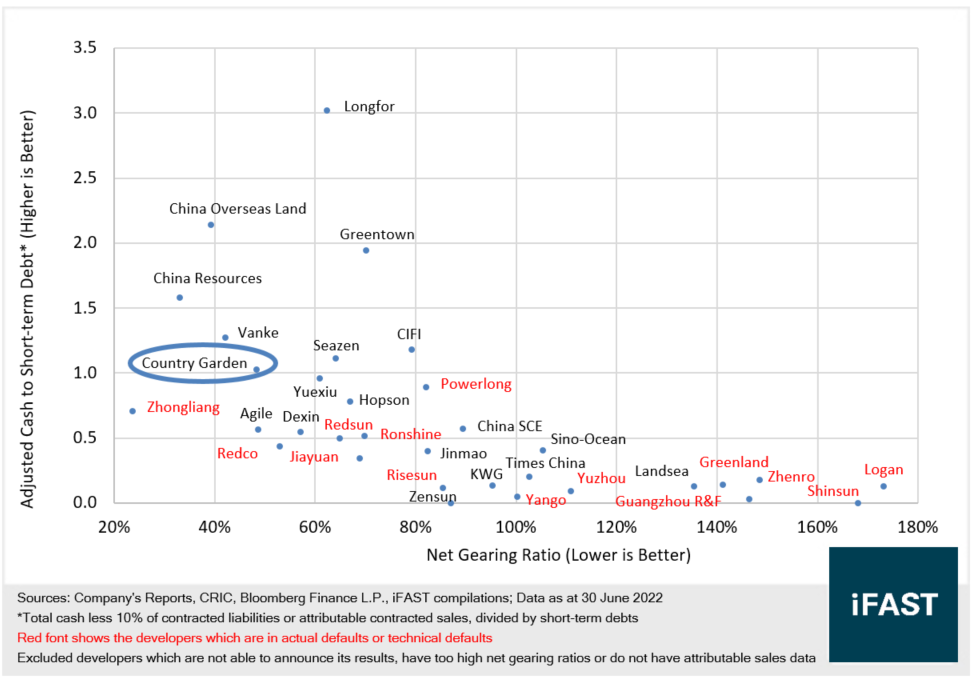
Although Country Garden’s adjusted cash to short-term debt ratio (defined as total cash deducting 10% of contracted liabilities or attributable contracted sales, divided by short-term debt) dropped to 1.1 times, it is still better than most of its peers (Chart 2). Its liquidity is clearly better, and its net gearing ratio is also more decent compared to the peers.
Based on its decent financial data compared to its peers, its lower sales decline rate and better cash flow performance, the Group can be considered one of the best non-SOE developers. We believe the Group has a higher chance of continuing to survive.
Chart 2: Chinese Real Estate Developers’ Adjusted Cash to Short-term Debt Ratio and Net Gearing Ratio Comparison
Wide range of Financing Channels; Active Bond Repurchase to Regain Market Confidence
It is worth mentioning that Country Garden still has a wide range of financing channels, including the issuance of asset-backed securities (ABS), onshore bonds and a convertible bond during the first half of this year, as well as a share placement in July to get the capital of HKD 2.44 billion. These demonstrated its better financing ability. Meanwhile, the Group successfully issued an onshore medium-term note, with the issue amount of RMB 1.5 billion. The note is fully guaranteed by a SOE-backed company called China Bond Insurance Corporation, implying that the Group is supported by the government and policies to a certain extent.
Country Garden grasped this crisis and took an initiative to buy back bonds at a discount in the open market, in an attempt to regain market confidence. As shown in Table 3, since year-to-date, the Group repurchased some USD bonds (total principal amount of USD 55.7 million) and onshore bonds (total principal amount of RMB 280 million) and repaid three USD bonds on time.
We expect that the Group will continue to repurchase bonds in order to save repayment costs and demonstrate to the market its better liquidity. It will also support the Group's bond prices.
Table 3: Country Garden’s Bond Repurchase and Repayment Records
|
Date |
Repayment / Repurchase / Tender Offer |
Bond Name |
Details |
|
17 January |
Repurchase |
COGARD 4.750% 25Jul2022 Corp (USD) |
Repurchased bond principal amount of USD 5 million, representing 0.7% of the total bond initial amount |
|
Repurchase |
COGARD 7.250% 08Apr2026 Corp (USD) |
Repurchased bond principal amount of USD 5 million, representing 0.7% of the total bond initial amount |
|
|
27 January |
Repayment |
COGARD 7.125% 27Jan2022 Corp (USD) |
Repaid bond principal of total bond initial amount of USD 425 million and accrued interest |
|
4 February |
Repurchase |
COGARD 4.750% 25Jul2022 Corp (USD) |
Repurchased bond principal amount of USD 6 million, representing 0.9% of the total bond initial amount |
|
3 March |
Repurchase |
COGARD 4.750% 17Jan2023 Corp (USD) |
Repurchased bond principal amount of USD 6 million, representing 1.0% of the total bond initial amount |
|
13 March |
Repurchase |
COGARD 4.750% 25Jul2022 Corp (USD) |
Repurchased bond principal amount of USD 1.6 million, representing 0.2% of the total bond initial amount |
|
Repurchase |
COGARD 4.750% 17Jan2023 Corp (USD) |
Repurchased bond principal amount of USD 8 million, representing 1.3% of the total bond initial amount |
|
|
6 April |
Repayment |
19COGARD01 |
Repaid bond principal of total bond initial amount of RMB 590 million |
|
25 April |
Repayment |
COGARD 7.125% 25Apr2022 Corp (USD) |
Repaid bond principal of total bond initial amount of USD 550 million and accrued interest |
|
23 June |
Tender Offer |
COGARD 4.750% 25Jul2022 Corp (USD) |
Cash offer to purchase bond principal amount of around USD 410 million, representing 58.6% of the total bond initial amount |
|
25 June |
Repayment |
COGARD 4.750% 25Jul2022 Corp (USD) |
Repaid bond principal of total bond initial amount of USD 700 million and accrued interest |
|
26 August |
Repurchase |
19COGARD02, 20COGARD01, 20COGARD02, 20COGARD03, 20COGARD04, 21COGARD01 21COGARD02, 21COGARD02, 21COGARD03 |
Repurchased partial onshore bonds, with purchased amount of RMB 280.55 million |
|
23 September |
Repurchase |
Repurchased partial onshore bonds, with purchased amount of RMB 14.56 million |
|
|
Sources: Company’s Announcements, Company’s Presentation, iFAST compilations Data as at 23 September 2022 |
|||
Despite Certain Credit Risk, Entering at Current Price provides Good Risk-to-Reward Ratio
Country Garden’s bond due in January 2023 is still at a safer level of around $75, reflecting the greater market confidence in its short-term liquidity. While prices of its medium to long-term bonds have fallen to lower levels of $45 or below. It indicates that the Group might have certain credit risk. We remain positive on the Group’s short-to-medium term bonds.
In addition, we believe investors should consider both price and default risk. Short-term bonds have a low default risk but a high cost of entry, which could result in potential losses of 80% or more for short-term bonds, in the event of an unexpected default or extension offer. Therefore, the longer-term bonds will be cheaper and generally more volatile, and the impact of changes in the Group's credit quality on these bonds will be higher.
Considering the above factors, we believe that the Group's January and April 2024 bond offers a good risk-to-reward ratio, with two bonds currently trading at around $40. The potential return is up to 150%, which is worth aggressive investors to make a small bet. The bond “COGARD 6.500% 08Apr2024 Corp (USD)” is now available on Bond Express. Investors can enter at a lower cost, or increase or decrease their holdings in small increments to capture the bond price volatility.
Bond Related Risks
Country Garden’s business model still heavily relies on property sales. If the downturn in the real estate industry continues or even worsens, it will put pressure on the Group’s cash flow performance.
The Group still has some refinancing capacity and can continue to refinance in Malaysia and Thailand. If the property markets in these places also change drastically, it would put additional liquidity pressure on the Group.
Although the Group repurchased some bonds, most of them are short-term bonds matured within one year. The Group did not repurchased a large number of medium-to-long term bonds in the market, reflecting that it is under greater capital pressure.
Bank loans account for around 60% of the Group’s total debt. If there are negative news related to the Group, the banks’ confidence and willingness to borrow might be affected. The loan quotas could be tightened, resulting in a huge increase in its liquidity risk.
If the Group eventually and unfortunately defaults on the bonds, the recovery value will be low given the current domestic housing environment. The order of claims for offshore bonds will be lower than that of onshore bonds. Investors should be prepared to buy the above mentioned bonds, as they are not absolutely safe and might fall to the low level of the defaulted real estate bonds (around $8 to $15).
Conclusion
Country Garden’s sales were less than expected. The fourth quarter will be the key for the Group. The property sales remain a key factor in supporting its liquidity and solvency. The Group's profit warning is not as terrible as it sounds, since the focus of the result should be Country Garden’s cash flow performance, which is still at a relatively healthy level.
The Group's debt reduction is well underway. The chance of continuing "to survive" is high. It still has a wide range of financing sources, and has actively made several bond buybacks since this year to regain the market confidence.
Given
that the Group’s 2024 January and April bonds are trading at $40 level,
reflecting certain credit risks. But we believe that the risk-to-reward ratio
is good for these two bonds, with a potential return of up to 150%. Aggressive investors can choose to make a
small bet.
Declaration: For specific disclosure, at the time of publication of this report, IFPL (via its connected and associated entities) holds positions in COGARD 6.500% 08Apr2024 Corp (USD) and COGARD 6.600% 23Feb2023 Corp (MYR) and the analyst who produced this report holds a NIL position in the abovementioned securities.