Earlier this year, Astrea VI private equity Class A-1 bonds were very well received by investors as its public offering was 3.1 times subscribed. Applicants who invested SGD 50,000 or less received part or full allocations, while those who applied for SGD 8,000 or less received full allocation.
The Class A-1 bonds were one of the very few retail bond offerings this year and the 3% coupon may be the most generous so far in 2021.
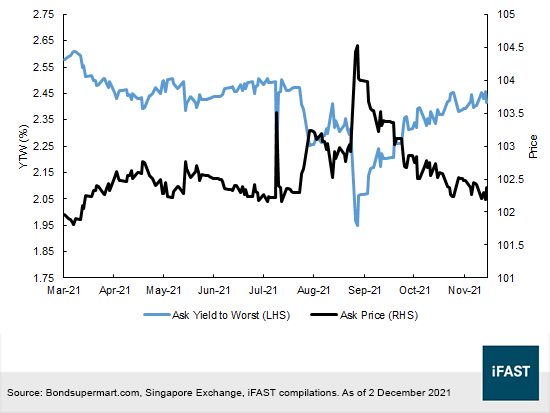
After launching at 100 in March, the ask price for ASTLC 3.000% 18Mar2031 Corp (SGD) - Class A-1 – Retail rose to as high as 104 this year. Bond prices have dropped since then, falling in tandem with higher benchmark yields. As of 2 December 2021, the bonds are trading at an indicative yield-to-worst of 2.42%.
Figure 1: Ask price and bond yields for the Astrea VI Class A-1 bonds
Astrea VI is the sixth series in the Astrea platform. Astrea VI Pte. Ltd. is a special purpose vehicle and issuer of the Astrea VI bonds. The sponsor - Astrea Capital VI Pte. Ltd. - is the sole shareholder of the issuer and an indirect wholly-owned subsidiary of Azalea Asset Management Pte. Ltd. (“Azalea”).
To find out more about Astrea VI, kindly refer to the article “Astrea VI: The most anticipated PE bond offering for 2021 has been announced (Part 1)”.
Set up in 2015, Azalea is a wholly-owned subsidiary of Seviora Holdings Pte. Ltd., and indirectly owned by Temasek Holdings (Private) Limited. Azalea has its own board and management team independent of Temasek.
Astrea III
The third Astrea transaction was launched in June 2016 and nearly all of the notes have been fully redeemed ahead of their maturities. As of July 2021, bondholders of the Class A-1 notes, Class A-2 notes and Class B notes have received their entire principal amounts. Class C notes, namely the ASTLC 9.250% 08Jul2026 Corp (USD) - Class C have an outstanding amount of USD 34.12m and this should be paid down by the next distribution date in January 2022.
Update on Astrea IV
During the sixth semi-annual distribution period in May 2021, the portfolio paid USD 177.0m of distributions but USD 171.0m was applied to the priority of payments. Out of this amount, USD 39.0m was paid to the reserves accounts. Combined with the contributions from the sponsor, the total value of the reserves accounts had risen to USD 338.0m.
Figure 2: Portfolio NAV and Reserves Accounts since March 2018
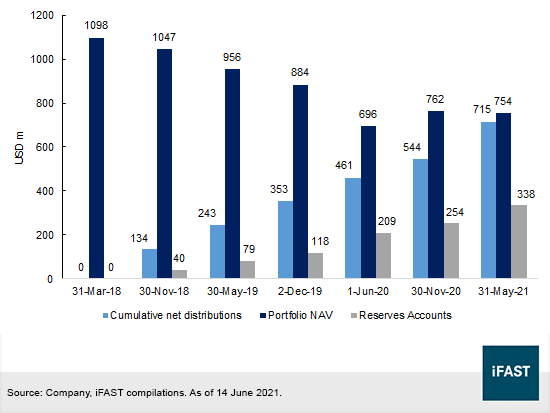
Total portfolio NAV declined slightly from USD 761.7m to USD 754.3m, but the maximum LTV ratio of 50% was not exceeded. There was also no need to draw down on the liquidity and capital call facilities.
The drop in portfolio NAV was largely driven by a few funds seen in Table 1. Hahn & Company I L.P. (2011) lost USD 17.7m between November 2020 and May 2021. The NAV of the fund is still lower than its NAV of USD 43.2m in November 2018.
Table 1: Top and bottom 5 performing funds in the Astrea IV portfolio
|
Underlying PE fund |
NAV at 31 May 21 |
NAV at 30 Nov 20 |
NAV change (USD m) |
Vintage year |
Region |
Strategy |
|
Hahn & Company I L.P |
13.7 |
31.4 |
-17.7 |
2011 |
Asia |
Buyout |
|
PAG Asia I LP |
30.1 |
46.6 |
-16.5 |
2011 |
Asia |
Buyout |
|
MatlinPatterson Global Opportunities Partners III L.P. |
2.2 |
16.2 |
-14.0 |
2007 |
US |
Buyout |
|
IK VII No.2 Limited Partnership |
23.6 |
33.8 |
-10.2 |
2012 |
Europe |
Buyout |
|
A8 - B (Feeder) L.P. |
12.7 |
20 |
-7.3 |
2012 |
Europe |
Buyout |
|
Blackstone Capital Partners VI, L.P. |
64.6 |
59 |
5.6 |
2011 |
US |
Buyout |
|
Permira V L.P.1 |
48.1 |
42.5 |
5.6 |
2014 |
Europe |
Buyout |
|
Bain Capital Fund XI, L.P |
32.6 |
26.8 |
5.8 |
2014 |
US |
Buyout |
|
Silver Lake Partners IV, L.P. |
111.5 |
101.8 |
9.7 |
2013 |
US |
Buyout |
|
Clayton, Dubilier & Rice Fund IX, L.P |
50.2 |
33.7 |
16.5 |
2013 |
US |
Buyout |
| Source: Company, iFAST compilations. As of 14 June 2021. | ||||||
All 3 classes of the Astrea IV bonds have yet to be redeemed, although it is likely that the issuer would pay down the Class A-1 bonds at its call date on 14 June 2023. With USD 338.0m in the reserves accounts, there is more than enough reserves to cover the size of the Class A-1 bonds of SGD 242.0m. Bondholders would be paid an extra 0.5% upon redemption as the sponsor’s performance threshold was met.
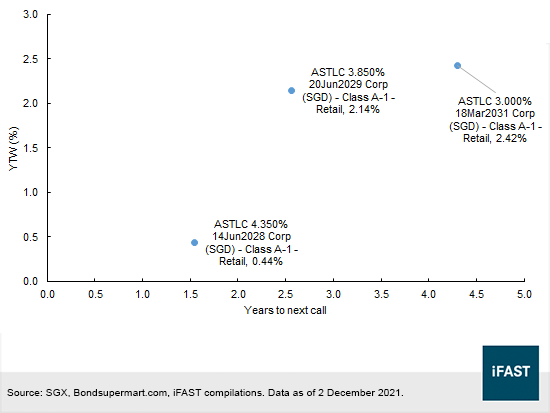
As of 2 December 2021, the ASTLC 4.350% 14Jun2028 Corp (SGD) - Class A-1 – Retail are trading at an ask price of 105.91 with an indicative yield-to-worst of 0.44%.
Update on Astrea V
During its most recent distribution period in June 2021, the issuer received USD 204.0m from the underlying private equity funds. After taking into account USD 16.0m of capital calls, USD 188.0m was applied to the priority of payments.
Figure 3: Astrea V portfolio performance since March 2019
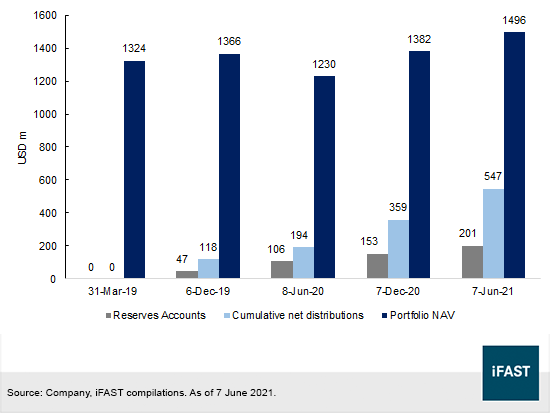
Out of the USD 188.0m, USD 47.0m was paid to the reserves accounts. This is a scheduled fixed amount that will be set aside every 6 months for the reserves accounts to redeem the Class A bonds. Even though the amount is fixed, the sponsor will occasionally waive the amount due to itself and contribute to the reserves account. For example, during the distribution period ended 8 June 2020, the reserves accounts increased from USD 47.0m to USD 106.0m due to the sponsor’s waiver citing an uncertain financial environment.
After applying the priority of payments, the residual amount of USD 134.0m was provided to the sponsor. Together with the USD 134.0m, the sponsor has received a total of USD 369.0m over the past years. When this amount exceeds the performance threshold of USD 407.0m, Astrea V Class A-1 bondholders will receive a 0.5% bonus payout upon redemption.
If the portfolio manages to pay a fixed amount of USD 47.0m every 6 months, it is likely that the Class A-1 bonds would be redeemed on its call date on 20 June 2024. As of June 2021, there are USD 201.0m in the reserves accounts and this represents more than 60% of the outstanding amount for the Class A-1 bonds (SGD 315.0m). As of 2 December 2021, the ASTLC 3.850% 20Jun2029 Corp (SGD) - Class A-1 were trading at an indicative yield to worst of 2.14% with an ask price of 104.22.
As seen in Figure 3, the Astrea V portfolio has been performing well over the past two years. Starting with an audited NAV of USD 1,324.4m in March 2019, the portfolio NAV has risen to USD 1,496.3m in June 2021. 28 out of the 38 underlying PE funds recorded gains during the 6-month period. Clayton, Dubilier & Rice Fund IX, L.P. (2013), which was also the top performing fund for the Astrea IV portfolio, recorded a USD 19.2m gain in NAV.
Table 2: Top and bottom 5 performing funds in the Astrea V portfolio
|
Underlying PE fund |
NAV at 7 Jun 21 |
NAV at 7 Dec 20 |
NAV change (USD m) |
Vintage year |
Region |
Strategy |
|
A8 - B (Feeder) L.P. |
24.4 |
38.4 |
-14.0 |
2012 |
Europe |
Buyout |
|
PAG Asia I LP |
19.1 |
29.4 |
-10.3 |
2011 |
Asia |
Buyout |
|
KKR North America Fund XI L.P. |
49.8 |
54 |
-4.2 |
2012 |
US |
Buyout |
|
Hopu USD Master Fund II, L.P. |
17.5 |
20.9 |
-3.4 |
2013 |
Asia |
Buyout |
|
Hahn & Company I L.P |
18.5 |
21.6 |
-3.1 |
2011 |
Asia |
Buyout |
|
TPG Asia VI, L.P. |
40.8 |
30.8 |
10.0 |
2012 |
Asia |
Buyout |
|
Insight Venture Partners (Cayman) IX, L.P. |
68 |
57.9 |
10.1 |
2014 |
US |
Growth Equity |
|
Welsh, Carson, Anderson & Stowe XII, L.P. |
46.3 |
35.5 |
10.8 |
2015 |
US |
Buyout |
|
TPG Partners VII, L.P. |
55.2 |
42.4 |
12.8 |
2015 |
US |
Buyout |
|
Clayton, Dubilier & Rice Fund IX, L.P. |
58.5 |
39.3 |
19.2 |
2013 |
US |
Buyout |
| Source: Company, iFAST compilations. As of 7 June 2021. | ||||||
Update on Astrea VI
The Astrea VI portfolio is nearly identical to the Astrea V portfolio. There are 35 funds in the Astrea VI portfolio but 38 funds in the Astrea V portfolio. As mentioned, the sixth Astrea transaction was launched this year and bondholders have received their first interest payment. During the first distribution period in September, the private equity fund portfolio paid out USD 309.0m of distributions and made USD 21.0m of capital calls. This resulted in a net distribution amount of USD 288.0m, which was applied to the priority of payments.
Figure 4: Astrea IV portfolio performance
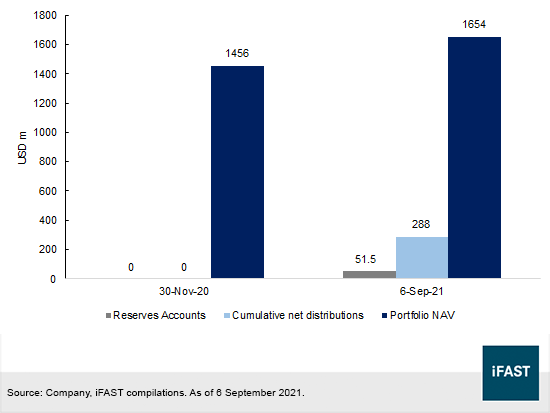
The portfolio climbed from USD 1456.2m to USD 1,654.1m in a span of 9 months. Due to its healthy performance, there was no need to draw down on its credit facility. Similar to the Astrea IV and Astrea V portfolios, Clayton, Dubilier & Rice Fund IX, L.P. (2013) was once again the top performing fund in the 9-month period. This was followed by Insight Venture Partners (Cayman) IX, L.P. (2014) which grew its NAV from USD 57.8m to USD 82.0m.
Table 3: Top and bottom performing funds in the Astrea VI portfolio
|
Underlying PE fund |
NAV at 6 Sep 21 |
NAV at 30 Nov 20 |
NAV change (USD m) |
Vintage year |
Region |
Strategy |
|
A8 - B (Feeder) L.P. |
25.9 |
40.5 |
-14.6 |
2012 |
Europe |
Buyout |
|
Yunfeng Fund II, L.P. |
41.6 |
51.3 |
-9.7 |
2014 |
Asia |
Growth Equity |
|
KKR North America Fund XI L.P. |
43.9 |
51.3 |
-7.4 |
2012 |
US |
Buyout |
|
Hopu USD Master Fund II, L.P. |
25.4 |
31.8 |
-6.4 |
2013 |
Asia |
Buyout |
|
EQT VII (No.1) Limited Partnership |
33 |
38.5 |
-5.5 |
2015 |
Europe |
Buyout |
|
Silver Lake Partners IV, L.P. |
96.5 |
79.4 |
17.1 |
2013 |
US |
Buyout |
|
Providence Equity Partners VII-A L.P. |
54.2 |
33.4 |
20.8 |
2012 |
US |
Buyout |
|
Bain Capital Fund XI, L.P. |
78.8 |
55.8 |
23.0 |
2014 |
US |
Buyout |
|
Insight Venture Partners (Cayman) IX, L.P. |
82.0 |
57.8 |
24.2 |
2014 |
US |
Growth Equity |
|
Clayton, Dubilier & Rice Fund IX, L.P. |
71.1 |
32.1 |
39.0 |
2013 |
US |
Buyout |
| Source: Company, iFAST compilations. As of 6 September 2021. | ||||||
As part of its mandate, USD 51.5m will be paid to the reserves accounts for the first ten distributions as long as the Class A-1 and Class A-2 bonds remain outstanding. After subtracting the USD 51.5m from the bonds principal amount of USD 644.0m, the net debt amount is USD 592.5m. With a portfolio NAV of USD 1,654.1m, the LTV ratio is therefore calculated as 35.8%. As this does not exceed the maximum LTV limit of 50%, no additional capital was required to be paid into the reserves account.
With just USD 51.5m in the reserves accounts, it may be difficult to predict if the issuer will call back the Astrea VI Class A-1 bonds on 18 March 2026. The reserves account is much smaller than the outstanding amount of SGD 382.0m for the Class A-1 bonds. However, the track records of Astrea IV and Astrea V show that the likelihood of redemption is high. If not redeemed on its scheduled call date, the coupon rate will step up by 1%. As mentioned earlier, the Astrea VI Class A-1 bonds are trading at an indicative yield-to-worst of 2.42%.
Relative valuation
There is often very low liquidity for Class A-2 and Class B bonds in the secondary market so we will leave out these bonds in our valuation comparison. On the other hand, Class A-1 bonds enjoy better liquidity as they trade on the Singapore Exchange. From their indicative yields in Figure 5, the Astrea V Class A-1 bonds (ASTLC 3.850% 20Jun2029 Corp (SGD) - Class A-1 - Retail) at an ask yield to worst (“YTW”) of 2.14% provide the highest yields while having shorter years to call, thereby giving the best value to investors as of 2 December 2021.
Figure 5: Relative valuation among Class A-1 Astrea SGD bonds
Nevertheless, we still recommend investing in all the Astrea PE bonds as the risk of default is low. There are structural safeguards to protect the interest of bondholders. For instance, the setup of reserves accounts ensures that the issuer has enough capital to redeem all Class A bonds on their call dates. When the performance thresholds have been met, payments to the reserves accounts will increase by half of the cash sweep to the sponsor thereafter.
In addition, there are available banking facilities that may be used funding requirements. Capital calls received at the asset-owning company may be funded through the facilities, in the event of cash flow shortfalls.
Furthermore, the LTV limit ensures that residual cash flows are first channelled to the reserves accounts in the event of poor portfolio NAV performances. Lastly, as the equity owner of the Astrea transactions, the sponsor is the first in line to absorb losses and the last person to receive liquidation proceeds in the event of a default. There is a strong alignment of interest between the sponsor and the Astrea bondholders as the sponsor sometimes waives its entitled cash flows during the distribution period.
Declaration: For specific disclosure, at the time of publication of this report, IFPL (via its connected and associated entities) holds a position in ASTLC 3.250% 18Mar2031 Corp (USD) - Class A-2 and the analyst who produced this report hold a NIL position in the abovementioned securities.
Our podcast series, Yield Hunters, is available on Spotify, iTunes Podcasts and Google Podcasts. We share our thoughts on new bond issues and hold discussions on the fixed income space. Listen to our latest episode below and follow us!