- Alphabet has issued its first-ever Hong Kong dollar bond, raising HK$16bn across 2-, 5- and 10-year tranches, all now available on the FSM Global platform. Net yields to maturity range from 4.08% to 5.05%, above high-quality local HKD bonds of similar tenor.
- Alphabet’s Q3 2026 revenue rose 24.7% YoY to US$127.6bn. Google Cloud revenue jumped 102.6% and its operating income more than tripled to US$11.1bn, making Cloud the main growth engine. However, higher AI R&D and depreciation costs meant that, excluding last year’s fine, the group’s operating margin fell by about 2.1 percentage points.
- AI capex has surged, free cash flow has been negative for two straight quarters, and total debt has climbed to US$150.3bn. Even so, total debt/EBITDA is only 0.81x, interest coverage is 51.0x and Alphabet still holds US$39.6bn of net cash, so its credit quality remains solid.
Debut HKD Bond Lands on FSM Global
Google’s parent company, Alphabet, issued its first HKD bond in November, raising HK$16bn in three tranches: HK$7.5bn of 4.350% notes due 2028, HK$7bn of 4.700% notes due 2031 and HK$1.5bn of 5.200% notes due 2036. The bonds settled on 19 November. Demand was strong, with orders for the HKD tranches exceeding HK$32.5bn, roughly twice the amount issued.
All three tranches are now available on the FSM Global platform, with net yields to maturity of 4.08% to 5.05%. For investors who manage their money in HKD, these bonds offer direct access to the debt of a global tech leader: coupons and principal are paid in HKD, so there is no currency risk and no conversion cost. We will look at why Alphabet is issuing HKD bonds, its latest financial position, and the investment value of the three tranches.
Why an HKD Bond? AI Capex Drives Funding Diversification
The main reason Alphabet is issuing HKD bonds is that its AI capex now exceeds the cash its business generates. The company has kept its full-year 2026 capex guidance at US$195–205bn, and management expects a significant increase in 2027. With free cash flow negative for two straight quarters, the funding gap has to be filled by borrowing. Issuing in HKD and SGD helps Alphabet reach Asian investors who do not yet hold much AI-related debt and reduces its reliance on any single market. And because the HKD is pegged to the USD under the Linked Exchange Rate System, the currency risk Alphabet takes on is quite limited.
In fact, since 2025 Alphabet has issued bonds in six currency markets outside the USD, with cumulative issuance of more than US$114bn — the most of any AI-related issuer. In August alone, it sold US$25bn of USD bonds and A$5.5bn of AUD bonds, followed by €6bn of EUR bonds in early November. Including this HKD and SGD issuance, its non-USD funding currencies now number eight. Issuers like Alphabet usually swap the proceeds back into USD and only issue when the all-in cost is no higher than for USD bonds. The strong oversubscription and tighter pricing this time reflect robust Asian demand for Alphabet credit.
Financial Update: Debt Is Rising, but the Credit Foundation Remains Solid
Operating Performance: Cloud Becomes the Growth Engine
Alphabet’s revenue rose 24.7% YoY to US$127.6bn in Q3 2026, its 13th consecutive quarter of double-digit growth. Operating income grew 29.9% YoY to US$40.6bn, and the operating margin rose from 30.5% to 31.8%.
Google Services remains the main profit driver. Revenue grew 10.6% YoY to US$96.3bn, or 75.5% of total revenue, with Search & other up 12.0%, YouTube ads up 9.2%, and subscriptions, platforms and devices up 11.0%. Google Services contributed US$39.2bn of operating income, 96.5% of the group total, making it a stable source of cash. Note, however, that while its operating margin reached 40.7%, the year-ago quarter included an EU fine of about US$3.5bn. Excluding the fine, last year’s margin would have been 42.5%, so the margin fell by 1.8 percentage points this quarter (see Chart 1). The decline likely reflects higher compute and depreciation costs allocated to Search and other products as AI features are added.
Chart 1: Operating Margin by Segment
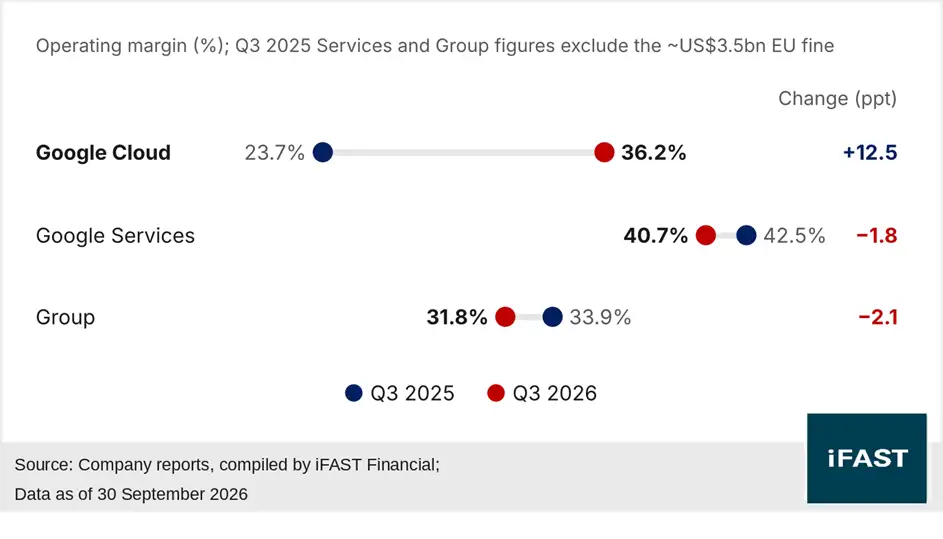 Google Cloud, meanwhile, is the growth engine. Revenue
surged 102.6% YoY to US$30.7bn, driven by AI infrastructure, AI solutions and
TPU system sales. Operating income rose from US$3.6bn to US$11.1bn, lifting the
operating margin from 23.7% to 36.2%. The key is that revenue doubled while
costs grew only about 70%: datacentre and TPU capacity built earlier is
steadily turning into revenue, and economies of scale are starting to show. The
margin gap between Cloud and Services has narrowed from about 18.8 to 4.5
percentage points. This means Alphabet has built a second high-margin profit
stream, reducing its reliance on businesses such as search advertising. More
importantly, Cloud backlog rose by nearly US$47bn QoQ to US$560.8bn, and
management expects over 55% of the group’s total backlog to be recognised as
revenue within the next 24 months, giving good visibility on future growth.
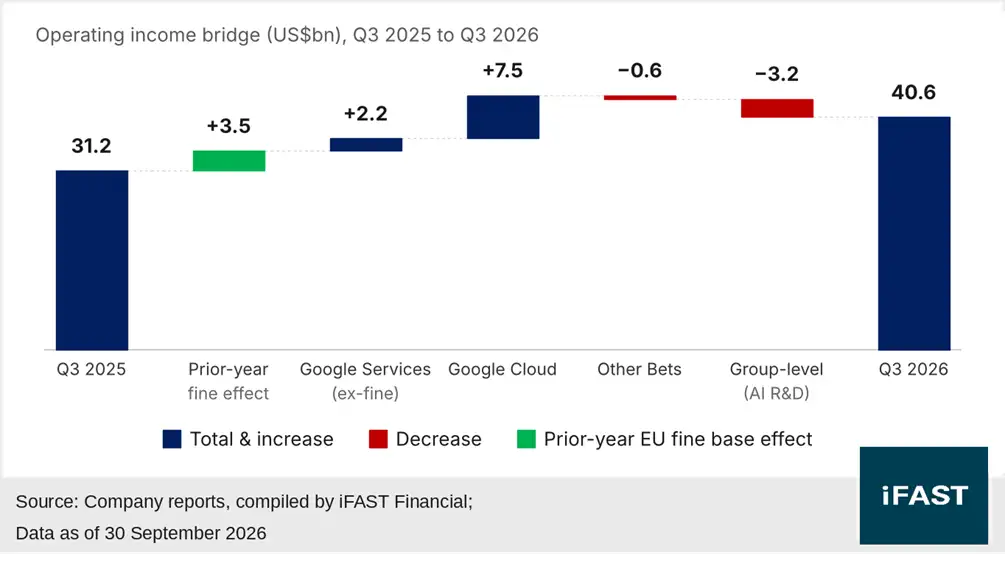
Other Bets (including self-driving unit Waymo, drone-delivery business Wing and life-sciences company Verily) saw operating losses widen 43.5% YoY to US$2.0bn, while group-level costs (mainly AI R&D) rose 71.4% YoY to US$7.7bn (see Chart 2). Together, they reduced operating income by US$9.7bn (vs US$5.9bn a year earlier). Notably, depreciation and amortisation rose from about US$5.6bn to about US$8.3bn, an increase of roughly 50%. As capex keeps rising, depreciation will become the main pressure on margins going forward.
Chart 2: Breakdown of the Change in Operating Income
 Cash Flow and Capex: Free Cash Flow Turns Negative
Operating cash flow fell 12.6% YoY to US$42.3bn in Q3, mainly due to inventory build-up for TPU system sales and a US$5.2bn EU fine payment. Excluding the fine, the decline was only 1.9%, so underlying cash generation was broadly unchanged (see Chart 3)..
Chart 3: Quarterly Capex vs Operating Cash Flow
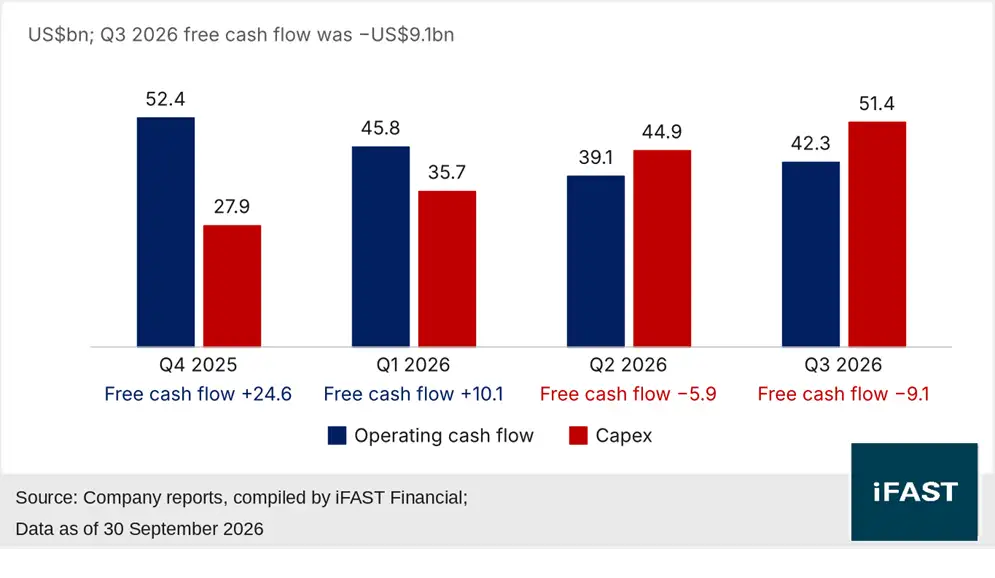
The problem is that the capex is growing much faster than cash flow. Q3 capex reached US$51.4bn, equal to 121.4% of operating cash flow, and free cash flow worsened from −US$5.9bn in Q2 to −US$9.1bn. On a trailing 12-month basis, the capex rose from 51.4% of operating cash flow a year ago to 89.0%. Free cash flow was still US$19.7bn, but down more than 70% YoY. With the capex set to rise further in Q4 and in 2027, we expect free cash flow to stay negative in the near term and bond issuance to become routine.
Balance Sheet and Liquidity: Higher Debt, but Ample Buffers
Total debt (including lease liabilities) more than doubled from US$67.0bn at end-2025 to US$150.3bn. Total debt/EBITDA rose from 0.31x a year ago to 0.81x, while interest coverage fell from 252.7x to 51.0x. Both metrics have weakened but remain at healthy levels. On liquidity, excluding its US$75.2bn SpaceX stake, which is subject to short-term sale restrictions, Alphabet holds US$189.9bn of cash and marketable securities, giving net cash of US$39.6bn (end-2025: US$59.8bn). Of its US$127.5bn of long-term debt, only about US$1bn matures within the next 12 months, so near-term refinancing risk is low.
The bigger thing to watch, however, is off-balance-sheet commitments. As of end-September, material purchase commitments totalled US$924.4bn, of which US$213.4bn is due within 12 months. On top of that are US$130.5bn of datacentre and energy leases that have not yet commenced, and US$98.5bn of contingent commitments (mainly guarantees and backstop arrangements). None of these are counted in total debt, so the real financial burden is higher than the book figure suggests.
Even so, most of these commitments are backed by real demand. Besides the Cloud backlog mentioned above, the new compute capacity will also serve Google’s own products, including AI features in Search, the Gemini app, which now has 1 billion users, and the training of Gemini models. Even if external demand slows, this capacity is unlikely to sit idle. With ample liquidity, the company has enough time to turn these investments into cash, and its credit quality remains solid.
Bond Investment: Short Tenors for Stability, 10-Year for Higher Yield
Given its strong profitability, net cash position and ample liquidity, we believe all three Google HKD bonds are attractive. We compare them with high-quality local HKD bonds of similar tenor on the FSM Global platform. The Google 2-, 5- and 10-year bonds offer net yields to maturity of 4.08%, 4.47% and 5.05% respectively, the longer the tenor, the wider the yield advantage (see Table 1).
Table 1: Google HKD Bonds vs Local HKD Bonds of Similar Tenor
|
Bond |
Issuer |
Years to Maturity |
YTM |
Bond Rating (S&P) |
|
|
1.98 |
4.08% |
AA+ |
|
|
HK Electric |
1.68 |
4.09% |
A- |
|
|
|
||||
|
|
4.98 |
4.47% |
AA+ |
|
|
MTR Corporation |
4.44 |
3.84% |
AA+ |
|
|
|
||||
|
|
9.98 |
5.05% |
AA+ |
|
|
Airport Authority Hong Kong |
8.16 |
3.99% |
AA+ |
|
|
Source: FSM Global; |
||||
More conservative investors may prefer the 2- or 5-year bonds, whose shorter duration makes them less sensitive to interest rates and swings in AI market sentiment. The 10-year bond offers the highest yield and spreads, but its price is more volatile, and with an issue size of only HK$1.5bn, secondary-market liquidity is lower. It is better suited to investors who can tolerate some price volatility.
Risks
The main risk is that the capex keeps rising. Management expects the capex to increase significantly again in 2027. If AI revenue growth fails to keep pace, free cash flow could stay negative for a prolonged period and leverage would rise further. In addition, US$924.4bn of off-balance-sheet commitments are not included in total debt, so the real financial burden is higher than the book level. If leverage keeps climbing, the rating outlook could come under pressure.
The second risk is funding risk across the AI sector. Some Cloud customers themselves rely on external financing; if funding conditions worsen, backlog could convert into revenue more slowly. Market concerns about returns on AI investment could also cause short-term price swings in AI-related bonds, including Google’s.
In addition, rising HKD interest rates would weigh on bond prices, with longer tenors hit harder. The secondary market for HKD bonds is relatively small, and with the 10-year tranche only HK$1.5bn in size, bid-ask spreads may be wider. Antitrust fines and lawsuits in the EU and elsewhere could also lead to additional costs.
Conclusion
Alphabet has issued its first-ever Hong Kong dollar bond, raising HK$16bn across 2-, 5- and 10-year tranches, all now available on the FSM Global platform. Net yields to maturity range from 4.08% to 5.05%, about high-quality local HKD bonds of similar tenor.
Alphabet’s Q3 2026 revenue rose 24.7% YoY to US$127.6bn. Google Cloud revenue jumped 102.6% and its operating income more than tripled to US$11.1bn, making Cloud the main growth engine. However, higher AI R&D and depreciation costs meant that, excluding last year’s fine, the group’s operating margin fell by about 2.1 percentage points.
AI capex has surged, free cash flow has been negative for two straight quarters, and total debt has climbed to US$150.3bn. Even so, total debt/EBITDA is only 0.81x, interest coverage is 51.0x and Alphabet still holds US$39.6bn of net cash, so its credit quality remains solid.
For specific disclosure, at the time of publication of this report, IFPL (via its connected and associated entities) holds NIL positions and the analyst who produced this report holds NIL positions in the abovementioned securities. This research report was prepared with the assistance of artificial intelligence (AI) tools. iFAST Financial Pte Ltd does not rely exclusively on AI for content generation; the content of this report — including all investment theses, ratings, price targets and conclusions — has been independently reviewed and verified by the research analyst(s) to ensure accuracy and professional integrity.
DISCLOSURE STATEMENTS FOR BONDS
Key risks of investing in bond
|
Key risks of investing in high-yield bonds
|
| Bonds with special features Some bonds may contain special features and risks that warrant special attention. These include bonds:
|
Remarks
|