1. US /
UK / Australia Government Bonds
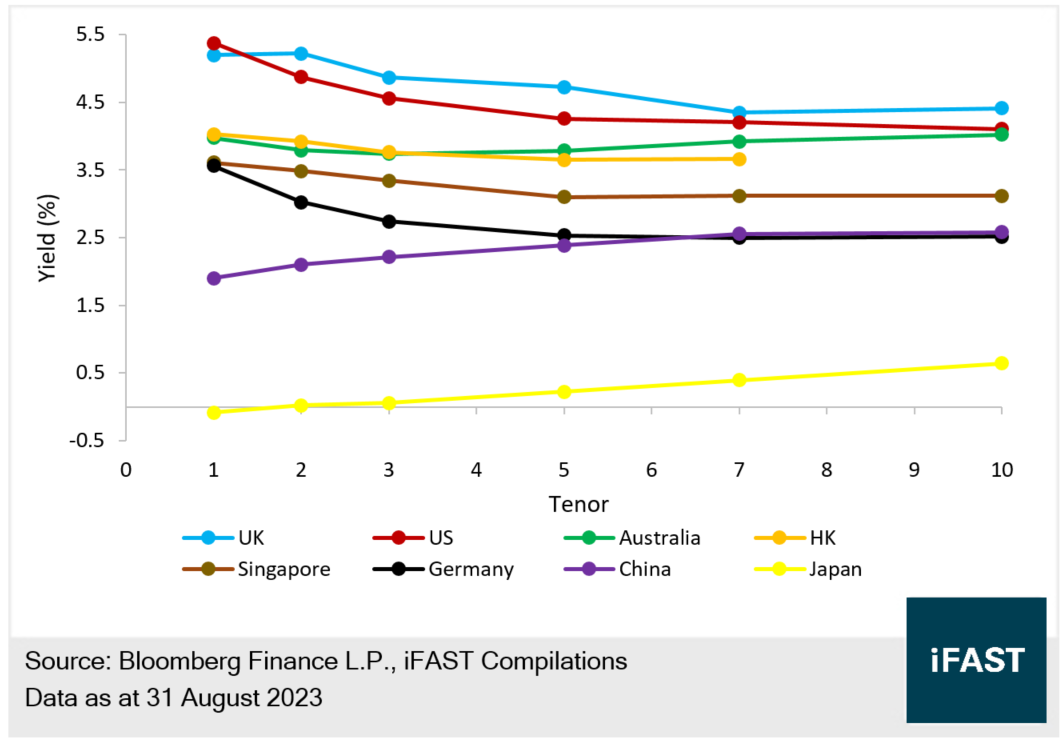
High inflation rates across the world from 2022 onwards have forced central banks to respond to inflation with interest rate hikes. This boosted treasury yields in different markets, with rates in some countries even rising to their highest levels since 2007, allowing investors to capture the high yield opportunities offered by treasury bonds. The government bond yields in the US, the UK and Australia could be more attractive than those in other major markets (see Chart 1):
- For the US, its short-term bonds (1 to 2 years) are the most attractive now, and the time to avoid medium-to-long-term bonds has gone as well.
- For the UK, the government bond yields are higher than others. It has become the most attractive market.
- For Australia, because interest rates may not have peaked yet, Australia’s yield curve is relatively flat, with 7- to 10-year government bond yields slightly higher than corresponding US Treasury yields.
Chart 1: Bond Yield Curves
Related Article: Comparing Different Government Bond Yields, which One is the Most Attractive Now?
2. High Investment Grade
Under the recession background, we believe that high investment grade (A-rated or above) corporate bonds are better choices for investors targeting extra yield pickup over US Treasuries, as their higher yield spread stability can offer a better safety margin to investors.
According to the S&P report, during the past financial crises, high investment grade bonds have a default rate of below 1% (see Table 1). Investors do not need to worry too much about the bond default risk.
Table 1: Historical Default Rates in Selected Years
|
Year |
Crisis |
Bond Rating and Default Rate (%) |
||||||
|
AAA |
AA |
A |
BBB |
BB |
B |
CCC/C |
||
|
1997 |
Asian Financial Crisis |
0 |
0 |
0 |
0.25 |
0.19 |
3.52 |
12.00 |
|
1998 |
0 |
0 |
0 |
0.41 |
0.82 |
4.64 |
42.86 |
|
|
1999 |
0 |
0.17 |
0.18 |
0.2 |
0.95 |
7.31 |
33.82 |
|
|
2000 |
Dot-com Bubble |
0 |
0 |
0.27 |
0.37 |
1.16 |
7.71 |
35.96 |
|
2001 |
0 |
0 |
0.27 |
0.34 |
2.98 |
11.45 |
45.45 |
|
|
2002 |
0 |
0 |
0 |
1.02 |
2.9 |
8.2 |
44.44 |
|
|
2007 |
Subprime Mortgage Crisis |
0 |
0 |
0 |
0 |
0.2 |
0.25 |
15.24 |
|
2008 |
0 |
0.38 |
0.39 |
0.49 |
0.81 |
4.11 |
27.27 |
|
|
2009 |
0 |
0 |
0.22 |
0.55 |
0.75 |
10.93 |
49.46 |
|
|
2010 |
The European Debt Crisis |
0 |
0 |
0 |
0 |
0.58 |
0.87 |
22.83 |
|
2011 |
0 |
0 |
0 |
0.07 |
0 |
1.68 |
16.42 |
|
|
2012 |
0 |
0 |
0 |
0 |
0.3 |
1.58 |
27.52 |
|
|
2020 |
COVID-19 |
0 |
0 |
0 |
0 |
0.94 |
3.53 |
47.68 |
|
Sources: S&P, iFAST compilations Data as of 31 December 2020 |
||||||||
3. Non-AT1 Bank Bonds
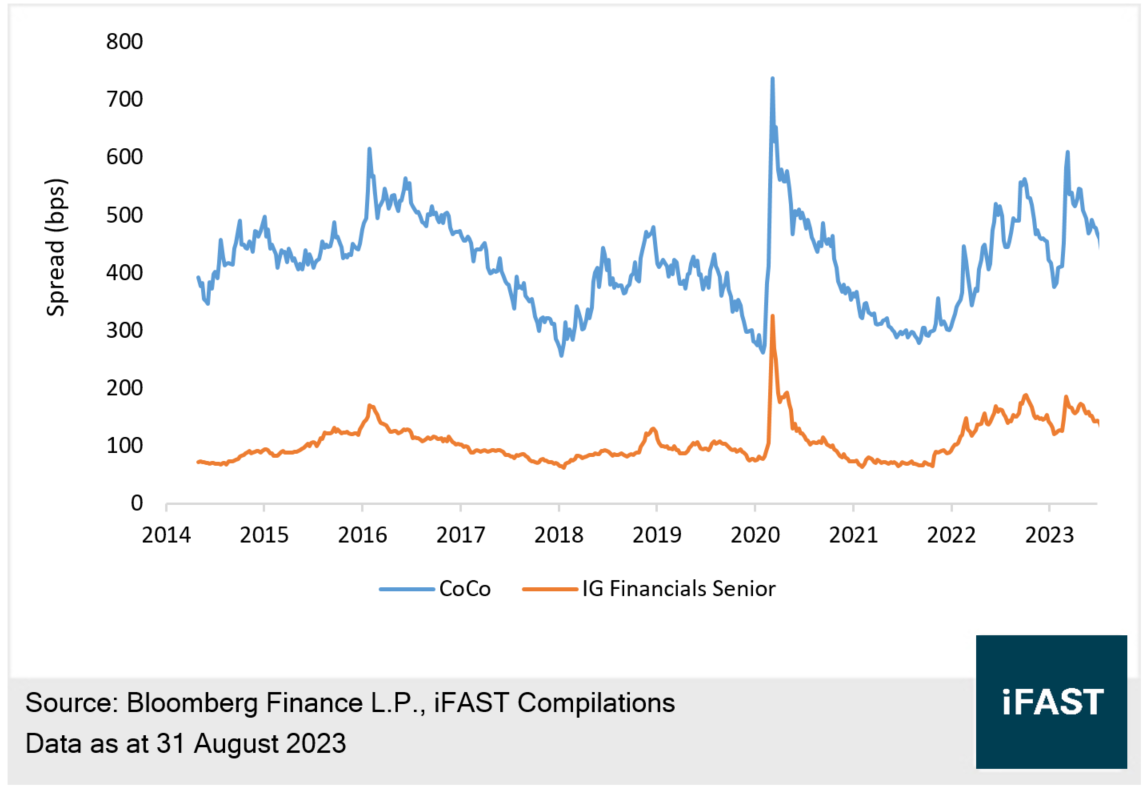
Amid the US local banking crisis and Credit Suisse’s incident, the overall yield spread of bank bonds is apparently higher than the historical mean now (see Chart 2), which could serve as an opportunity to investors.
But considering the more complicated terms and the lower seniority of AT1 bonds, we are more in favor of the banks’ senior unsecured bonds and T2 bonds, sacrificing a part of investment return for better protection.
Chart 2: Bank Bonds’ Yield Spread
4. Semi-conductors
The unfavourable industry sentiment resulted in a widened yield spread for semiconductor issuers, increasing their investment attractiveness. As a typical cyclical sector, the semiconductor industry is expected to bottom out in 2H2023, semiconductor companies will soon pass through the toughest moment, and industry fundamentals are awaiting recovery.
Most issuers in the semiconductor industry are assigned with the investment-grade rating, with a net cash position or low leverage level. They have enough liquidity to handle the industry downturn. Therefore, we believe that it is a great time to invest in semiconductor bonds now.
Related Article: Idea of the Week: Time to Buy on Dips? Decent Investment Choices Among These 4 Semiconductor Issuers
5. Hong Kong Real Estate Companies
In general, the gross margin of Hong Kong development projects is higher (normally 40% or above), and significantly higher than that of Chinese development projects (around 10% to 20%). Besides, the leverage levels of these Hong Kong real estate companies are generally low, with a strong interest coverage ratio and lower cost of borrowings (around 2% to 4% level). This reflects the decent credit positions of most companies.
Normally, Hong Kong real estate companies are more conservative in acquiring land or investing in new projects. With most of their assets located in Hong Kong, they have a greater advantage in refinancing by pledging valuable land and investment properties in Hong Kong to obtain loans with better terms. They also have many investment properties for rental and long-term appreciation purposes, so their credit positions are generally stronger. Therefore, we are bullish on the bond performance of large and some small and medium-sized real estate companies.
Related Article: Idea of the Week: Hong Kong Real Estate Companies—These Talents Might Be Overlooked
6. Upstream Oil & Gas (Producers / Oilfield Service Providers)
The oil price is at a higher level, which is favourable to upstream oil companies. The capital expenditures by global upstream oil producers remain at a lower level compared to the past decade. The prolonged underinvestment in the industry gradually impacts the supply side. With oil producers continuing to be self-restricted in deploying capital, we can expect the tighter supply to continue going forward. It is difficult for oil prices to fall significantly.
OPEC+ might also face the dilemma of increasing production due to years of underinvestment in the past. In addition, while OPEC+ hopes oil prices would remain high, it provides strong support for oil prices. The US released massive amounts of strategic oil reserves, leading to a nearly 40-year low in total crude oil inventories. The action of replenishing oil reserves led to difficulty in cooling down oil prices further.
We are bullish on oil prices to remain higher for much longer. Upstream oil companies would thus benefit. The industry norm is to put debt reduction into a higher priority. Their balance sheets would improve significantly as the high oil price environment persists. Massive free cash flows are available for debt reduction and debt repayment. Their credit risk should be manageable in the short to medium term.
Related Article: Idea of the Week: Unravelling the Investment Logics of Oil Bonds
7. Insurance
Benefiting from the interest rate hike cycle across the globe, the widening margins in the insurance sector are expected to boost the earnings, net book value and embedded value of major insurance companies. In general, their asset sides are less sensitive to interest rates than the liability side (since the portfolio duration is shorter than that of insurance policies). Also, driven by an increase in interest rates, the portfolio expected return is higher.
Additionally, their capital requirements are generally reduced under the scenario stress tests due to higher discount rates, driving their capital adequacy ratios. As a result, insurance companies’ capital adequacy ratios are expected to be improved, enhancing their solvency.
At the same time, the credit ratings of issuers or their subsidiaries are mostly high investment grade, reflecting their low default risk.
The bond structure of insurance companies is generally simpler than that of bank bonds. Although a lot of bonds issued by insurance companies are subordinated, fixed-tenor bonds usually do not involve the loss absorption feature. It is suitable for investors who are looking for a stable income.
8. Korean Investment Grade
The Korean investment grade bonds usually have the government background, or are guaranteed by quangos. It is positive for the issuer to have financing and maintain a good credit quality.
Besides, the issuers mostly engage in public utility. The operating condition tends to be stable. Under the same credit rating, the yield of Korean corporate bonds is usually higher than that of bonds in other regions. It is suitable for investors who are looking for an extra yield pick-up.
Investors can refer to our analytical articles to learn more about the credit profiles of Korean companies.
Related Article: Idea of the Week: Investment Choices Among Korean Issuers
9. Japanese High Yield
In Japan, there are only three USD bond issuers with international credit ratings but high yield ratings (Rakuten Group, Nissan Motor and Softbank). We are positive on their credit performances. Their short- to medium-term default risks are under control, with the bond yield to maturity of 6% to 10%. It is worth investors’ attention.
Investors can refer to our analytical articles to learn more about the credit profiles of individual companies.
Related Articles:
Idea of the Week: Attention Nissan Fans! A Japanese Company with High Yield Pick
Idea of the Week: Softbank Group, the Top Choice among Japanese High-yield Bonds
Idea of the Week: Is Rakuten Group with a yield of 10% Attractive?
Appendix: Selected Bond List
|
Theme |
Bond Name |
Issuer / Guarantor |
Issuer / Guarantor Credit Rating |
Ask Price (Investors Buy) |
Yield To Maturity |
|
US / UK / Australia Government Bonds |
T 3.125% 15Aug2025 Govt (USD) |
United States Government |
AA+ / AAA |
96.7 |
5.1% |
|
T 3.125% 15Nov2028 Govt (USD) |
United States Government |
AA+ / AAA |
94.5 |
4.5% |
|
|
T 2.750% 15Aug2032 Govt (USD) |
United States Government |
AA+ / AAA |
89.5 |
4.4% |
|
|
UKT 0.625% 07Jun2025 Govt (GBP) |
United Kingdom Government |
AAA / AA- |
92.9 |
5.1% |
|
|
UKT 0.500% 31Jan2029 Govt (GBP) |
United Kingdom Government |
AAA / AA- |
80.9 |
4.7% |
|
|
UKT 0.875% 31Jul2033 Govt (GBP) |
United Kingdom Government |
AAA / AA- |
71.8 |
4.6% |
|
|
ACGB 3.250% 21Apr2025 Govt (AUD) |
Australia Government |
AAA / AAA |
99.0 |
4.0% |
|
|
ACGB 2.250% 21May2028 Govt (AUD) |
Australia Government |
AAA / AAA |
93.4 |
4.0% |
|
|
ACGB 4.500% 21Apr2033 Govt (AUD) |
Australia Government |
AAA / AAA |
103.6 |
4.3% |
|
|
High Investment Grade |
META 4.600% 15May2028 Corp (USD) |
Meta Platforms |
AA- / N.R |
99.8 |
4.7% |
|
CKHH 4.750% 21Apr2028 Corp (USD) |
CK Hutchison Holdings |
A / A- |
97.3 |
5.5% |
|
|
BAYFIM 4.257% 16May2026 Corp (USD) |
Bayfront Infrastructure |
AAA / AAA |
98.0 |
5.1% |
|
|
Non-AT1 Bank Bonds |
SUMIBK 5.464% 13Jan2026 Corp (USD) |
Sumitomo Mitsui |
A- / N.R |
99.7 |
5.6% |
|
STANLN 4.300% 19Feb2027 Corp (USD) |
Standard Chartered PLC |
BBB+ / A |
94.6 |
6.1% |
|
|
HSBC 4.375% 23Nov2026 Corp (USD) |
HSBC Holdings PLC |
A- / A+ |
95.3 |
6.0% |
|
|
Semi-conductors |
AMD 2.950% 01Jun2024 Corp (USD) |
Advanced Micro Devices |
A- / W.R |
98.2 |
5.0% |
|
HYUELE 6.250% 17Jan2026 Corp (USD) |
SK hynix |
BBB- / BBB |
100.5 |
6.0% |
|
|
WDC 4.750% 15Feb2026 Corp (USD) |
Western Digital |
BB / BBB- |
95.5 |
6.8% |
|
|
Hong Kong Property Developers |
HENLND 2.375% 27May2025 Corp (USD) |
Henderson Land |
N.R / N.R |
94.3 |
5.8% |
|
NWDEVL 5.875% 16Jun2027 Corp (USD) |
New World Development |
N.R / N.R |
79.0 |
13.4% |
|
|
CSIPRO 5.450% 21Jul2025 Corp (USD) |
CSI Properties |
N.R / N.R |
86.1 |
14.4% |
|
|
Oil & Gas |
PDCE 5.750% 15May2026 Corp (USD) |
PDC Energy |
BB / N.R |
100.0 |
5.7% |
|
VTLE 9.500% 15Jan2025 Corp (USD) |
Vital Energy |
B / N.R |
100.7 |
8.9% |
|
|
ANTOIL 8.750% 26Jan2025 Corp (USD) |
Anton Oilfield Services |
N.R / N.R |
84.0 |
23.6% |
|
|
Insurance |
AIA 5.625% 25Oct2027 Corp (USD) |
AIA Group |
A+ / AA- |
102.1 |
5.1% |
|
FWDGRP 5.750% 09Jul2024 Corp (USD) |
FWD Group |
N.R / N.R |
98.5 |
7.4% |
|
|
PHNXLN 6.625% 18Dec2025 Corp (GBP) |
Phoenix Group |
N.R / A+ |
99.4 |
6.7% |
|
|
Korean Investment Grade |
KOREAT 4.000% 08Aug2025 Corp (USD) |
KT Corporation |
A- / A |
97.3 |
5.5% |
|
POHANG 4.375% 04Aug2025 Corp (USD) |
POSCO |
A-/ N.R |
97.5 |
5.7% |
|
|
HYUCAP 2.125% 24Apr2025 Corp (USD) |
Hyundai Capital Services |
BBB+ / BBB+ |
94.1 |
5.8% |
|
|
Japanese High Yield |
NSANY 3.522% 17Sep2025 Corp (USD) |
Nissan Motor |
BB+ / BBB- |
94.7 |
6.2% |
|
SOFTBK 5.125% 19Sep2027 Corp (USD) |
SoftBank Group |
BB / N.R |
93.4 |
7.1% |
|
|
RAKUTN 10.250% 30Nov2024 Corp (USD) |
Rakuten Group |
BB / N.R |
101.5 |
8.8% |
|
|
Sources: Bondsupermart, iFAST compilations Data as of 31 August 2023 |
|||||
For specific disclosure, at the time of publication of this report, IFPL (via its connected and associated entities) hold a position in T 2.875% 31Oct2023 Govt (USD), T 2.250% 31Mar2024 Govt (USD), T 2.500% 31May2024 Govt (USD), T 3.250% 31Aug2024 Govt (USD), T 3.125% 15Aug2025 Govt (USD), UKT 0.625% 07Jun2025 Govt (GBP), UKT 4.125% 29Jan2027 Govt (GBP), CKHH 4.750% 21Apr2028 Corp (USD), META 4.600% 15May2028 Corp (USD), BAYFIM 4.257% 16May2026 Corp (USD), STANLN 4.300% 19Feb2027 Corp (USD), HSBC 6.500% 20May2024 Corp (GBP), HSBC 5.300% 14Mar2033 Corp (SGD), HSBC 4.375% 23Nov2026 Corp (USD), HYUELE 6.250% 17Jan2026 Corp (USD), VTLE 9.500% 15Jan2025 Corp (USD), FWDGHD 5.750% 09Jul2024 Corp (USD) and the analyst who produced this report hold a NIL position in the abovementioned securities.